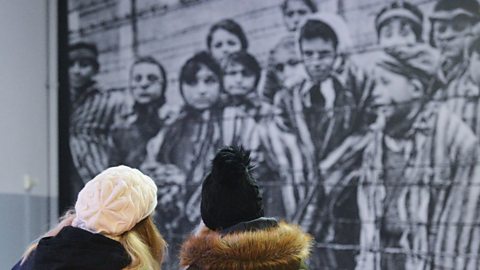
Holocaust Memorial Day is on the 27 January.
On this day we remember the six million Jewish people who were murdered under the An abbreviation for the National Socialist German Workers’ Party (NSDAP) and its members. The Nazi Party's main ideas were based on racism, including antisemitism, and opposition towards democracy and other political systems. regime.
We also remember the millions of other people who were killed or have been affected by Nazi persecution, as well as the people who were killed in the genocides in Cambodia, Rwanda, Bosnia and Darfur.
BBC Bitesize explores what this day means and why we mark it.

Holocaust Memorial Day
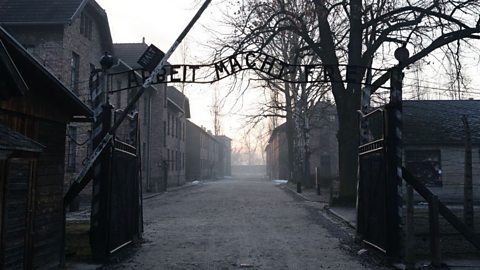
On 27 January 1945, the infamous concentration camp Auschwitz-Birkenau, in south-west Poland, was liberated by Russian troops.
27 January is now the day the world remembers the Holocaust, its victims and those from other acts of genocide throughout history.
Holocaust Memorial Day began in 2000 when 46 governments signed the Stockholm Declaration. It came about after government representatives from around the world met in Stockholm, Sweden to discuss the education, remembrance and research of the Holocaust.
The United Nations also marks 27 January as an annual International Day of Commemoration to remember the victims of the Holocaust.
This day of remembrance is a reminder of how hatred, bigotry and Antisemitism is a type of prejudice or discrimination towards Jews individually or as a group. It is based on unfounded stereotypes that target Jews as a people or their religious practices and beliefs. can cause unimaginable danger to our world. It is a call to remember, reflect and take action to ensure such horrors never happen again.
What is the Holocaust?
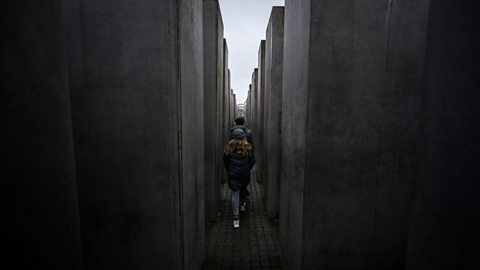
The Holocaust was a systematic, state-led persecution and murder of six million European Jews by the Nazi regime and its A person, organisation or country who worked with the Nazis to persecute and murder Jewish people, and other targets of Nazi persecution, during World War Two.. It took place throughout Europe between 1933 and 1945.
It's important to recognise that when we're referring to the deaths of millions of European Jews, we are also talking about the disappearance of cultures, communities, languages and traditions.
The term Holocaust refers specifically to the genocide of Jewish people. Other groups also experienced horrific and violent persecution by the Nazis including Roma and Sinti people, Soviet civilians and prisoners of war, Polish citizens, black people, people with disabilities, political opponents of the Nazis, LGBTQ+ people, and Jehovah’s Witnesses.
Why mark it?
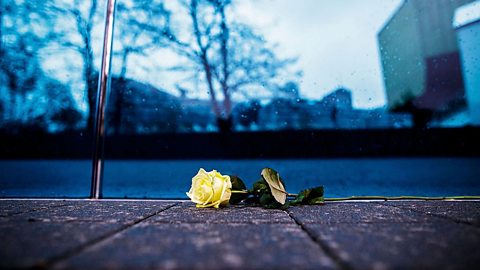
To ensure that the Holocaust is never forgotten.
To make sure that what happened is not distorted or denied by anybody and to build a future based on empathy, understanding and respect.
This day is marked so we acknowledge that genocide doesn't happen on its own. That there is a process of To treat someone differently or unfairly because they belong to a particular group., discrimination based on a racial or ethnic group, particularly those that are marginalised. and hatred that must be prevented. A day where people come together to learn about and remember the persecutions of the past and to stand against hatred and prejudice in the present.
This article was published in January 2019 and updated in January 2026
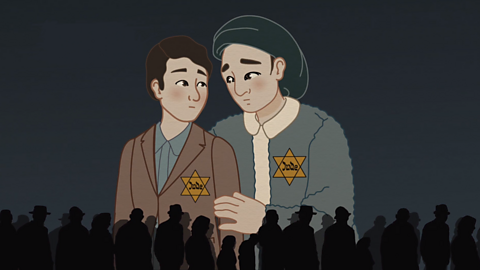
The Holocaust, 1939 - 1945
The Holocaust was the murder of approximately six million Jewish men, women and children by Nazi Germany and its collaborators during World War Two.
Facts about Judaism
Jews believe that there is only one God, with whom they have a special agreement called a covenant.
Surviving genocide: Antoinette’s story
To mark Holocaust Memorial Day, a survivor of the genocide in Rwanda tells us why she chose to focus on forgiveness.