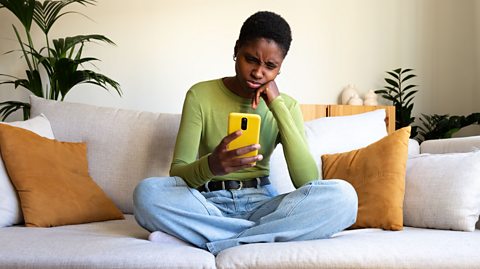
It’s fair to say, most of us use our phones every day. A survey by the price comparison website Uswitch showed that young people in particular spend roughly four hours and 37 minutes on a smartphone on average per day.
But while we take such an interest our phones, the question that often arises is whether our devices are repaying that attention. Are the online conversations true? Do our phones listen to us? BBC Bitesize Other Side of the Story dug a little deeper.
Why do people think their phones are listening to them?
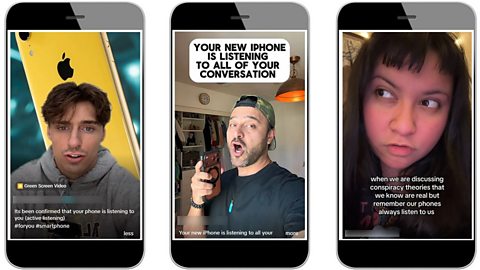
Many social posts claim that phones can hear you or even read your mind. For example, have you ever had a conversation with somebody about, say, woolly gloves - then found ads for them all over your feeds?
There are 194k searches on TikTok related to the subject, with one post gaining more than 250k views alone.
People on social media have shared their concerns and conspiracies about how companies could be tracking them on apps – which some people believe. If you start to see ads related to a subject you and your friends have discussed, it could be coincidental but could also leave you questioning why it is happening.
Depending on how often you engage with content on a certain subject, you may see more of the same content due to your algorithm on social media. This tracks our online behaviour – making decisions about what content to show us based on posts we interact with, like and share.
What claims are made online about our phones?
Some creators claim that data is being collected by apps and this can be stopped by changing your phone settings but this has not been proven to be true.
Some people have shared online conspiracies about companies or even the government spying on them – with some confusion as to why it is happening.
Does my phone listen to me?
Yes and no, but not in the way that you may think. Most phones listen to us passively to enable voice assistants like Siri or Alexa and Google Assistant. They are waiting for cues such as “Hey Siri” so they can search for topics you ask about online.
Phones also listen to us so that voice assistants can give us personalised recommendations on things such as apps. However, there’s no evidence to suggest that our conversations are recorded. In an October 2025 post by Head of Instagram, Adam Mosseri, he debunked the myth that the social platform listens to app users.
He explained that there could be a variety of reasons why something you have spoken about has come up on your feed. It could be a coincidence, that you have interacted with something related to the topic in the past, or simply searched a question related to it.
However, Mosseri disclosed that Instagram does work with advertisers that share information about who was on their website – which allows apps to use that information to show you content related to it.
What can I do if I think my phone is listening to me?
Other Side of the Story contacted the government's Department for Science, Innovation and Technology (DSIT) to find out if there was any official information regarding our phones 'listening' into our conversations.
A spokesperson told us: "Apps and social media can only access parts of your phone that you give them permission to use, like your camera for photos or your locations for maps. They must ask you first and explain why they need it. You can say no or change these permissions in your phone's settings."
They continued: "The UK has some the strongest laws in the world to protect your personal data. These laws are called the Data Protection Act and UK GDPR [General Data Protection Regulation] and control how companies and organisations can use your personal information. These laws say they must keep your data safe, only use it fairly, and delete it when they don't need it anymore."
DSIT also recommends doing these things if you are worried about your personal information:
- Use strong passwords and don't share them
- Use two-step verification or passkeys to protect important accounts, like your email
- Check app permissions before downloading them from an app store
- Only share personal information with trusted websites
- Think carefully before posting personal details online
- Use privacy settings on social media
This article was published in January 2026

Not sure if the news you’re seeing on social media is true or false? Can you always tell if the things you see online are real or fake? Learn how to get the other side of the story with our quizzes, videos and explainers.
Do secret menus exist?
Are there dishes that only certain people know about?

Are you addicted to your phone?
Take this personality quiz to see what kind of relationship you have with your phone.