According to the 2026 Bitesize Careers Survey, health, medicine, technology and innovation are high on the list of problems and issues teens want to solve as part of their job when they enter the world of work.
The Bitesize Careers Survey also found that 36% of teens are concerned that AI will take jobs from them in the future, but while AI technology is changing the way we do things in lots of industries, it is also creating jobs in sectors such as healthcare. So, what roles are there in AI tech and healthcare? Presenter and Job Detective, Emma-Louise Amanshia, tries to guess what job Charlotte does that involves both health and AI.
Emma-Louise: This is Charlotte. She works in health and AI technology. But I need to work out exactly what it is that she does. Let’s play Job Detective!
Emma-Louise: Do you use AI in your job?
Charlotte: I do, yes, on a daily basis.
Emma-Louise: And how do you use it?
Charlotte: So my job uses AI in that it uses the data that people import to try and understand patterns in health. So similar to how you might use large language models of AI. And so what those computers do behind the scenes is to look at the data that people are inputting to then predict and try and understand what people want to get back from it. So my job does the same thing except with people’s health data.
Emma-Louise: Do you work directly with patients?
Charlotte: I do work with patients, yes.
Emma-Louise: Hmm. Okay. And is the technology side - is that key to your job?
Charlotte: It is definitely key. I do a lot of tech in my job.
Emma-Louise: Looking at the list. There’s a lot of jobs here that I’ve actually not heard of. Do you work in a hospital or a lab?
Charlotte: I work at a university.
Emma-Louise: I think medical imaging is like X-rays and scans. So I guess a medical imaging specialist looks after that sort of stuff. Is that right?
Charlotte: So a medical imaging specialist is somebody that will take images of a person’s body to try and understand more about the internal problem that’s going on with them.
Emma-Louise: I don’t think that’s your job.
Charlotte: It’s not my job.
Emma-Louise: Okay, this is tricky. Did you have to get a degree to get your job?
Charlotte: So there’s different ways into my job. I did a degree and a master’s and then a PhD. And along the way, I learnt various different skills in research to get to where I am.
Emma-Louise: Do you work on your own or as part of a team?
Charlotte: I have a team of people and I work in different teams at the university, but also in several other settings. So patients from hospitals, clinicians, so doctors, people in policy-making and the government, and across different universities as well.
Emma-Louise: I don’t think you’re a medical device engineer. What does that job do?
Charlotte: So there’s somebody who comes up with a new type of technology that practically helps somebody to manage their condition. You might have heard of glucose monitors for people with diabetes. And no, that’s not my job.
Emma-Louise: I don’t think you’re a professor or a lecturer in AI in health.
Charlotte: I am not. But I do work very closely with them.
Emma-Louise: All of these jobs use quite a lot of tech. But you haven’t mentioned anything about software, so I don’t think you’re a healthcare software developer?
Charlotte: No. Healthcare software developers generally work with building specific apps.
Charlotte: So something like the NHS app. But no, I don’t develop software like that.
Emma-Louise: I don’t think it’s your job, but what does a bio-pharmaceutical scientist do?
Charlotte: Somebody that actually helps to develop new drugs or treatments to treat specific health conditions. And no, that’s not my job.
Emma-Louise: I think I’m getting closer. All the jobs left look quite similar to me. What does a health data scientist do?
Charlotte: So a health data scientist is somebody that works with really big health data sets. So for example, when you go to the doctor, the doctor puts in certain information about your health into a really big data set. And a health data scientist is someone that uses all that data to basically understand patterns in that data. So then we can make better decisions to keep the population healthy.
Emma-Louise: I don’t think you do that.
Charlotte: It is my job.
Emma-Louise: That’s your job. I can’t believe I got it wrong. I was convinced!
I didn’t get it right. Hopefully you did. But if you want to find out more about Charlotte’s job and other amazing ones just like it, head to the BBC Bitesize Careers website.
1. Clinical AI engineer
A clinical AI engineer develops and deploys AI solutions such as Large Language Models to improve patient care.
2. Bio-pharmaceutical scientist
A bio-pharmaceutical scientist designs, develops and tests new medicine made from biological sources, rather than chemical sources.
3. Medical clinician
A medical clinician provides direct care to patients such as diagnosing, treating and managing illnesses.
4. Medical device engineer
A medical device engineer is someone who comes up with new technology to practically help a patient by diagnosing, monitoring, or treating them.
5. Clinical statistician
A clinical statistician looks at patient data and analysis to help guide public health and policies.
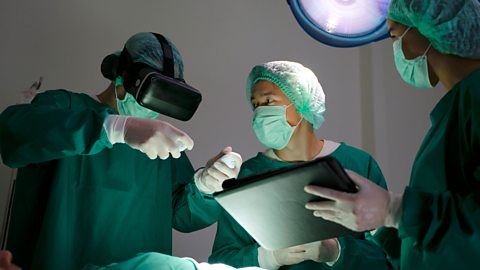
6. Medical imaging specialist
A medical imaging specialist uses imaging technology such as X-rays, ultrasound or MRI scans to diagnose, monitor and treat injuries and illnesses.
7. Qualitative health researcher
A qualitative health researcher is someone who studies health by exploring why and how people experience something, rather than the numeric data and statistics.
8. Health data scientist
A health data scientist is someone who works with really big health data sets. They use the data to understand patterns to help make better decisions to keep the population healthy.
9. Healthcare software developer
They are responsible for developing and building software to help with healthcare services, this could include for patient data or applications for hospitals.
10. Professor or lecturer in AI and health
This is an academic professional who researches and teaches about AI in the field of healthcare.

Careers in healthcare. collection
A collection of stories from people working across the healthcare sector.
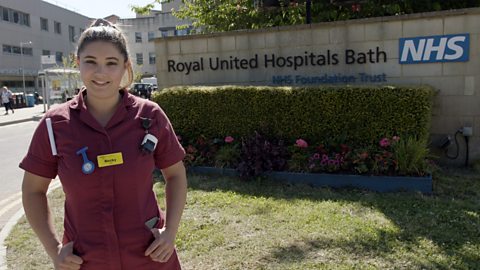
Becky: healthcare assistant. video
Becky is a healthcare assistant at Royal United Hospitals Bath.
Hassan: sonographer. video
Hassan is a sonographer at Royal Blackburn Hospital.