We’ve all heard of Blackbeard…
…but what about the female pirates? Historically, women were forbidden from any seafaring professions until the 20th Century, as mariners believed they caused bad luck. But despite the superstitions, many women defied convention to command hundreds of ships in search of treasure, liberation and even revenge!
BBC Bitesize looks at some of the female pirates that roamed our oceans throughout the centuries.
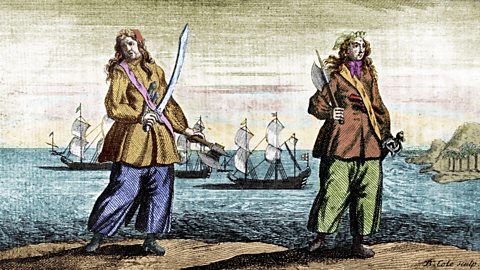
Breaking the mould: Anne Bonny
Anne Bonny was an Irish American pirate known for her exploits in the Caribbean during the 18th Century. In August 1720, she abandoned her husband and assisted in commanding a ship in the Bahamas alongside her lover, the pirate known as John “Calico Jack” Rackham.
The decision to allow Anne abroad was controversial at the time. During her time on the ship, she and a crew of approximately 20 pirates robbed many merchant vessels along the Jamaican coast.
On their adventures they were joined by another female crew member, Mary Read. Both Anne and Mary would dress themselves in men’s attire while at sea and participate in armed conflict.
In 1720, a pirate hunter ambushed their ship, but Mary and Anne fought back. Despite their efforts, the entire crew were placed in jail. They took the stand in Spanish Town, Jamaica, accused of piracy, however Anne was spared.
What happened next to Bonny remains a mystery, but her life and that of many other pirates was the subject of a biography called General History of the Robberies and Murders of the Most Notorious Pyrates. Written under a pseudonym, academics speculate the book may have been written by Robinson Crusoe author Daniel Defoe.
An American first: Rachel Wall
A native of Pennsylvania, Rachel Schmidt left home at the age of 16 to live near the waterfront. It was here that she met her future husband, the fisherman George Wall, who convinced her to leave her job as a domestic servant and join him as a pirate in 1781. Together they stole a vessel called the Essex and roamed near the Isles of Shoals.
They waited for rough weather and disguised the Essex to look damaged by the storm. Rachel would call to passing ships for help, and when they docked they would rob them. Over the space of a year, they reportedly managed to collect more than $6,000 in cash and even more for the cargo, which they sold in Boston and Portsmouth.
However, the law soon caught up with Rachel when she racked up a series of charges for theft and larceny. In 1789, she was accused of stealing a bonnet, shoes and buckles from a 17-year old girl.
Despite claims of innocence during the trial, Rachel was found guilty and became the last woman to be sentenced to death in Massachusetts. Historians believe she may have been the first American-born woman to ever become a pirate.
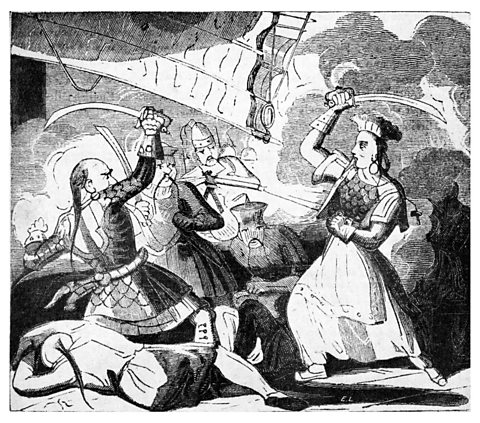
Rising to the top: Zheng Yi Sao
How did a woman born into poverty in 18th Century China turn into one of the most notorious pirates of all time?
At the height of her escapades, Zheng Yi Sao commanded over 1,800 pirate ships and an estimated 70,000 men. For comparison, Blackbeard was thought to be in charge of four ships and 300 pirates!
It all started in 1801, when she married a famous pirate called Zheng Yi and assisted in the creation of a unified pirate confederation. But upon the death of her husband six years later, Zheng Yi Sao took charge and grew her powerbase, even introducing her own pirate law code to maintain control.
She quickly launched attacks on salt fleets, one of the most lucrative trades at the time. Her pursuits were so successful that only four of the government’s 270 salt ships remained outside her control. Her military and economic dominance grew so strong that the Chinese government had to ask British and Portuguese navies for help dealing with piracy.
In 2022, Zheng Yi Sao made an appearance in the form of the character Madame Ching as part of the Doctor Who special ‘Legend of the Sea Devils’.

Out for revenge: Jeanne de Clisson
Noblewoman turned pirate? Now that’s a plot twist!
Jeanne de Clisson, otherwise known as The Lioness of Brittany, was born in 1300. At the age of 30, she had her third marriage to Olivier de Clisson IV, a wealthy Breton nobleman. Together the duo possessed enough combined assets to cement their status as a true power couple of the 14th Century.
But amidst a background of political conflict, Olivier was found guilty of treason and sentenced to execution. His death was shocking and marked a turning point in Jeanne’s life, who swore her revenge against those that wronged her husband.
She sold all the de Clisson estates and used the funds to build an army of men who had been loyal to her husband and led them on a rampage across the Normandy coast.
Despite being found guilty of treason she seems to have escaped without punishment, instead turning her attention to piracy and developing a fleet of ships. She had each of the ships painted coal-black, dyed their sails blood red and named her flagship ‘My Revenge’. Shiver me timbers!
She managed to secure the support of the English King, who had Jeanne’s fleet attack any French ships that she encountered. Her career of piracy in the English channel ended after 13 years when her flagship sunk in 1356.
This article was published in March 2026
Pirate history: true or false?
Buried treasure, walking the plank, the Jolly Roger- how much of it is true?
Did Robin Hood really exist?
When historical fact and fiction blur.

Where does goth music get its name from?
How an ancient people gave name to a contemporary subculture