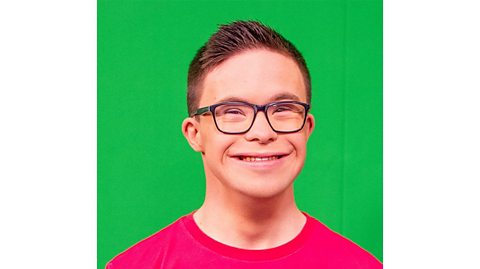
George Webster is a BAFTA-winning TV presenter, he’s also an actor, dancer and author.
Ahead of World Down Syndrome Day, George talked to BBC Bitesize about why representation matters to him, how everyone can benefit from listening to others’ experiences and why he wanted to write books.

“It's important to hear from different people”
When George was growing up, he told us there weren’t any books written by, or featuring anyone with a learning disability. The reason he decided to write books featuring people like him, was because “it's important to celebrate it”.
He said, “I want everyone to understand that being different is great. It's important to hear from different people's voices, from every person's experiences.” Being positive and delivering that message, is why he became an author.
Uplifting stories and characters based on George’s real life
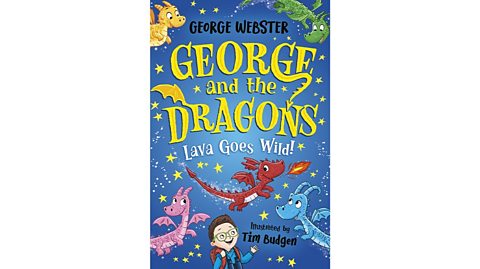
In his latest book, we return to the adventures of George, a boy with down syndrome, his two friends and a mini dragon as they go on a school camping trip to a magical forest. At one point Lava the dragon flies off and George has to get everyone working together, sharing and finding their strengths, to bring Lava home.
With more than a nod to his own time growing up (maybe without the dragons) many of the characters, adventures and games have been inspired by real life. George translates his experiences of friendship to the relationships in his stories: “we play lots of games together that are made up and we involve the dragons as well because you always have to involve everyone.”
People that supported George when he was at school are also featured, “I've a Teaching assistants (TAs) support teachers with classroom activities such as helping children with reading and writing in my book and in real life I did have a TA at school”. Makaton is a sign and symbol language designed to support spoken language – signs are used with speech, in spoken word order to help communication. Using signs can help children who have no speech or whose speech is unclear also plays an important role in all of George’s books.
“Before I spoke with words, I used Makaton”
George explained that using Makaton really helped with his speech and communication. Then watching Makaton being used on BBC children’s programmes helped inspire George’s career: “for me, it was Justin Fletcher as Mr. Tumble and Dave Benson Phillips because, before I spoke with words I used Makaton.”
Makaton is a sign and symbol language designed to support spoken language – signs are used along with speech, in spoken word order to help communication. Using signs can help children who have no speech (either because they have communication difficulties or are very young) or whose speech is unclear.
Makaton also helped George understand other people: “my sister joined in, that’s how she communicated with me as well, we really get on.” One of George’s favorite signs was ‘more food please’ and he has made sure to include that in his books.
I get to work with my childhood heroes
Seeing programmes on TV like Something Special with Mr Tumble on CBeebies, that uses Makaton and features children with learning difficulties, had an big impact on George: “they're my childhood heroes and I now get to work with the amazing Justin, which is so surreal.”
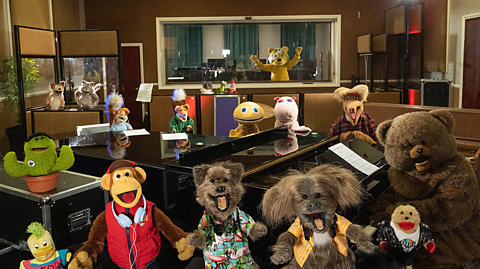
George’s TV career was launched on CBeebies in 2021 and he was celebrated widely for becoming the first children’s TV presenter with down syndrome: “there was such a massive positive response on social media, not just all over England, all over the world like Australia, Canada, and that really meant a lot.”
George acknowledges that being on TV brings a wider audiences to his books: “it’s not just kids with disabilities, kids with all abilities and I'm really grateful for that because, in my opinion, they're books for everyone.”
And some tips for budding writers
George has been a judge on book prizes written for children, and also Bitesize’s 500 Words competition for tales by children, so he has read a lot of great stories. George’s tips for anyone wanting to write: “it doesn't need to have the perfect grammar, the perfect illustration, the perfect punctuation, perfect spellings. It’s about writing a story and using your imagination. Go wild, okay, that's all it's about, just writing the story.”
“Just think, you're writing a story you're passionate about, then when the judges read it they'll be transfixed. They'll be transported into different worlds and I like being transported to different worlds, so please do that.”
George Webster’s reading and viewing recommendations
- The Curious Incident of the Dog in the Night-Time by Mark Haddon. “The main character has autism and that's amazing.”
- Wicked. (both films and the theatre show) “Elphaba, everyone laughed at her and was making fun of her because she's different. They think she's wicked, but she's not actually wicked.” George also added that he’d been to the Wicked film premiere recently and met Jonathan Bailey, “he just saw me as me, like you see Elphaba in Wicked”.
And for younger readers:
- Room on the Broom by Julia Donaldson. “I loved reading all the Julia Donaldson books and Room on the Broom has an especially important message. The witch meets all these different characters; she's making friends, she includes and involves them, which is lovely.”
- Godfrey is a Frog, by Alex Latimer. “It's all about finding out the things that are good about you, finding out about your differences which is great.”
- Blue Monster, by Petr Horáček. ”The monster wants to play with his friends but they don't want to, so he accidentally eats them. They don't die, they escape, but by the end they forgive each other and start playing.”
This article was published in February 2026
Liz Pichon: Five books to try if you’re dyslexic like me
Liz told BBC Bitesize she was really bad at spelling in school but loved drawing.
Five school books that sizzle on screen
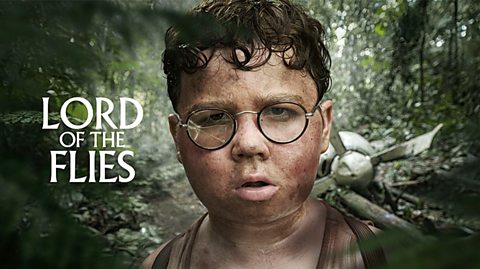
As the BBC brings Lord of the Flies to TV for the first time, BBC Bitesize takes a look at other school-day classics that have come to life on screen
Do you know your classic TV puppets?
From Basil Brush to Thunderbirds, put your knowledge of childhood puppets to the ultimate test in this BBC Bitesize quiz.