Oh no! Your five-minute relaxation break has once again turned into an hour of candle peeling TikToks.
We’ve all been there – whether it’s slime-squishing, sand-slicing, or sink-scrubbing, there’s something so relaxing about watching these activities on a loop.
A 2013 Reddit sub-forum is often credited as the birthplace of this trend, which soon exploded across social media platforms. But what’s the science behind these oddly satisfying videos? BBC Bitesize takes a look at the psychology behind the trend that never seems to end.
Why we love spirals and patterns
First, we have to go back. For thousands of years people have been fascinated with mathematical patterns that are pleasing to the eye, whether for scientific discovery or creative fun.
In 1525, German artist and theorist Albrecht Dürer first described the logarithmic spiral – put simply, a curve that can go on forever – and French mathematician and philosopher René Descartes discussed its mathematical properties later in 1638. A type of logarithmic spiral known as the golden spiral can be observed in nature.

Then came the machines: architect and engineer Peter Hubert Desvignes developed the 'Speirograph' mechanism, which was used to help prevent banknote forgeries by creating elaborate patterns to print on them, in 1827.
Inspired by the patterns on a one pound note in the 1960s, engineer Denys Fisher then developed and marketed the spirograph toy. Once it was accessible to the masses, the spirograph took the UK by storm and became Toy of the Year in 1967.
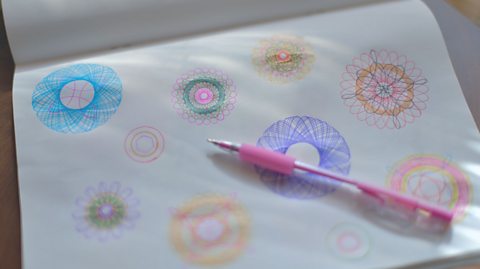
What makes watching swoops and loops appear so satisfying?
One theory is that it appeals to a childlike wonder in us. When we watch someone performing a skill with their hands, it taps into something from our younger years when we learn fine motor skills by observing.
This is linked to the phenomenon known as Auto-Sensory Meridian Response (ASMR). Professor and ASMR expert Craig Richard calls this specific trigger "observation-mediated ASMR": the hardwired response in all of us to watch and learn.
The joy of slime
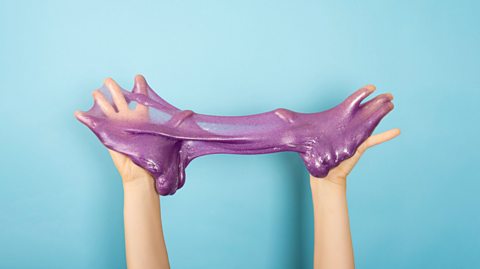
Another oddly satisfying toy became a huge trend when it was marketed by Mattel in the 1970s: play slime. That means your parents or even your grandparents are probably familiar with slime on the playground – or perhaps ruining a coat pocket!
Something about this squishable, squeezable goo struck a chord with young people everywhere. Slime made a comeback with adults and children alike in 2016 with the rise of mainstream ASMR videos and still doesn’t show any signs of disappearing. Chances are you’ve stumbled onto Slimetok, whose hashtag has over 506 million views on TikTok.

Slicing and dicing
The picture above shows a block of soap being expertly cut. This is another thing we find oddly satisfying. There are thousands upon thousands of videos of people cutting soap on the internet.
Along with the visuals many find the sound of the soap being sliced relaxing. Some videos also show people shaving slivers of soap and it's the movement of these slivers that hits the spot for some viewers.
Obviously - don't try cutting or shaving a bar of soap yourself at home, stick to watching the videos to be safe.
But why are these things so satisfying?
The short answer is the experts don’t know exactly why we find these things satisfying – but there are plenty of theories. In the case of slime, or even the spirograph, nostalgia may be a factor, as these videos could be triggering memories of happy times spending with our favourite toys. And the predictability of knowing what's going to happen next because we've seen it or experienced it before can also be soothing and reassuring.
Another theory is that seeing a job well done – such as watching a surface be cleaned from start to finish in a neat way – gives us the same relief and satisfaction as completing the task ourselves. Along with the meditation-like effects of observation-mediated ASMR, the cinematic elements of these videos also engages the brain: symmetry is something that we naturally find satisfying, likewise things that have self-similar patterns such as fractals. Watching things swirl, fold or squish through small spaces might fall into this category.
So naturally, spirals, soap-cutting and slime are up there on the oddly satisfying scale. But these sensory experiences are also subjective – many will get them, and many won’t.
Can watching these oddly satisfying things actually help?
What do we do with this information? Well, you might actually use oddly satisfying things to relax, self-regulate and even bond with others. While the ‘instant-hit’ or short-term satisfaction responses have been observed in people watching these videos, many psychologists agree that longer-term satisfaction comes from having the experiences in real life – that way you include all of the senses and not just visual stimuli.
A fun idea might be to get together with friends and make your own slime (sustainable alternatives, which would make your slime compostable, include cornflour and water), have a go at origami, or play with some water orbs and see what you find oddly satisfying.
This article was published in March 2026
Five things that may help you relax just by looking at them
Find out how to use relaxing pictures to make you feel calm.

Can you wrap your head around these positively puzzling paradoxes?
Take a look at the paradoxes that have left us scratching our heads throughout the ages.

Five times the movies got their science right
Science fiction often has scientists’ eyes rolling, but some film writers and directors have gone above and beyond to get their facts spot on.