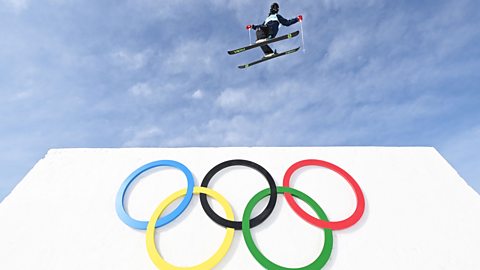
For a country where snowfall often brings things to a standstill, Great Britain hasn’t done too badly at the Winter Olympics and Paralympics.
Since the first Winter Olympic Games in 1924 in Chamonix, France, British Olympians and Paralympians have picked up over 70 medals on snow and ice.
BBC Bitesize takes a look at some of the most iconic golden moments in British winter sport history.
The 1924 men’s curling team
Britain’s first gold at the Winter Olympics came at the inaugural Games in 1924 in Chamonix, France – but the title wasn’t officially confirmed for another 82 years.
The medal was won by Great Britain’s men’s curling team, made up of father and son Willie and Laurence Jackson, Robin Welsh and Tom Murray.
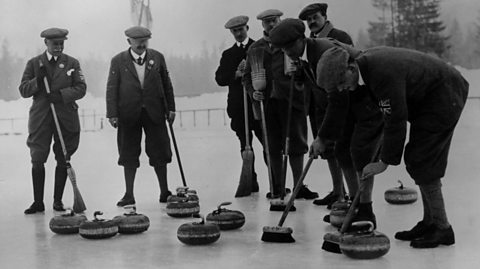
Three teams entered the tournament with Great Britain decisively overcoming Sweden and France to earn the gold medals.
But the event was considered a demonstration sport at the time and not a full event – meaning it was played to promote the sport of curling rather than as part of standard competition. In 2006, the International Olympic Committee retrospectively upgraded the curling competition to be considered a full Olympic event – and the curling squad’s place in British sporting history was secured.
Jayne Torvill and Christopher Dean
The duo of Torvill and Dean will be best known to some for their part on ITV’s Dancing on Ice – but back in 1984, they produced one of British sport’s most iconic performances.
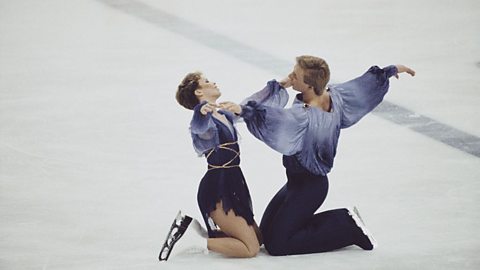
The Nottinghamshire skaters were three-time ice dancing world champions before the Games in Sarajevo, and went in as the overwhelming favourites.
The pair danced to Boléro by the French composer Maurice Ravel and produced a routine that stunned an estimated 24 million television viewers back in the UK.
The judges were impressed – giving them an unprecedented clean sweep of perfect scores for artistic impression.
After a spell of professional skating, the pair turned amateur for a return to the Olympics in 1994 – winning bronze in Lillehammer, Norway.
Kelly Gallagher
Great Britain competed at the first Winter Paralympics in 1976 and as a team picked up 21 silver and bronze medals across the first ten Games.
But a gold medal had eluded the squad, until 2014 in Sochi, Russia.
ParalympicsGB skier Kelly Gallagher was making her second Paralympics appearance, having finished just outside the medal places in the giant slalom for visually-impaired athletes in Vancouver in 2010.
Gallagher, who has oculocutaneous albinism, a condition which affects the pigment in her hair, skin and eyes, skied with a guide – pairing up with Charlotte Evans.
The duo had success in the run up to the Games, winning three silvers and three bronze medals across the 2011 and 2013 world championships.
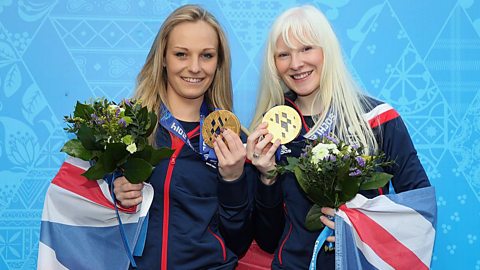
Gallagher – who was Northern Ireland’s first ever Winter Paralympian – was the first skier in the visually-impaired Super-G skiing event and set a time that couldn’t be beaten to take the country’s first-ever gold at the Games.
Lizzy Yarnold
Until 2018, no member of Team GB had ever retained their Winter Olympics title or doubled their golden tally.
Four years earlier, Lizzy Yarnold arrived in Russia as one of the favourites for the skeleton – a one-person, high speed sledding event.
She showed her quality at the Games – setting the fastest time in each of the competitors’ four runs, winning gold by just under a second.
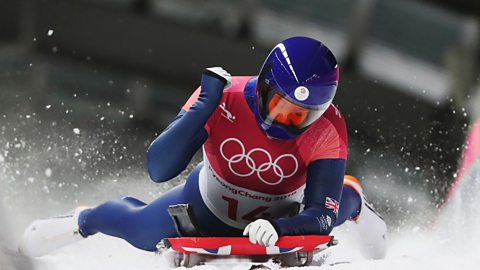
As defending champion in 2018, Yarnold took to the track in South Korea under different circumstances. She had suffered from a number of health problems, including dizzy spells, a chest infection and the discovery of a tumour behind her knee in the run up to competing.
Despite those challenges, she produced the run of her life in her final attempt, setting a new track record to claim top spot by around half a second, becoming Britain’s greatest ever Winter Olympian.
Menna Fitzpatrick
At just 19 years old, Menna Fitzpatrick became Great Britain’s most decorated Winter Paralympian of all time in a stunning Games skiing debut in 2018.
She took to the South Korean slopes with guide Jennifer Kehoe – Fitzpatrick was born with congenital retinal folds which means she has no vision in her left eye and limited vision in her right eye.
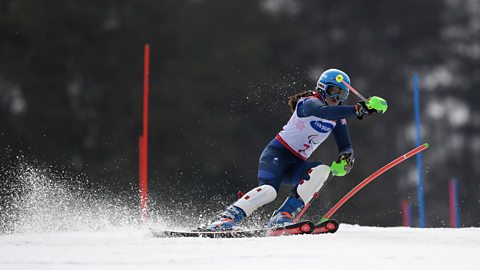
They picked up a bronze in the Super-G before silver medals in both the Super Combined and the giant slalom.
The final day of the Games saw them back in action for the slalom – producing a stunning run to win the gold by just 0.66 seconds. It was ParalympicsGB’s second ever gold medal at a Games and the duo’s first, taking their tally in Pyeongchang to four medals in total.
Fitzpatrick wasn't finished there though. She headed to Beijing in 2022 with a new guide after Kehoe retired to focus on her career in the Army. Teaming up with Katie Guest, Fitzpatrick added to her impressive haul with silver in the Super-G and bronze in the Super Combined.
The Macclesfield-born skier is hoping to add to her already unprecedented medal haul in Milan Cortina - but faces a race against time to be fit after suffering a knee injury in late 2025.
This article was published in February 2022 and updated in January 2026

The physics of Winter Olympic sports
Across curling, ski jump and bobsleigh, athletes have to get to grips with friction, air resistance and gravity
Your five-minute guide to the 2026 Winter Olympics and Paralympics
Find out all you need to know ahead of Milan Cortina 2026

The ultimate Winter Olympics and Paralympics quiz
Do you know your stuff when it comes to sport on snow and ice? Take our tricky quiz to find out!