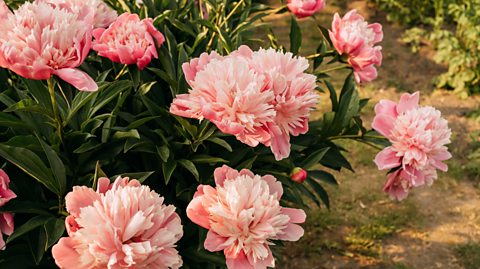
Peonies are undeniably very beautiful flowers, but to Victorians they held meaning beyond their lovely bright colours and fulsome bloom.
Peonies were symbols of wealth and good fortune in a “language of flowers” used by people at that time to send, sometimes, secret messages.
Bitesize uncovers the history behind this unusual way of communicating - and how it continues to influence our own romantic traditions today.
What was the language of flowers?
In the 19th Century, it was popular to link particular emotions and ideas to individual types of flowers. These could be used to pass messages - usually of love - by gifting an individual flower or a bouquet made up of different flowers that conveyed a more complicated message.
Was this a new idea?
It was not - but the idea really captured the Victorians’ imaginations and it became a big trend with many books decoding the language of flowers published at that time.
Flowers and plants have been given symbolic meanings throughout history. Many appear in the Bible as a way of expressing sentiments. Lupins, a purple flower that blooms in the wild in Israel, are used as a reminder of our mortality - as their flowers come to an end in the last days of summer, so eventually will our lives.
Shakespeare’s plays mention more than 50 types of flowers and plants, most memorably in Hamlet when Ophelia, driven mad by unrequited love, hands out flowers saying: “There’s rosemary, that’s for remembrance” and “there is pansies, that’s for thoughts”.

How did people understand what the flowers meant?
Some meanings were already well-known as they had been part of cultural knowledge for many centuries. The red rose as a symbol of romance for example goes back all the way to Ancient Greece, when it was the sacred flower of Eros, the god of love.
For the rest, you could buy a book that revealed their meanings. There were many of these published throughout the Victorian era and were often like a dictionary that allowed you to look up a particular flower to find out the sentiment linked to it, or you could find the emotion or idea you wanted to express and discover which flower to use. For instance, if someone sent you a bouquet of pinks - fragrant flowers with fringed petals - you would find out they were confessing “pure love”. And if you wanted to tell someone you thought they were a “delicate beauty”, the dictionary would suggest a hibiscus.
Some parts of the plants were too rude to be included
The books tended to be quite decorative, often with sketches of the flowers alongside poems about their meanings. Many of them were very small so they would fit into a woman’s hand as they were mainly aimed at female readers. As a lot of the language of flowers books were published anonymously, it is thought that many of them were written by women as at that period authors who didn’t give their names were often female.
However, they didn’t usually include much botanical information as it was considered inappropriate for Victorian women to learn about plants’ reproductive parts, such as seeds.
Flowers could be used to tell fortunes
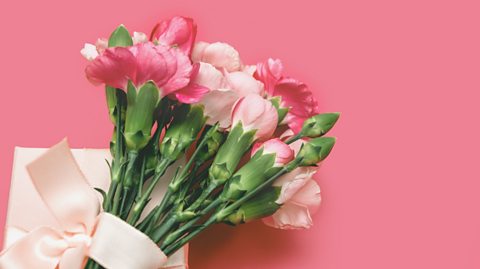
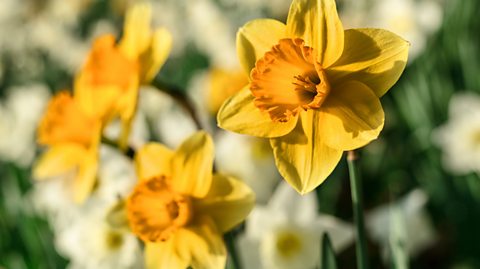
There were other sorts of language of flowers books that went beyond expressing secret messages. They included books matching your birth date or month to a particular flower - something that is still promoted by florists today. People born in January have the carnation (symbolic of motherly love) as their flower, February is violet (faithfulness), March is daffodil (new beginnings), April is daisy (innocence), May is lily of the valley (purity), June is the rose (love), July is delphinium (dignity), August is the gladiolus (strength), September is aster (wisdom), October is marigold (determination), November is the chrysanthemum (friendship) and December’s is a plant rather than a flower - holly (good fortune).
Another book, the Lexicon of Ladies' Names by Sarah Carter from 1860, lists women’s names in alphabetical order with a designated flower next to each one - Agnes meant modesty and her flower was a white violet, Rowena was flowering reeds meaning “confidence in heaven”.
There was also a book that guided you to put together an imaginary bouquet that told your fortune according to your choice of flowers.
Meanings changed over time
If you thought a flower had a different meaning than those given here then that could be because their symbolism has changed over time. The sentiments attached to each one tends to reflect society’s attitudes at the time. In the 19th Century, they were influenced by conservative moral and religious values about women and their role as wives and mothers, giving us an insight into ideas that were very different from our attitudes today.
This article was published in February 2026
Quiz: Can you tackle a Victorian exam paper?
Test your knowledge against this test from 1859.

Are these the most mesmerising gardens in the world?
Take a journey across the world to explore some of the most mind-blowing gardens.
LGBTQ+ coded languages
Explore the world of Polari and the diaries of Anne Lister (Gentleman Jack).