Wuthering Heights review: This bold reinvention of Emily Brontë's novel is 'sexy, dramatic and swoonily romantic'

 Warner Bros
Starring Margot Robbie and Jacob Elordi, Emerald Fennell's new take on the classic romance is far from faithful to the original book – but it is "utterly absorbing" in its own right.
Emerald Fennell's Wuthering Heights is not very faithful to Emily Bronte's novel, but we knew that. The trailer alone evoked so much hand-wringing from Brontë purists that the film became divisive sight unseen. This Wuthering Heights is very true to Fennell, the director of the scathing revenge drama Promising Young Woman and the lush, bitter story of class and obsession, Saltburn.
Cathy and Heathcliff are still recognisably Bronte's lovers, irresistibly drawn to each other from childhood yet fated to be apart. But Fennell's approach is an extravagant swirl: sexy, dramatic, melodramatic, occasionally comic and often swoonily romantic. There is a lot of standing in the rain and wind, kissing in the rain and wind, and just rain and wind on the Yorkshire moors. She laces the 19th-Century setting with contemporary touches, from its costumes fit for an Oscar red carpet to its sexual frankness. A flesh-coloured wall is based on a scan of Robbie's skin, veins and all.
But under it all Fennell channels something essential in the book – the corrosive behaviour that can result from thwarted desire. Jealousy, anger and vengeance are as natural to Cathy and Heathcliff as their endless passion for each other. If you embrace the film's audacious style and think of it as a reinvention not an adaptation, this bold, artful Wuthering Heights is utterly absorbing.
The film opens with a jolt of violence, invented by Fennell, that the young Cathy (Charlotte Mellington) watches with wide-eyed excitement. The screenplay combines some characters, invents backstories and lops off the second part of the book. Unlike Brontë's version of Cathy's kind father, this Mr Earnshaw (Martin Clunes) drunkenly rescues the abandoned boy Heathcliff (Owen Cooper of Adolescence), takes him back to their rustic home, Wuthering Heights, and brutishly treats him as a servant. The childhood scenes are bracing, but the film quickly moves on.
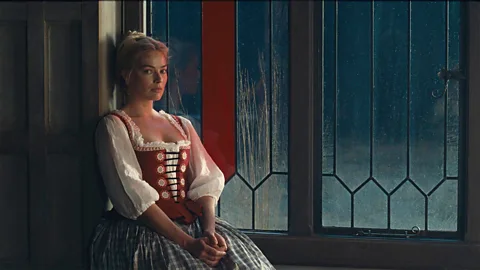
Robbie turns up in the first of many bright red-and-white dresses, and her performance is magnificent, making Cathy wild and selfish but with a conscience, and an innocence beneath her sense of entitlement. And forget her age. Fennell simply makes the characters older. Mr Earnshaw even says, "She's already well past spinsterhood". Elordi embodies Heathcliff's dashing, bad-boy energy, even when stuck with a stringy-haired wig. Heathcliff is more than a shirtless, sweaty hunk, although he is often that. Elordi reveals how defensive and easily wounded he is, how he resents his status as a servant.
Wuthering Heights
Director: Emerald Fennell
Cast: Margot Robbie, Jacob Elordi, Shazad Latif, Alison Oliver
Run-time: 2hr 16m
Release date: 13 February
As Fennell surfaces the sexual desire Brontë could only hint at, she creates a very long tease. Cathy and Heathcliff throw hungry glances at each other. Each gets a masturbation scene. When he overhears the practical Cathy say "It would degrade me to marry Heathcliff" – one of the novel's famous lines – he runs away from Wuthering Heights before hearing her add how much she loves him.
At times the film's over-the-top choices seem kitschy. Heathcliff rides on horseback against a bright orange sky, long hair flying in the wind as if he escaped from the cover of a romance novel. But overall Fennell uses stylised images well. After Heathcliff leaves, an overhead view shows Cathy slumped on the floor so that all we see is her billowing red skirt, her despair and grief revealed in a single shot.
More like this:
• Why Wuthering Heights is the year's most divisive film
• 16 films to look forward to in 2026
• 10 of the best films to watch in February
Edgar Linton (Shazad Latif), the rich man Cathy marries, is attractive and devoted. She likes him; he's just not Heathcliff. Alison Oliver gives a standout, lively performance as Isabella, Edgar's grown yet childish ward, who adores Cathy and creepily makes a doll with strands of Cathy's actual hair.
The now-prosperous Heathcliff returns years later, looking like a gentleman. He and Cathy have sex on the windswept moor, in her carriage, and after he climbs through her bedroom window. It is all steamy but discreetly shot. When his jealousy turns more cruel than ever, though, and he manipulates the innocent Isabella into becoming his chattel, the change is far too abrupt.
At the end, we flash back to young Heathcliff, who says, "I'll love you 'til the day I die, and after". But a line just as important comes earlier, in the adult Heathcliff's dark, passionate plea to Cathy, capturing the vehemence beneath this film's dazzling surface: "Kiss me and let us both be damned."
★★★★☆
--
If you liked this story, sign up for The Essential List newsletter– a handpicked selection of features, videos and can't-miss news, delivered to your inbox twice a week.
For more Culture stories from the BBC, follow us on Facebookand Instagram.