How toddlers in Finland are saving an endangered Sámi language

 Erika Benke
Special nurseries are helping the Sámi people in Finland to bring their almost-lost language back from the brink of extinction.
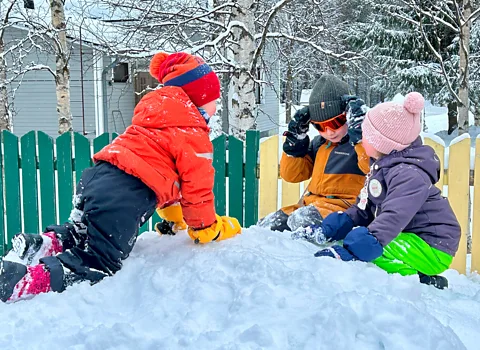
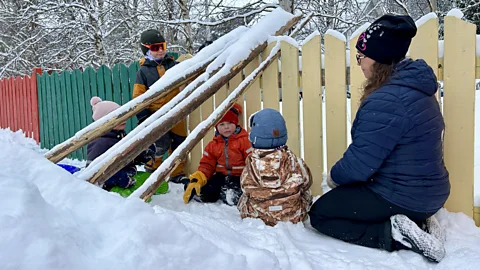
It's -8C (17.6 F) and snowing heavily, but in Inari, a village in Lapland, 350km (220 miles) above the Arctic Circle, that doesn't stop nursery children from going outside to play. Bundled up in colourful warm clothes, they're busy building snow forts and tunnels, as their excited chatter resonates through the cold air.
The words thrown around are in Inari Sámi: an indigenous language that's only spoken in the area of Lake Inari in Finland, and one that was on the brink of extinction just a few decades ago.
In 1995, only two families spoke Inari Sámi to their children, and just four speakers were under the age of 20.
"At that point, it was quite a typical opinion that the Inari Sámi language was going to die out," says Annika Pasanen, professor of sociolinguistics at the Sámi University of Applied Sciences in Kautokeino, Norway. "Most speakers were elderly and they didn't have many opportunities to use Inari Sámi, so it was spoken very little."
Everything changed, Pasanen says, when local children began taking part in a novel, immersive language experiment. The programme has transformed a language that was once considered doomed after being inspired by indigenous language revitalisation projects in New Zealand, the other side of the world from Lapland.
"There aren't many other examples of the status, prestige, and the use of a language undergoing such a change," Pasanen says. "It is one of the most exceptional revitalisation cases in the world."
Indeed, the efforts to save Inari Sámi are widely cited as one of Europe's most successful examples of indigenous language revival. But the language's resurgence has also raised questions about who it is for, whether saving a language can ever be separated from the history that nearly erased it and what to do if resources dry up.
Building a 'language nest'
Once back inside from the snowy playground, the 11 children of the Inari village nursery sit on soft pads resembling large tree slices.
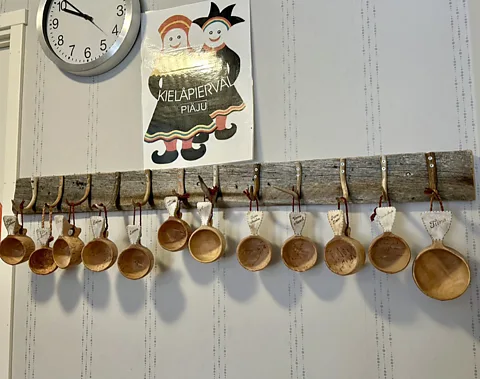
Their room is adorned with traditional Sámi decorations and symbols: a Sámi flag and several drums hang on the wall next to a picture of a hand-painted, cut-out paper reindeer. The curtain has a fish pattern and the dolls are dressed in bright, handmade Sámi outfits. In the entrance hall, there's a row of traditional outdoor drinking cups made of birch, each belonging to a child, with names neatly written on the handles.
The children's faces light up as they sing Sámi nursery rhymes, clapping to the rhythm while they chant. Activities like this play a crucial role in preserving and passing down the Sámi language and cultural heritage, says Tiina Lehmuslehti, their teacher, who leads the session by gently guiding the children and encouraging them to participate.
This is an Inari Sámi Language nest – an early years education concept with the goal is to create a new generation of speakers by completely immersing young children in the indigenous language.
 Erika Benke
Language nests were first developed in New Zealand in the 1970s to help preserve Māori languages Following their success, they have since been recognised as a crucial tool for language revitalisation among indigenous communities, spreading worldwide.
They came to Finland in 1990 after the establishment of the Inari Sámi Language Association in 1986 by language enthusiasts Veikko Aikio, Ilmari Mattus and Matti Morottaja. The association set up the nests and ran them until handing over administration to the municipal education authorities in 2022. They are funded by Finland's Ministry of Education through Finland's Sámi Parliament.
"I'm so happy to be able to teach these children," says Lehmuslehti. While some of the childern she teaches only speak Finnish when they join the language nest, within a couple of months, they switch to Inari Sámi in day-to-day small talk with staff. From then, it takes about six months for the three to four-year-old children to begin speaking fluently. Research shows that young children in immersive language environments such as these can pick up a new language with relative ease.
Over the last 30 years, this rapid language acquisition among children aged one to six years old at three language nests in northern Lapland has helped halt the decline of Inari Sámi. Since the introduction of local language nests in 1997, the number of young speakers has grown to about 100. The estimated total number of Inari Sámi speakers, including all ages, now stands at 500.
It's a "radical change", says Pasanen.
"When small children start speaking a highly endangered language that hadn't been spoken by children for decades, it's something very powerful," says Pasanen. "It immediately takes away all the pessimism about the language dying out."
It's not just the total number of child speakers that gives rise to optimism. There are now 20 to 30 families with small children where Inari Sámi is spoken as the home language by at least one of the parents, says Pasanen. And some of the young parents now transmitting the Inari Sámi language to their children have themselves learnt it in a language nest.
"This means that language nests have reversed the language shift, the process where Inari Sámi was being replaced by Finnish," says Pasanen.
Who is a 'Language Nest' really for?
Thirty-year-old Sammeli Salonen is one of the young adults taking the language back. In his family, Inari Sámi was lost to a generation.
"My father's mother's – my grandmother's – first language was Inari Sámi, but she forgot it after being sent to a boarding school where she was forbidden to speak Sámi," says Salonen. Hers was a common experience among Sámi children in the 50s, 60s, and 70s: a period when governments in Nordic countries implemented policies aimed at assimilating Sámi people, which often entailed discouraging or erasing their language and changing their identity. When she returned, she only spoke Finnish and that's the language she then spoke to her kids.
Salonen, instead, was born in 1994, well after assimilation policies ended. He was among the first Inari Sámi children to attend a language nest, and now it's his daughter's turn.
"It's important to have kids with Sámi roots in the language nests," says Salonen. He notes, however, that language nests are not just for Sámi families and that it's equally crucial to have Finnish families participate too. "It doesn't matter who you are and where you come from: Inari Sámi needs as many speakers as possible," says Salonen.
Children from Sámi-speaking families have priority access to the language nests, as they are a core group that's crucial for language revitalisation and nests help access education in their mother tongue. Sámi and Finnish children with no knowledge of the language are then welcome to be in the language nest if there are spaces available.
About 20% of the children in Lehmuslehti's language nest are Finnish, she says, and the number of applications is growing all the time. "It's only positive," says Lehmuslehti.
Not enough Inari Sámi teachers
Under Finland's Language Act, all three Sámi languages spoken in Finland – north Sámi, Inari Sámi and Skolt Sámi – are recognised as official languages in the four municipalities where they're spoken. Government agencies in these areas are required to provide services in Sámi, including education and official paperwork. Municipalities are also required to offer education in Sámi for pupils who speak it.
The right to get an education in Sámi is stated in Finland's basic education act, which came into force in 1999 and is "very progressive" legislation, even by international standards, according to Pasanen. "It's not that common that such small groups have at least in principle a right to get educated in their own language," says Pasanen. Finland's status as an economically stable, bilingual country, where Finnish and Swedish are both official languages, has created a sound foundation for supporting minority indigenous languages.
This is "something quite extraordinary at a global scale", says Pasanen. "We are talking about education offered in, and through, the language. So it's about biology, mathematics… taught in the Sámi language."
But the resources needed to follow through with these legislations are finite. With a pool of 500 Inari Sámi speakers in the Lake Inari area in total, it's no surprise that there's a shortage of teachers. There simply aren't enough educated, fluent Sámi speakers to fill all the jobs in children's language nests and to then accompany these kids through the rest of their education once they're off to elementary and middle school.
"I often ask people, 'Hey, what are you doing next year? Do you want to come and work with us?'," Lehmuslehti laughs. An intensive one-year adult education course in Inari Sámi language and culture is offered at the Sámi Education Institute to help bridge the workforce gap, and anyone can apply.
 Erika Benke
"Many of the current teachers in the language nests, including Finnish people, have gone through this education," says Pasanen. But the demand for teachers is still growing faster than the supply, and when language nest children go on to elementary and middle school, a lack of teachers means that not every subject will be taught to them in Sámi.
"In the first school year, Sámi classes make up almost 100%," says Pasanen, but the number of classes taught in Finnish increases every year, and by year six, only half of the classes end up being in Sámi. "The situation is unstable and it varies from year to year."
Reading and writing in Inari Sámi
While the number of hours spent learning in Sámi may shrink as children move through school, the language has been expanding in other directions – beyond the classroom and into public and digital life. The Inari Sámi Language Association, which first brought language nests to Finland in the 1990s, is revitalising writing and reading in Inari Sámi too by translating existing literature, publishing new books and circulating newspaper stories in the indigenous language.
More like this:
• The Viking messages unearthed on Sweden's rune stones
"We have 30 people who can write in Inari Sámi, so we can publish 100 articles a year in our online newspaper. That's about 500-600 pages," says Marja-Liisa Olthuis, the chair of the Inari Sámi Language Association.
The team of writers has also created 6,500 Wikipedia articles. "For a language spoken by 500 people, Inari Sámi is very well-represented in Wikipedia," says Pasanen. Her son, one of the first Finnish children to learn the language in a language nest, has been a prolific Inari Sámi author on Wikipedia.
One of the proofreaders at the Inari Sámi Language Association is Fabrizio Brecciaroli, an Italian who learnt Sámi as an adult. He used to teach Italian as a foreign language in Switzerland before he took up his job at the Inari Sámi Language Association.
"If someone learns Italian as a second language, they won't really make a difference to the language and the culture. But with a small language like Inari Sámi, every new speaker counts," says Brecciaroli. "Each can make a real impact," Brecciaroli says. The successful revitalisation of Inari Sámi serves as an example to other minority languages around the world.
"Language is part of culture. If the Inari Sámi language disappears, there won't be Inari Sámi people anymore," says Brecciaroli. "Thanks to revitalisation, being an Inari Sámi and speaking the language is now something to be proud of."
--
If you liked this story, sign up for The Essential List newsletter – a handpicked selection of features, videos and can't-miss news, delivered to your inbox twice a week.
For more science, technology, environment and health stories from the BBC, follow us on Facebook and Instagram.