London Tube strikes: What you need to know

 BBC/Harry Low
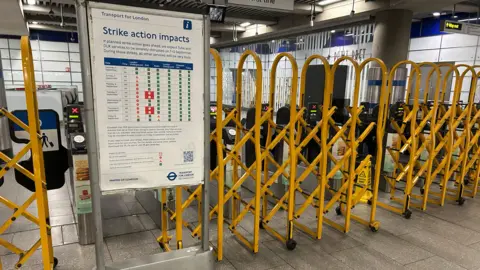
A series of six 24-hour strikes by drivers on the London Underground has been announced, with the walkouts starting later this month.
Members of the Rail, Maritime and Transport (RMT) union voted to oppose the introduction of a four-day working week with condensed hours.
The first strike is to take place on 24-25 March, although it is unlikely to result in a total shutdown.
The union said it was concerned about shift lengths, unacceptable working time arrangements and the possible impact of fatigue on safety.
Transport for London (TfL) described the strikes as "completely unnecessary" and said it was currently trialling a voluntary four-day week for drivers on the Bakerloo line.
When are the Tube strikes?
As it stands, members of the RMT union will strike on:
- 24–25 March (12:00 Tuesday - 11:59 Wednesday)
- 26–27 March (12:00 Thursday - 11:59 Friday)
- 21–22 April (12:00 Tuesday - 11:59 Wednesday)
- 23–24 April (12:00 Thursday - 11:59 Friday)
- 19–20 May (12:00 Tuesday - 11:59 Wednesday)
- 21–22 May (12:00 Thursday - 11:59 Friday)
How much disruption is expected?
It is difficult to predict at this stage how severe the disruption will be and how much of the network will be affected.
London Underground said there will be some disruption on most Tube lines but the level experienced will not be as severe as the strikes last September.
Only drivers belonging to the RMT union are due to strike - that is roughly half of the total number of drivers on the network. Aslef's participation in last year's strike with the RMT affected nearly all services.
Many Tube drivers are set to turn up to work as usual, including members of Aslef trade union - which accepted the proposals.
TfL said it would have a clearer idea of how much disruption was likely in the coming days.
What is the strike about?
The RMT has rejected an offer for drivers to work a four-day week.
Under the proposal, most drivers would see their working week reduced from 36 hours to 35 hours.
Their contractual hours would remain the same because paid meal breaks would be introduced.
This effectively means drivers would work longer days, but fewer days each week and fewer overall hours each week.
The arrangement is currently being trialled on the Bakerloo line on a voluntary basis to test its viability.
The RMT said the working day would be too long under the plans, risking driver fatigue and compromising safety.
The union instead wants a 32-hour week over four days, meaning drivers would work a total of three hours less each week for the same salary.
TfL said drivers could remain on a five-day week if they wanted to, pointing out that the change was voluntary.
Could the strikes be called off?
Talks are planned for week beginning 16 March, BBC London's transport correspondent Tom Edwards has said.
It is very possible the talks could bear fruit or, at the very least, open the door to further negotiations and delay the industrial action.
Eddie Dempsey, the RMT's general secretary, said: "There is still time for London Underground to come up with a workable solution but we will take strike action if we cannot get a negotiated settlement."
TfL said it had urged the RMT to call the strikes off.
 PA Media
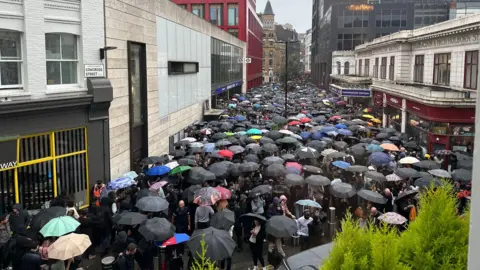
London Underground drivers last went on strike in September in a dispute over pay and conditions.
The industrial action caused severe disruption across the capital's transport network.
Listen to the best of BBC Radio London on Sounds and follow BBC London on Facebook, X and Instagram. Send your story ideas to hello.bbclondon@bbc.co.uk