Positive outlook at battery research centre

 BBC
BBCBatteries are essential for modern life, powering everything from cars to drones and homes. The government is now making a £200m investment in a Coventry factory to help companies create the batteries of the future and avoid the costly mistakes of the past.
On the outkirts of Coventry is the UK Battery Industrialisation Centre (UKBIC), designed to bridge the gap between a company's clever new battery idea and proper industrial production.
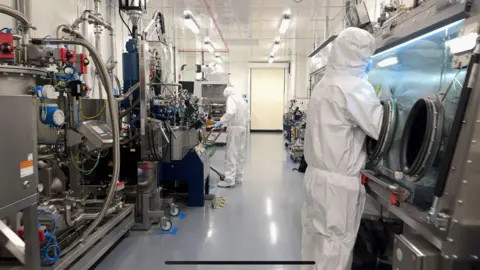
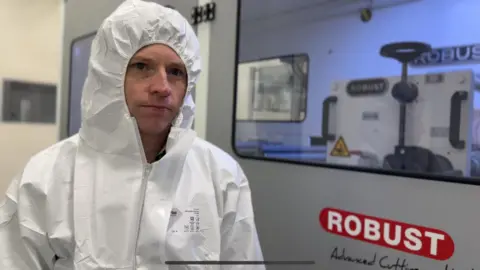
With both of us clad head to toe in protective white overalls, gloves and masks, the Chief Technology Officer Richard LeCain took me on a tour of UKBIC's new production line full of high tech equipment.
"Just to buy those machines, install those machines and run these machines and have the environment around it is very expensive," he said.
"We take all of that cost out for our customers so they don't have to spend £200m on their own factory - they can come here and use our machines.
"They use our expertise and we help them to industrialise what they're doing."
This whole project is trying to address one of the UK's great historical industrial missteps.
While much of the work on lithium ion batteries was done here in the UK it was other countries, like Japan and China, that had much of the success in turning that research into high-value, high tech products that now dominate the market.
Here, a battery starts as a thin layer of material, coated and treated to become the anode, the negative terminal, which is then combined with the cathode, the positive terminal, produced on the same line.
You can make them into a familiar cylinder or join them together to form a pouch and fill it with electrolyte.
Every stage of this process, from the chemistry of the coatings to the engineering of the size of the battery can be tweaked. What works in a research lab may not survive being scaled up for industrial production.
And the batteries produced here might end up in almost anything that needs electricity, according to Managing Director of UKBIC Sean Gilgunn, also fetchingly covered up to protect the precious batteries on the line.
"We help companies that are developing batteries for electric vehicles, for vertical takeoff aerospace applications, as well as defence and even energy storage. So a multitude of applications. And wherever that battery goes into the end market is a positive for Britiain - we're building British batteries."
Millions of pounds of investment is aiming to make sure we don't lose out on the next big battery thing.
Follow BBC Coventry & Warwickshire on BBC Sounds, Facebook, X and Instagram.