'Autism diagnosis helped my son understand himself'

 BBC
BBCThe head of a charity that supports those in the community with autism says getting an early diagnosis can help people to progress through education and into adulthood more smoothly.
Nicollete Powell, head of the Isle of Man branch of Praxis Care, said those on the island were sometimes left without a diagnosis due to its limited spread of services or pathway.
A developmental disability, autism affects how people perceive the world and interact with others.
Nicolette said her own son now had a way of "understanding himself" after being diagnosed as autistic at the age of 17 while living in the UK.
It is estimated nearly 1,500 people living on the Isle of Man have some form of autism.
The Department of Health and Social Care (DHSC) has invited people to share their views on best practice for the autistic community ahead of a month-long campaign focusing on the condition.
A series of public meetings is set to be staged ahead of Autism Acceptance Month in April, in efforts to ensure the island becomes "truly autism-friendly" and "reflect the lived experience" of the community.
'Stuck in a loop'
The 10-year National Autism Spectrum Condition Strategy, which received Tynwald approval in 2024, set out six goals such as an increased acceptance of the disability, and an attempt to improve inequalities in care on the island.
The scheme has so far seen the unveiling of a new social group for autistic people aged 18-25-year-old, along with more advice and support for schools.
But getting a diagnosis - for many the first big hurdle in their autistic journey - has historically been difficult, Nicolette said.
Unlike in the UK, the Isle of Man did not have an "NHS equivalent" to an autism diagnostic service, which left many having to pay privately or tend with the limited amount of services available, she said.
Currently on the island, those aged between two and 17 can self-refer or be referred by their parent, carer, GP or education staff to the Talk service, which provides a single point of access for those who need support with their mental health.
However, there is no autism assessment or diagnostic service available for those aged 18 or over on the island.
A plan to introduce an all-age diagnosis pathway for autism and attention deficit hyperactivity disorder (ADHD) is mooted to come before Tynwald in February.
Nicolette said: "If you can't afford to pay privately, people are often left without one way into adulthood.
"Even if you get a private diagnosis, statutory bodies could question the validity of those results because they don't know where they've come from.
"People here are sort of stuck in a loop."
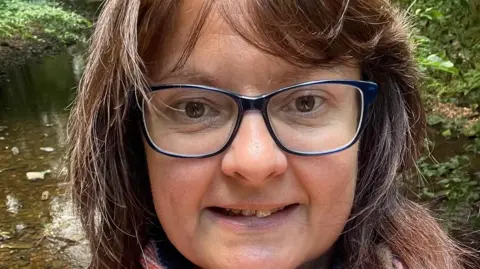 Nicolette Powell
Nicolette, who was a registered learning disabilities nurse in the UK before moving to the island, said an early diagnosis was vital for signposting the person and their family to relevant services for the future.
But its not just on the island that securing an early diagnosis can be tricky, something illustrated by Nicolette's own son's late diagnosis of autism and ADHD at the age of 17 in the UK.
"We struggled for a long time to get a diagnosis because he was so anxious and wouldn't engage with any professionals," she said.
She said her con, who is now 18, had had trouble in mainstream schools as they "couldn't understand" him.
Without a diagnosis, she said those with suspected autism or ADHD were unsupported by the education or criminal justice systems, and were potentially vulnerable to "manipulation" by their peers in efforts to "fit in".
'It was emotional'
Nicolette said, before her son's diagnosis, she was not convinced one would change things that much but conceded that she has since seen him take positive steps.
"He has a way of understanding himself now, he himself said he's benefitted from the diagnosis," she said.
"He often had low self esteem, felt he was to blame for some of his behaviours, but now he can take that level of blame away and is able to therefore put strategies in place.
She said finally getting the diagnosis was a milestone, adding: "It was emotional for even me, I cried."
A DHSC spokesperson said the department regularly met with the autistic community to hear their views but admitted "much of our autistic community" did not attend the meetings held in the past.
Through the February sessions and April's campaign, the department was "looking at ways to reach those within our autistic community who may not usually engage with our team, such as older adults".
The meetings themselves - at Keyll Darree on the Noble's Hospital - aims to gather views on the key themes the awareness month should focus on.
The first will be held on 2 February between 13:30 and 14:30 GMT, with he second due to take place on 10 February from 19:30 to 20:30.
Those wishing to attend the meetings have been encouraged to pre-book online, while those unable to attend can share their views through an online survey.
Read more stories from the Isle of Man on the BBC, watch BBC North West Tonight on BBC iPlayer and follow BBC Isle of Man on Facebook and X.