Family 'may still have to sell third of farm' to pay inheritance tax

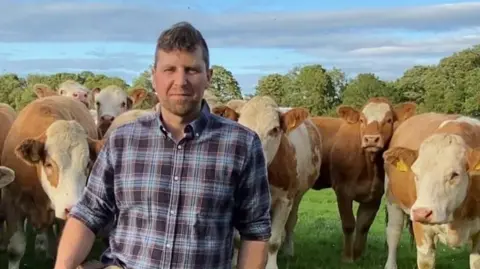 Watson family
A farmer who has worked full time on his parents' farm since he left school at 16 fears he may have to sell up to a third of their family's land to pay inheritance tax.
Fergal Watson runs a large cattle and cereal farm in Cloughey in the Ards peninsuala in County Down.
The property, which stretches to nearly 700 acres, is owned by his elderly widowed mother, who he has helped care for since she was diagnosed with dementia.
Their home is among 4,500 farms in Northern Ireland which are still likely to be hit by new inheritance tax bills, despite the threshold recently being raised to £2.5m.
"I do not see a way out for myself that I will not have to sell land that I have worked for in my lifetime to pay for," Watson said.
He warned the new tax rule, which comes into force in April, will "cripple" many family farms and ruin rural economies which rely on the support of local farmers.
"It's going to bring in very little to the exchequer, but it's going to break, in lot of cases, family farms up forever," he told BBC News NI.
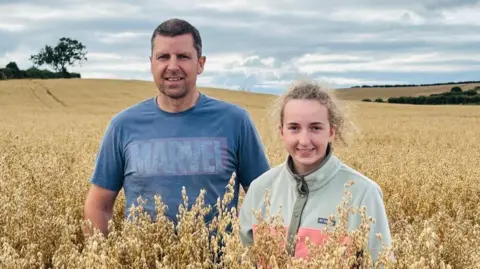 Watson family
Now 49-years-old, the married father of one started helping his late father with livestock as soon as he was "able to walk about the yard".
He said they spent two generations expanding the farm, putting all their money "and every bit of your being into the farm - because that's what farmers do".
Watson pointed out that he had already paid tax on the land when he bought it.
He insisted the new tax was "unaffordable" and their farm would become smaller and weaker each time there was a family death.
What is happening to farmers' inheritance tax?
In 2024, the government announced plans to scrap the traditional inheritance tax exemption for farms, saying all farms worth over £1m would become liable for tax.
It led to widespread protests by farmers, who warned the change would wipe out family farms, many of which were asset rich but cash poor.
In December 2025, the plan was watered down, increasing the threshold at which farms become liable for death taxes from £1m to £2.5m.
The government also pointed out that married couples and civil partners can pass on their £2.5m allowance to their spouse on death.
That means that between them, farming couples could bequeath up to £5m in agricultural assets to descendants.
Some farmers working for 'minimum wage'
The climbdown will not help the Watsons, because Fergal estimates his mother's farm could be worth about £9m on paper.
Despite that considerable sum in assets, he said it is difficult to make ends meet from day to day profits on the farm.
"In a lot of cases you'd be on a minimum wage because you take the hours that a farmer would work - it could be 85 hours in a week on average," he explained.
On top of his day job, he and his five siblings share out 12-hour night shifts looking after their disabled mother.
Her health deteriorated after their father died in 2017 and the widow currently needs 24-hour care.
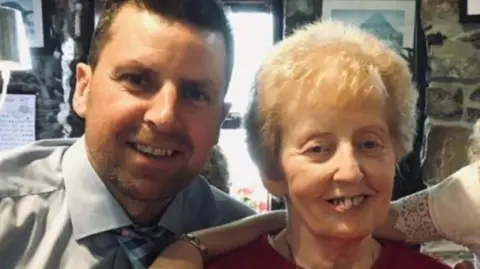 Watson family
"She can't stand, she can't walk, she can't even sit up," Watson said.
Because of her condition, they were unable to benefit from a rule in which a person can avoid inheritance tax by signing over their property seven years before death.
"My mother can't legally sign the farm over to anybody, and if she did she would need to live seven years to avoid the next generation paying inheritance tax," Watson explained.
He is calling for a "morality clause" to be inserted into the legislation to prevent families like theirs having to sell farms.
"For people like my mother who are old and have a life-limiting illness and do not have seven years left to live, there should be an allowance...to get businesses signed over," he said.
'The consumer will feel the pain'
Watson argued protecting family farms would also help to defend the security of food supply.
He warned that if farming becomes unprofitable "the consumer will feel the pain because food prices will go through the roof and we'll be relying on imports".
He was also hoping to bequeath the farm to his teenage daughter, who is considering a degree in agriculture.
But the farmer now worries his daughter would face the same large tax bill again on his death.
"The farm would be down to less than half in that time - it could happen in six months, it could happen in six years."
Higher land values
 Getty Images
Analysis by the Department of Agriculture, Environment and Rural Affairs (Daera) warns that any increase in land values could "significantly" add to the 4,500 local farms which are still likely to be liable.
Although allowances can transfer between spouses, almost a third of farmers in Northern Ireland are not married or do not have a civil partner, including 17% of larger farms – which will be those impacted by inheritance tax.
Agricultural land values in Northern Ireland have hit record highs in recent years.
That meant on land value alone, about half of all farmers in Northern Ireland were likely to face an inheritance tax bill under the original proposal.
The latest analysis presumes an average value per acre of £21,000.
On that basis, the figures from the department suggest farms with 48 hectares (118.6 acres) or more of land would exceed the £2.5m threshold.
The Daera committee chair, Ulster Unionist Robbie Butler, said land prices in Northern Ireland may already be higher than assumed for the analysis.
"If that is the case, that obviously skews the figure – what are they talking about, 17.5% of farms and 48% of land? It's going to be bigger than that.
"And as machinery prices, animal prices, all of those things rise, this is not a fixed item."
The Sinn Féin deputy chair of the committee, Declan McAleer, said tax planning for farmers remained challenging, particularly for elderly farmers.
"There's also an issue where there's no spouse or civil partners involved as well for passing on."