Hamas holds vote to choose new interim leader, source tells BBC

 Reuters
Hamas is holding an election for a new interim leader, a senior Palestinian official familiar with the armed group's affairs has told the BBC.
Voting is taking place across Gaza, the occupied West Bank and among Hamas's members elsewhere.
The outcome may signal which direction the movement intends to take - particularly as the US and other mediators discuss post-war governance of Gaza, reconstruction efforts and the future status of armed groups there.
The elections come after most of Hamas's senior leadership were killed in Israeli strikes following the group's 7 October 2023 attacks on Israel, in which about 1,200 people were killed and 251 others taken hostage.
People in Gaza have already cast their votes in secret, according to the source, but it is unclear whether the process has concluded elsewhere. When announced, the new leader will hold office for a year.
Hamas governs the Gaza Strip and in recent years has had growing support in the West Bank, though its activities there are heavily constrained by the Israeli military and Palestinian Authority security forces.
A US-backed ceasefire in Gaza came into effect in October, and negotiations continue over the deal's later phases.
Under the proposed terms of the US plan, Hamas would have no role in the future governance of the territory. Governance would eventually be handed over to the Palestinian Authority, which administers parts of the West Bank, once it has undergone reforms.
Yahya Sinwar, the overall head of Hamas, was killed by Israeli forces in Gaza in October 2024, and its political leader, Ismail Haniyeh, was killed in an Israeli attack in Iran in July that year. Hamas's military chief Mohammed Deif was also killed that July, in an Israeli air strike on Gaza.
The position of overall head of Hamas has remained vacant since the deaths of Haniyeh and Sinwar, with the movement being led by an interim committee headed by Qatar-based Mohammad Darwish after the latter was killed.
Under the movement's rules, the head of Hamas is chosen by an electoral college of around 86 members drawn from the General Shura Council, Hamas's top decision-making body representing Gaza, the West Bank, Palestinian prisoners in Israel, and officials based abroad.
According to the official, the race is primarily between:
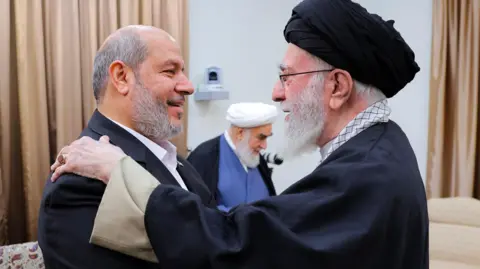
- Khalil al-Hayya, who leads Hamas in Gaza and is widely seen as aligned with Sinwar and Haniyeh
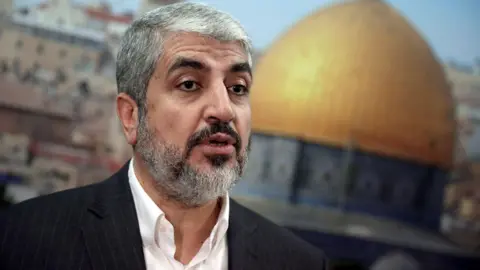
- Khaled Meshaal, the head of Hamas abroad and one of the movement's veteran figures, who previously served as its overall leader for nearly two decades
Meshaal is currently thought to reside in Doha, Qatar.
Other internal discussions have included additional names, but no formal shortlist has been announced.
Impact of war
The war that followed Hamas's 7 October attack has had a deep impact on the movement's internal politics.Israeli strikes have killed senior Hamas figures and significantly diminished the group's military and political structures, weakening the influence of its Gaza-based leadership.
More than 72,000 people have been killed in Gaza, the Hamas-run health ministry says, though it does not distinguish between civilians and fighters.
For years, Hamas has been shaped by a persistent internal rivalry between two broad currents.
One, often described as aligned with the Muslim Brotherhood, and represented by Meshaal and parts of the external leadership, is viewed by observers as more pragmatic and less ideologically rigid.
The other was seen as closer to Iran, a vital Hamas ally that supplies financial backing and weaponry, and was represented most prominently by Sinwar and leaders inside Gaza.
In 2017, when Haniyeh became head of the political bureau and Sinwar assumed leadership inside Gaza, decision-making shifted heavily towards the territory.
The recent war, however, appears to have reopened space for figures from the movement's so-called "old guard", traditionally linked to Meshaal.
 Getty Images
Under Hamas's internal regulations, its political leadership is composed of 18 members: six representing Gaza, six representing the West Bank and prisoners, and six representing Hamas abroad.
Figures associated with the "old guard" appear to be regaining more prominence after years of Gaza-dominated decision making, according to officials familiar with the discussions.
With Gaza devastated by years of conflict and its political landscape in flux, the selection of a new leaderis seen as a critical step in determining how Hamas navigates mounting internal and external pressures in the year ahead.