Pakistan's push in Iran war diplomacy - is India sidelined?

 AFP via Getty Images
The chatter in Delhi is unmistakable: as Pakistan positions itself as an intermediary in the US-Iran crisis, is India being sidelined?
Islamabad has moved with unusual agility, casting itself as an intermediary between Washington and Tehran.
Last week, it reportedly relayed a 15-point US peace plan to Iran and offered to host talks - an offer Tehran rejected. This week, Pakistan took the lead again, with its foreign minister flying to Beijing to seek Chinese backing for a five-point peace plan to end the conflict.
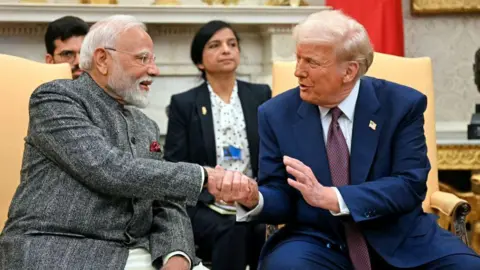
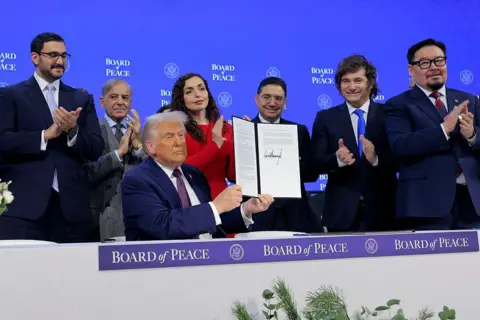
For India, Pakistan's larger neighbour and arch rival, the optics are awkward. The unease is sharpened by a more uneven phase in India's ties with the US, even as Pakistan appears to be rebuilding channels with President Donald Trump.
That, in turn, has sparked a familiar divide within India's strategic community.
Some opposition parties and analysts argue that Delhi, with its own cross-cutting ties in the region, should at least have explored a mediatory role - lest it appear absent at a moment of geopolitical flux.
The opposition Congress party has attacked the government, calling it an "embarrassment" for Indian diplomacy after reports of Pakistan being tapped as a mediator.
"By being more agile and aggressive in the 'war of narratives', Pakistan has often outmanoeuvred India diplomatically," strategic affairs expert Brahma Chellaney wrote on X.
 Getty Images
Others see little value in such visibility for its own sake, cautioning that mediation without leverage or invitation can backfire. They believe India's interests are better served by quiet diplomacy and strategic distance.
That view finds echo in the government. In an all-party meeting last week, Indian External Affairs Minister S Jaishankar reportedly dismissed Pakistan's role as "dalali" (brokerage), noting it has played such a part since 1981, including in US-Taliban talks.
"We don't run around asking countries what kind of brokerage we can do," he is reported to have said.
But for some analysts, the intensity of the debate in Delhi says as much about perception as policy.
At its core, argues Happymon Jacob of Shiv Nadar University, the issue is not strategy so much as psychology.
"The response in India has been one of competitive anxiety: if Pakistan can, why not us!," he noted in an op-edit.
"At best, that is a fear of missing out. At worst, it's jealousy of a smaller neighbour attracting the kind of attention some in our strategic community believe India deserves. But neither the fear of missing out nor jealousy is a sound basis for good foreign policy."
Michael Kugelman, a senior fellow for South Asia at the Atlantic Council, also pushes back on the "zero-sum approach of India-Pakistan rivalry", arguing India was never really in the running to mediate and is unlikely to step in without a formal invite.
Pakistan's diplomatic burst, he suggests, may be short-lived and limited to a go-between role, with mistrust making direct US-Iran talks unlikely anytime soon. As he puts it, "this misrepresents the state of play".
If India was never really in the mediation race, the more relevant question, many say, is what role it should play instead.
For Ajay Bisaria, former Indian high commissioner to Pakistan, the answer lies in recognising both India's strengths and its constraints.
 AFP via Getty Images
While India has peacemaking potential, given its stakes and relationships across the region, it is not a tool that can be "directed" by Washington, he says.
"That makes India unsuitable for this role," Bisaria adds, arguing that Delhi should pursue a more substantive peace-promoting role - but "not in the manner of Pakistan and not at the current stage".
Between these positions lies a more pragmatic middle ground: India need not insert itself into high-risk mediation, but it cannot afford to be passive either.
"This war has damaged India's interests in almost every practical sense... The deeper question is whether India is willing to say so with sufficient clarity," former Indian foreign secretary Nirupama Rao wrote on X.
At home, that restraint has drawn criticism. Opposition leaders have accused the Narendra Modi government of a conspicuous silence on Israel's actions in Gaza and strikes on Iran, arguing it signals an increasingly pro-Israel tilt and a break from India's traditional diplomatic balance.
"Restraint has its place. Calibration is necessary. But when fundamental questions arise - about sovereignty, about the limits of force, about the protection of civilians - India cannot afford to be silent," Rao says.
Bisaria believes India also needs to think beyond headline diplomacy.
India is a stakeholder in both peace and conflict, he says - wars disrupt its central objective of sustained economic growth.
 Getty Images
Rather than chasing a mediatory role, he adds, Delhi should invest in the less visible mechanics of peacemaking, building specialist capacity to handle "the nuts and bolts" - from hostage swaps and back-channel military contacts to negotiating safe passage through chokepoints like the Strait of Hormuz - in the long run.
Set against this debate about India's role is a parallel question: why has Washington turned to Islamabad at all?
Part of the answer lies in geography and networks.
As Ejaz Haider, a Lahore-based defence analyst, says, Pakistan is "the only country in the Muslim bloc" that maintains working ties with both Iran and the Gulf monarchies - giving it a rare ability to shuttle messages across a fractured region.
More consequential is the harder edge of Pakistan's leverage.
Umer Farooq, an Islamabad-based analyst and a former correspondent of Jane's Defence Weekly, argues Pakistan's diplomatic relevance rests on its security role in the Gulf.
Saudi Arabia and its neighbours, ringed by Iranian-backed militias - from Yemen to Iraq and Lebanon - see Pakistani land forces as a credible buffer, Farooq says.
"Our diplomatic importance is based on this leverage," he says - offering not just access, but a form of coercive reassurance that India lacks in this theatre.
That mix of access and leverage, however, is only part of the story.
Avinash Paliwal, who teaches politics and international studies at SOAS University of London, says Pakistan's mediation push reflects hard compulsion, not diplomatic theatre.
 AFP via Getty Images
"Unlike India, Pakistan does not have the luxury to sit this war out. If it escalates, Pakistan will be forced to enter the war on Saudi Arabia's side. The true choice Islamabad faces, then, is to either succeed at de-escalation or join a costly war," he says.
Nor does the oft-cited lack of leverage in Iran, the US or Israel invalidate the effort, according to Paliwal.
"No country has such leverage… India included," he says.
"Even if Islamabad fails to muster a ceasefire, these efforts have buttressed its credibility as a sincere player with 'skin in the game'. Pakistan is sending a signal to all those countries witnessing this war with horror that it is willing to risk its limited equities to prevent escalation."
It is precisely this signalling - and the visibility that comes with it - that tends to raise hackles in Delhi.
Expectations of India's global role have been elevated in recent years, both by its growing economic weight and by official rhetoric projecting it as a leading voice on the world stage.
As Modi's government has framed India's rise in expansive terms, projecting it as a leading voice for the Global South and a bridge across geopolitical divides, the temptation to be present in every global crisis has grown.
But that ambition, Jacob says, needs tempering. "India has demonstrated leadership on climate and energy; it need not - and cannot - do everything."
"The real challenge is managing the gap between capability and expectation - and having the wisdom to know what to do, and just as importantly, what not to."