Why are measles cases rising in the UK?

 Getty Images
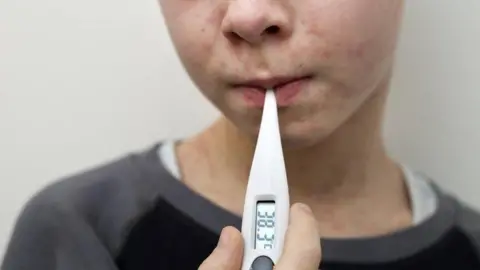
An outbreak of measles among some schools in north London has prompted health chiefs to remind parents to vaccinate their children against the fast-spreading disease.
Due to rising cases among unvaccinated, young children, the UK has lost its measles elimination status - given to it by the World Health Organization (WHO).
Cases of measles have also been rising in Europe and around the world, with the increase blamed in part on poor uptake of the MMRV (measles, mumps, rubella and chicken pox) vaccine.
What is measles and what are the symptoms?
Measles is a highly contagious disease which is spread by coughs and sneezes or by touching things that someone with measles has coughed or sneezed on.
- high fever
- sore, red and watery eyes
- coughing
- sneezing
Small white spots may appear inside the mouth.
A blotchy red or brown rash usually appears after a few days, typically behind the ears and on the face, before spreading.
The rash may be harder to detect on brown and black skin.
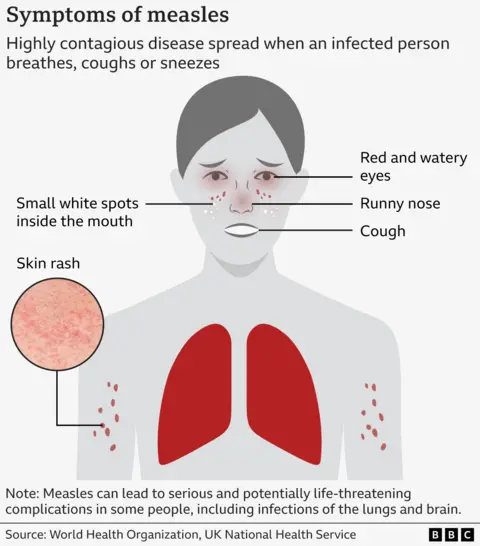
Measles normally clears up within seven to 10 days. However, it can lead to pneumonia, meningitis, blindness and seizures.
Around 1 in 15 people with measles can become seriously unwell
Babies and young children, pregnant women and those with a weakened immune system are at increased risk.
Measles can be fatal, but this is rare.
Between 2000-2025, 36 children and adults died in England and Wales from measles or related infections.
There were two measles-related death in 2025, including a child who died at Liverpool's Alder Hey Children's Hospital after contracting the disease.
There were five deaths in 2024, four adults and one child.
Can adults get measles and can you catch it twice?
You can catch measles at any age. It is possible - but highly unlikely - to catch it twice as the body builds up immunity to the disease after being infected.
Getting it while pregnant can lead to stillbirth, miscarriage or babies being born small.
The NHS advises adults to ensure they have had both doses of the MMR vaccine before starting a family.
How common is measles in the UK?
Figures published on 15 January 2026 showed there had been almost 1,000 confirmed measles cases in England since 1 January 2025.
The majority (655 of 957, or 68%) of cases were in children aged 10 years and under, while 25% (242) affected those aged 15 and above.
Case numbers began to climb in April 2025 with outbreaks in London and the North West, but stabilised in July.
That followed 2,911 confirmed cases in England in 2024, the highest annual total in more than a decade.
In 2024 an initial outbreak in Birmingham was then overtaken by a surge of cases in London.
Across the rest of the UK, there were:
- Scotland: 28 confirmed measles cases in 2025 (24 in 2024)
- Northern Ireland: four in 2025, (22 in 2024)
- Wales: two in 2025 (20 in 2024)
The WHO removed the UK's measles elimination status after the 2024 data.
The UK was first declared measles-free in 2017, but lost the status two years later, before reclaiming it after the spread of the virus was almost halted completely in 2021, largely due to social distancing during the Covid pandemic.
How common is measles around the world?
According to the WHO, the total number of global measles cases has fallen sharply, from an estimated 38 million in 2000 to 11 million in 2024.
Deaths have dropped even more steeply: from around 777,000 in 2000 to 95,000 in 2024, the lowest annual estimate in decades.
However measles cases have increased in some specific parts of the world.
In March 2025, the WHO and Unicef warned that the number of cases in the European region had doubled to 127,350 in 2024 - the highest level seen in 25 years.
The number of cases fell back during 2025 to 33,998, partly because the virus spread so far through under-vaccinated communities during 2024.
Both the US and Canada have also seen a significant jump in cases.
According to the Centers for Disease Control and Prevention (CDC), the US had 2,255 confirmed measles cases in 2025, reported across 44 states and in New York City. There were three confirmed deaths.
That compares to 285 confirmed cases in 2024, and 59 cases in 2023.
Of the 2,255 cases seen in 2025, 577 (26%) involved children under 5, and 93% of those infected were either unvaccinated or their status was unknown.
Experts warn the US risks losing its measles elimination status if cases continue to grow during 2026.
Canada lost its status in November 2025.
After recording just 16 cases between 2020 and 2023, the country had more than 100 in 2024 and more than 5,000 in 2025.
Health officials said the majority of the 2025 cases were recorded in "under-vaccinated communities" in the provinces of Ontario and Alberta.
Why are measles cases rising?
 EPA
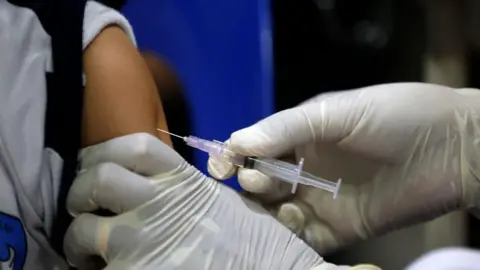
EPAThe WHO says vaccination rates have fallen across the globe, leaving millions of children at risk.
The percentage of young primary school children in the UK who receive both recommended MMR doses is also below WHO targets.
UKHSA figures for 2024-25 show that 84.4% of children across the UK had received two MMR doses by their fifth birthday. The recommended figure is 95%.
The equivalent figure was 84.5% in 2023-24, down from a high of 88.8% reached in 2014-15.
Child health experts say some people underestimate the seriousness of measles because the success of the vaccine programme meant it had largely been eradicated, with fewer people aware of the danger it can pose.
In addition, many routine health appointments were missed during the Covid pandemic.
Other experts say it needs to be easier for people to get access to vaccines - for example by making them available in supermarkets.
They also say it is important to build trust in communities where vaccine rates are low.
There are still some people who wrongly believe the MMR jab is linked to autism. Researcher Andrew Wakefield falsely claimed the two were connected in 1998.
His work was later dismissed, and Wakefield was struck off by the General Medical Council in 2010, but fears about the jab persisted despite the link between autism and MMR being completely disproven.
 Reuters
The increase in measles in the US follows a sharp rise in anti-vaccine sentiment.
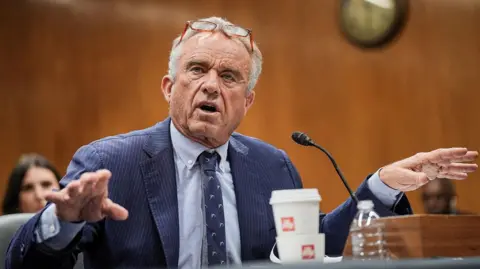
The current Health Secretary Robert F Kennedy Jr previously spread misinformation about childhood vaccinations and minimised the danger of measles. He also promoted unproven treatments like cod liver oil.
As cases grew in 2025, he backtracked on the MMR vaccine, writing in a post on X that it was "the most effective way to prevent the spread of measles".
How can I get vaccinated against measles in the UK?
The first measles vaccinations were introduced in the UK in 1968. The two-dose MMR vaccine started in 1996 and is very effective.
After both MMR doses, 99% of people are protected against measles and rubella and 88% are protected against mumps.
Most MMR side effects are mild but the injection site can be red, sore and swollen for a few days.
Babies and young children may develop a high temperature for up to 72 hours.
Some people get a mild rash and aching joints.
Serious reactions are rare.
There is no evidence linking the MMR vaccine with autism.
On 1 January 2026, the MMR was replaced by the measles, mumps, rubella and varicella (MMRV) vaccine, which adds protection against chickenpox.
Children born on after 1 January 2025 will be offered their first dose of MMRV at 12 months old and their second dose at 18 months old. Some other young children will also be offered it.
Older children and adults born on or before 31 December 2019 who have not been vaccinated against measles, mumps and rubella can still get a free MMR jab at any point via their GP.