Orbital space race heats up in Arctic north

 SSC
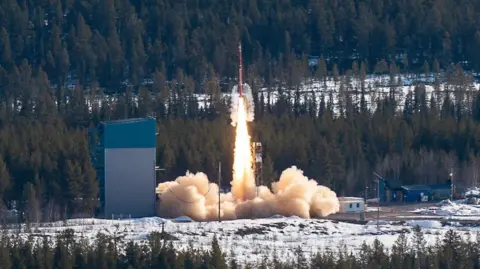
SSCIt's 04:00 on a snow-covered hill in Swedish Lapland, 120 miles (200km) north of the Arctic Circle.
A countdown echoes from a Tannoy: "Three, two, one."
A rocket blasts off from a launcher, shooting into the sky and illuminating the darkened valley below.
Moments later, a second rocket motor kicks in with a deafening roar.
We are visiting the Esrange Space Centre near the city of Kiruna, run by the Swedish Space Corporation (SSC Space), where more than 600 rockets have launched since the 1960s, mostly sub-orbital rockets used for scientific research, or to test-run space flights.
Built by scientists from the German Aerospace Centre Mapheus, the rocket I saw blast off, flew for 14 minutes, leaving the atmosphere and reaching an altitude of almost 260km.
"It was a good flight, we're really relieved," beamed campaign manager Thomas Voigtmann.
This rocket was on a quest for several minutes of valuable micro-gravity or weightlessness, carrying experiments that will help researchers study biological cells, materials and other processes.
However, Esrange has also emerged as a player in a Europe-wide race to deliver orbital rocket launches.
"Within a couple of years, we will have the first satellite launch from here," says SSC business development director Mattias Abrahamsson.
The new launchpad was inaugurated in early 2023, but has faced delays.
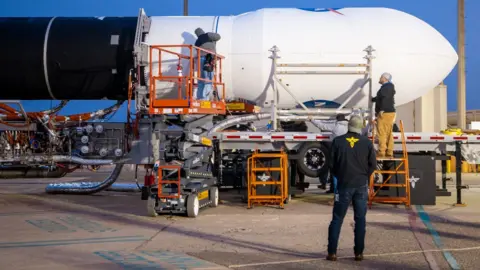
Two clients are preparing rockets to carry satellites into orbit from northern Sweden: South Korea's Perigee; and American company, Firefly, which achieved a lunar landing last year.
"We are now building out more infrastructure that is specific to Firefly's Alpha rocket," explains Katarina Lahti from SSC's orbital launch and rocket test division. That includes different fuelling, security and safety systems, she adds.
The signing of a technology safeguard agreement between the US and Sweden, allowing American companies to send advanced space technology to the Scandinavian country, is another major milestone, Lahti says.
Meanwhile, Esrange is hosting ground tests for Themis, Europe's first reusable rocket, as well as engine testing for German start-up Isar Aerospace.
 Firefly Aerospace/Trevor Mahlmann
Fuelled by a growing demand for internet connections, communications and mapping, the volume of satellites above Earth has skyrocketed, and is projected to reach half a million by the end of the 2030s, according to a recent report in Nature.
"There's around 10,000 satellites orbiting right now. The plan is to go to about 40-50,000 satellites in just some years," explains Abrahamsson, as he stands overlooking several large antennae.
That's drawing commercial companies into a segment once dominated by government agencies.
It's also spurred several spaceport projects across Europe - from the Azores in Portugal, to Norway's far north.
"This is a big market and there's room for all of us," says Lahti, who hopes SSC's 60-year rocket legacy will help it win orbital business, as well as its favourable northern location for delivering satellites into polar orbit, and stable weather conditions.
Elsewhere, the Atlantic Spaceport Consortium (ASC) operates on the Portuguese island of Santa Maria, while start-up EuroSpaceport hopes to launch orbital flight from a ship anchored in the North Sea, 50km off the Danish coast.
On Scotland's Shetland Islands, SaxaVord is the UK's first licensed vertical spaceport, and is working with a number of companies, including Germany's Rocket Factory Augsburg (RFA) and HyImpulse.
However, the sky-high ambitions of some competitors have already been brought back down to Earth.
Sir Richard Branson's Virgin Orbit was shuttered following a failed 2023 mission from Cornwall in southern England, and Scottish rocket manufacturer Orbex, which planned to launch its low-cost rocket from SaxaVord, said last week it was appointing administrators.
"Spaceports will be like seaports, and you will need multiple for the amount of traffic, but also for resilience," says Hermann Ludwig Moeller, director of the European Space Policy Institute.
"You will have winners and losers," he reckons. "It's not so much the rocket [technology]. It is really the market."
"There are two or three [spaceports] that you could imagine will succeed," he tells the BBC, adding he expects to see a successful European continental orbital launch "this year".
 ISAR
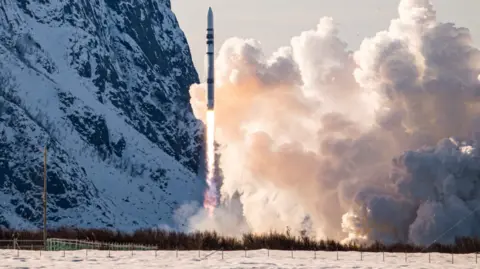
ISAROn a remote island 300 kilometres above the Arctic Circle, Norway's Andøya Spaceport, is now the frontrunner.
Isar Aerospace launched its 28-metre Spectrum rocket from there last year, but achieved just 30 seconds of flight before spectacularly crashing into the Norwegian Sea.
Now the Munich-based company is targeting another attempt this March which, if successful, will be a giant leap for Europe's commercial space ambitions.
"Our goal with this mission is to demonstrate real progress," says CEO and co-founder Daniel Metzler. "To achieve that, we will once again push our systems to their limits."
The world's changing geopolitical and security situation has made European leaders rethink their approach to space, with added urgency, and look to establish more autonomy.
SSC's Abrahamsson says it's strategically important to have orbital launch capabilities on Europe's shores, "We need to have the capacity in Europe to do it on our own."
It also "enables rapid deployment or replacement of critical systems if you have a crisis or a threat", Lahti suggests. "This also strengthens European defence capabilities."
Amid sanctions and the invasion of Ukraine, European missions haven't used Russia's Baikonur Cosmodrome in Kazakhstan for a decade.
 ESA/M. Pédoussaut
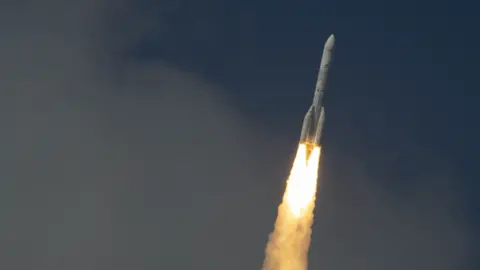
The European Space Agency's (ESA) facilities at Kourou in French Guiana, can handle about a dozen orbital launches a year, and ESA also relies on the US, which has several key launch sites, from NASA's Cape Canaveral to SpaceX's Starbase.
Kourou's position close to the equator on the South American continent has some launch advantages, but European-built rockets must be shipped thousands of kilometres then reassembled, adding to logistical challenges.
Ariane 6 - Europe's most powerful rocket yet - launched from there earlier this month, carrying satellites destined for Amazon's Leo constellation, a rival to Elon Musk's StarLink.
"There's a lot going on in space for internet connectivity," says Moeller, speaking to the BBC from French Guiana, where he'd just witnessed Ariane 6 lift off. "It is part of what I call the 'internet age' of space."
"It will be a competition between Amazon Leo and Starlink. You will also see Chinese developments, and maybe European developments eventually," he adds.
Of the 319 successful orbital launches in 2025, there were just seven from Europe (Kourou), compared to 189 from the US and 90 from China.
Europe has the "know-how" and "engineering skill", Moeller says. But while investment in the space sector has stepped up significantly, that's a fraction of what the US spends and it's still playing catch up.
Back at Esrange, Matias Abrahamsson says he isn't worried about the competition between other new European spaceports: "Every site is needed because there's that many satellites that need to be launched, and that many rockets that are being developed."