How shows like Bridgerton keep the lights on at England's stately homes

 Courtesy of Netflix
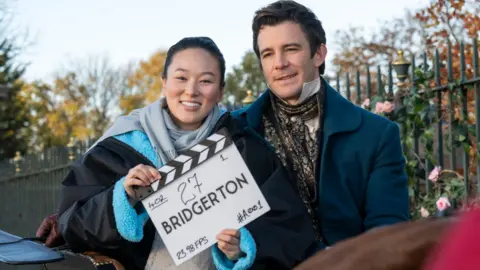
With new episodes of Bridgerton landing on Netflix, England's stately homes are once again in the spotlight.
Filming has become a lifeline for many of these historical estates, providing vital income, funding conservation and attracting new visitors.
The charity English Heritage manages 400 properties across the country, many of which have been used on screen, such as Ranger's House in Greenwich, south-east London, which doubles as the Bridgerton family home.
Christina Pascoe, commercial development lead at the charity, says the TV cash helps maintain "quite simply but very important" features.
"Like replacing drapes, carpets, stone masonry work - even something as simple as cleaning the windows on the front of Ranger's House," she says.
"That sounds like a really minor thing... but for us, that is really important because it is expensive to have that work done by a specialist."
 English Heritage
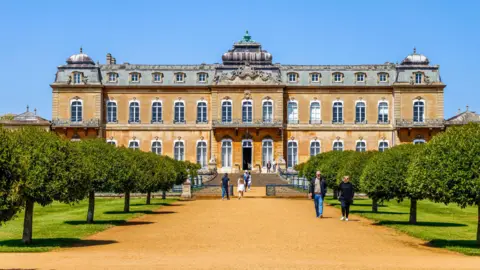
English Heritage says its most in-demand site is Wrest Park near Silsoe in Bedfordshire, which has featured in The Crown, Downton Abbey and was recently closed to the public for an Amazon Prime movie shoot.
Pascoe explains its interior "look remarkably like the state rooms inside Buckingham Palace" but are also largely unfurnished.
"That's very attractive because [the crew] don't have to decant the whole space before they start to load in their props."
 Courtesy of Netflix
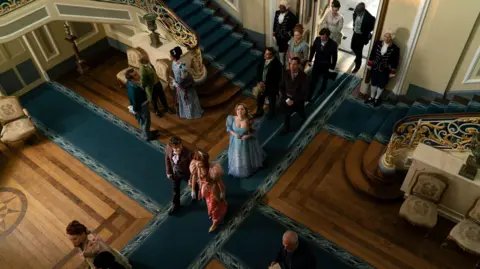
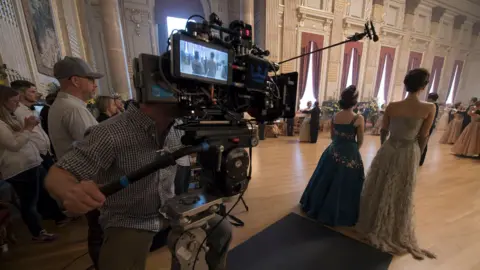
Tony Wood, a supervising location manager who has worked on Bridgerton, says what we see on screen is in stark contrast to the village of trucks, catering tents and thick black cables running through corridors on set.
"Filming is 150 strangers running around in shorts, trying to get a job done, running around with big metal boxes," says Wood.
He notes that the most attractive properties are those within 30 miles of London, as every pound spent on a crew's hotel bill is "money that you're not spending on the screen".
It may seem simpler to shoot at a studio, but Wood says you cannot fake the "real life" of a stately home.
"The cost of building four, five rooms that link together and [are] all as opulent and architecturally fantastic as a location would cost an awful lot of money.
"It's not just one room, you can see out of the window to the countryside, you can see the vastness of it all... you can't get that in a studio."
 Courtesy of Netflix
The National Trust, which runs more than 500 properties in England, Wales and Northern Ireland, says filming at their locations can start at a cost of about £6,000 a day.
Harvey Edgington, the charity's senior filming officer, says that figure could be higher if the property needs to close to the public.
"To do that in June and July will cost a lot more money than if they're trying to do it on a wet Wednesday in November."
 Courtesy of Netflix
Properties further from London are becoming more popular for crews as studios expand across the UK.
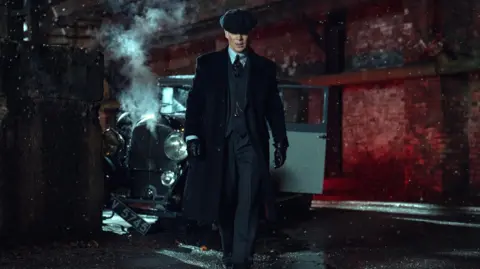
Recently crews were at Calke Abbey in Derbyshire to shoot The Immortal Man, the upcoming Peaky Blinders movie, the same location where scenes from the latest Highlander movie were shot - which stars Superman actor Henry Cavill.
Appearing in a high-profile project can boost a location's profile.
Harvey recalls that Antony House in Cornwall quadrupled its visitor figures the year after it featured in the 2010 Alice in Wonderland starring Johnny Depp.
 Stowe House
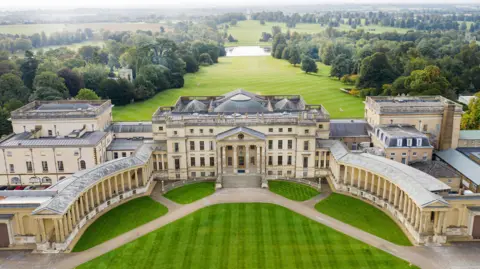
Stowe House is a Grade I listed estate near Buckingham.
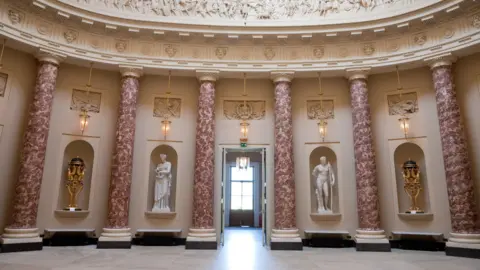
It featured in memorable ball scenes in the early episodes of Bridgerton but decades earlier was used by Steven Spielberg as a backdrop for a Nazi rally in Indiana Jones and the Last Crusade.
Because Stowe is a functioning independent school, filming is always confined to the holidays.
On one occasion, director Ridley Scott was due to film parts of 2023 epic Napoleon at the estate, but when the schedule slipped into term time, the visit was cancelled.
The producers still paid the fee.
 Stowe House
Susy Pullen, who looks after the commercial side of Stowe House, says: "Working in these historic and old spaces; nothing's very cheap.
"To do anything costs quite a lot of money, so we're always looking at how we can get income in."
During one production, crew members noticed "scruffy" doorways and paid to restore them so they would look best on film.
Meanwhile, Stowe House custodian Anna Makavoy makes sure crew members are not leaning against anything, or causing harm to the house.
Makavoy adds: "I may not even notice if I'm in the same room as a famous person because my eyes are on the prize, making sure they're not damaging anything."
 Ashridge House
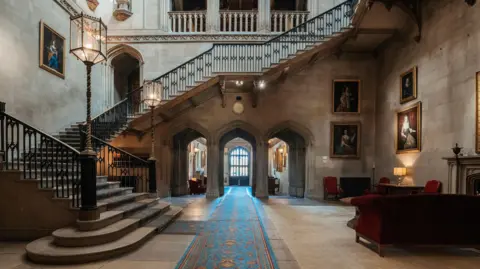
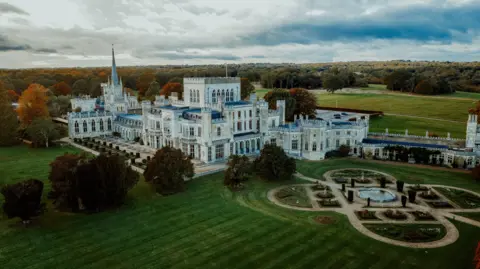
Ashridge House near Tring in Hertfordshire has a long history. Once a home of King Henry VIII, in the 19th Century it was transformed into a neo-gothic house by the Bridgewater family.
Harry Potter production designer Stuart Craig took physical moulds of the weathered limestone to create the brickwork of Hogwarts.
Managing director David Evans proudly beams: "You can look at freezes from the film and then compare them to our staircase and it's identical."
He says filming provides a "good chunk" of the estate's annual income.
"The filming revenue is really directly attributable to preserving the house and making sure that it's here for for generations to come."
 Ashridge House
Evans says filming is also vital for reaching a younger generation as it puts "Ashridge House on the map a little bit".
"It adds another angle and opens up a new audience for us that perhaps wouldn't have come to us before," he explains.
Follow Beds, Herts and Bucks news on BBC Sounds, Facebook, Instagram and X.