Six planets on show in celestial 'parade'

 getty
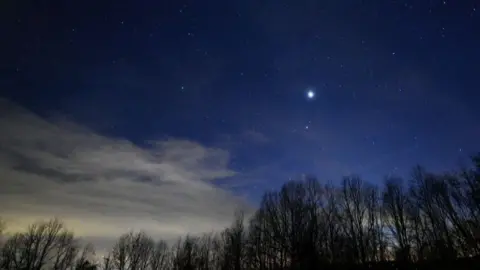
gettyStargazers are in for a cosmic treat this weekend weather permitting, as six planets appear together in the evening sky.
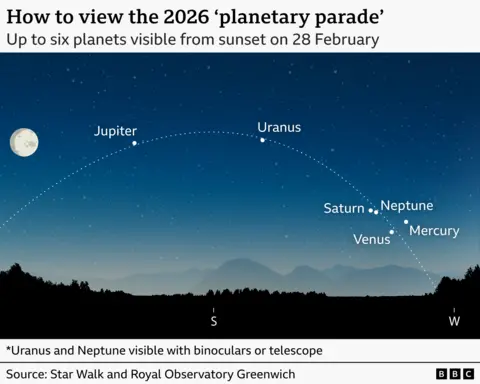
They should all be visible in the same part of the sky shortly after sunset, creating what is often called a planetary parade.
Mercury, Venus, Saturn and Jupiter should be visible to the naked eye but Uranus and Neptune will likely require binoculars or a telescope.
For viewers in the UK, the best time to see them will be on Sunday. To give yourself the best chance, head somewhere with a clear view of the western horizon.
What is a planetary parade and where should you look?
A planetary parade describes a moment when several planets appear to line up in the sky from the Earth's perspective.
Dr Becky Smethurst, Royal Astronomical Society Research Fellow at the University of Oxford and YouTuber explains that the planets "will be in a straight line, but it's a straight line on a curved sky … all the planets orbit in the same flat plane."
"If you think about taking a ball of pizza dough and setting it spinning above your head, it flattens out," she explained. "That's what happened to the gas cloud around the Sun that ended up forming the planets, and why they're all in the same flat plane."
"When we look up at the night sky, all the solar system objects take roughly the same path … they're not all lining up in a row in their orbits, they're just sort of on the same side of the solar system right now."
Just after sunset, Mercury, Venus, Saturn, and Neptune will appear low in the western sky, close to the horizon.
If you don't have access to binoculars or a telescope you might be able to attend a local astronomy society event to get a better look.
A viewing spot with the clearest view of the horizon is best, particularly to see Mercury and Venus, which will appear very low in the sky.
Higher in the sky, Uranus will be sitting in the constellation Taurus and won't set until around midnight giving skywatchers with the right equipment a better chance of tracking it down.
Jupiter will be the easiest of the six to find, shining brightly in the constellation Gemini and high enough to stay in view for much of the night, even from light-polluted towns and cities.
Seeing six planets gathered in the sky isn't an everyday event, but it's not as rare as you might think.
A full seven-planet parade is far less common. One appeared in February 2025, and it will be many years before all seven can be seen together like that again.
 Getty Images
According to the Star Walk app, the planets will appear most closely grouped on 28 February, though the exact date depends on your location.
The best viewing dates include 25 February in São Paulo, 28 February in Athens, New York, Mexico City and Tokyo, 1 March in Beijing, Berlin, London and Mumbai, and 2 March in Reykjavik.
"A planetary alignment like this can be particularly exciting as it gives you the opportunity to see various worlds during one evening," said Jess Lee, Royal Observatory Greenwich astronomer
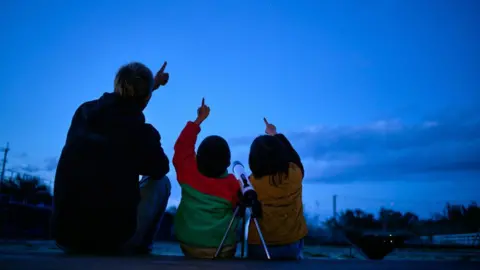
Smethurst emphasises that a great stargazing experience isn't just about what you look at, it's also about how you prepare.
One key step is giving your eyes time to adjust to faint starlight. She suggests starting indoors: "I like waiting sort of in the warm of my kitchen for five or 10 minutes in the dark before I step out," which allows for the "immediate reward of being able to spot even the faint things in the night sky straight away."
Comfort is crucial too. Instead of straining your neck, she suggests "laying down a picnic blanket on the ground or sitting in some sort of lounge chair" and making sure if the weather is cold where you are to "wrap up warm because if you're not moving, it gets very cold."
And finally, once your eyes are adjusted, avoid bright lights. If you're using a phone app to locate planets, enable the red light feature, because "the red light won't affect your night vision as much as a bright white light would."
And even if you miss the peak day of the parade, don't worry, because some of the planets will still be hanging around
"We will have lost Mercury in early March, but on 7 March and 8 March, Venus and Saturn are going to be very close together on the sky, making it easier to spot both of them," said Smethurst.
Will skies be clear enough to see it?
The weather over the weekend is currently looking rather mixed with variations in the amount of clear sky you might see in the coming nights.
For Friday night the clearest skies will be across Scotland and Northern Ireland while it'll be mostly cloudy elsewhere with some rain across parts of England and Wales.
Meanwhile, it'll be Saturday night where fortunes will be reversed with England and Wales having clear skies early in the night before turning cloudier from the west later.
On Sunday night any clear skies will be quite limited to eastern and southern parts of England.
You can check the latest weather where you via the BBC Weather app or online.
Additional reporting by BBC Weather presenter Simon King and Chris Fawkes