'We need more popular books like this in Manx'

 CULTURE VANNIN
Manx translations of books aimed at younger readers can significantly help people learning the language, it has been suggested.
Culture Vannin's language officer Ruth Keggin-Gell said there was a need for "easier texts" to allow both children and adults alike to improve their reading and comprehension skills.
She recommended material that would appeal to people across the age range, without being arduous to take in.
"Sometimes books that are in English which can be translated into Manx aren't always the easiest to necessarily read," she said. "There's a real need for more intentional, easy reading material which would, in turn, help adult learners."
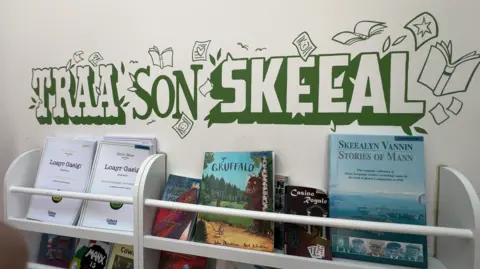
Adrian Cain, a teacher at the island's only Manx school – the Bunscoill Ghaelgagh in St John's – has translated some of the books that fit that bill.
He said some older texts, or complicated translations, could be a "drag" for those still learning the language because there was a need to constantly look up words.
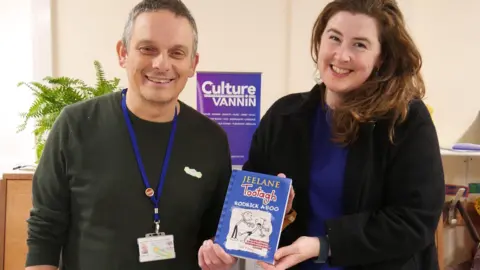
His latest project is a Manx version of the second book in the best-selling Diary of a Wimpy Kid series by Jeff Kinney - entitled in Manx Jeelane Tootagh – Rodrick Aboo.
The illustrated humorous series charts the challenges faced by Greg Heffley as he navigates middle-school life, recorded in the from of diary entries.
Inspired by his own son's enjoyment of the series, Adrian said while the books were for younger people, they could also "help learners who are adults and want to improve their Manx in a colloquial and not scary sort of way".
He said: "There is a need for material at a certain level which children can access... but it's not just children.
"There's quite a lot of literature in Manx, a lot of it you need to be a very good speaker of Manx.
"But sometimes you just don't want to plough through stuff, where you have to have a dictionary in case there are a few words you don't get."
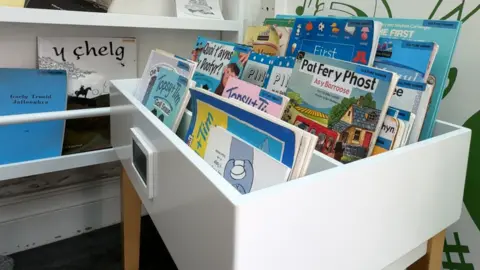
Keggin-Gell said while Culture Vannin supported the publication of some Manx books, it was a collaborative effort with other language organisations to bolster the resources available.
They included Yn Çheshaght Ghailckagh - the Manx Language Society – which has the biggest archive of material, and educational charity Mooinjer Veggey – Manx for "little people" – which receives funding from the Department of Education, Sport and Culture to produce resources for young children.
Keggin-Gell said it was "very important when you're coming to publish anything in the Manx language to think about how useful that will be as a resource".
She explained: "You can't just have a knee-jerk reaction, you know, you've got a finite amount of resources financially but also in terms of people's time.
"So actually it's about looking for a book or a piece of work that's going to bring the most value and help the most amount of people."
'Important conversation'
She said digital improvements meant not all resources needed to be published, with a growing number of translations available to read online or in a printable format.
She those in the Manx language community "talk to each other in terms of translations" to avoid doubling up.
"That's a really important conversation to have because there is a limited amount of people who can do these translations and it doesn't make sense to duplicate assets," she added.
Keggin-Gell said as well as the more academic works, it was very important to have popular texts like the Wimpy Kid series "that are seen, that are in the public view - like these New York Times bestsellers".
"Because why shouldn't they be in the minority languages as well?"
"If they're in English, why shouldn't you be able to access them in whatever language you speak to help you?"
Read more stories from the Isle of Man on the BBC, watch BBC North West Tonight on BBC iPlayer and follow BBC Isle of Man on Facebook and X.