Race against time to save athletics track

 John Pearce
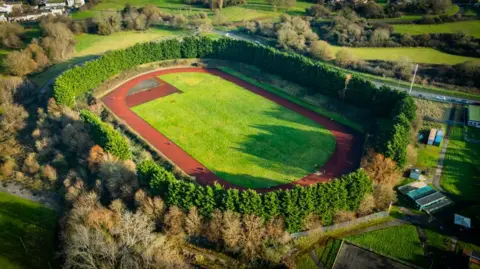
A once-thriving competitive athletics venue that cultivated several Olympic athletes is now a disused facility at the centre of a campaign to save it from redevelopment.
Whitchurch Athletics Track, in south Bristol, opened in 1973 as an eight-lane synthetic outdoor track owned and operated by Bristol City Council.
At the time, it was one of the most significant athletics sites in the area, serving as a hub for training, competition and community sport.
In its heyday, the track was home to Bristol & West Athletics Club. Eugene Hechavarria, a coach at the club, said the atmosphere back then was "thriving."
On Monday, 60 runners from clubs across Bristol attended an event at the site in an effort to demonstrate continued demand and community support.
 Drew Mclellan
Bristol City Council previously said it was aware of concerns raised by residents who fear that redevelopment could deprive the area of access to sporting facilities.
Like many parts of the country, Bristol is under pressure to build tens of thousands of homes in the coming years.
The government has said it wants to build 1.5 million homes in England by 2029 to tackle the housing shortage.
'Such a buzz'
Whitchurch regularly hosted club training sessions, athletics meets and school events, drawing participants from across the city.
"I remember when they had the Avon County Championships at Whitchurch," said Hechavarria.
"It was such a buzz. Many people, not only from Whitchurch, but the wider field from Bristol would go there and they would say 'wow it's like the Olympic stadium'."
Having eight lanes meant it could accommodate full-scale competitions, unlike some of the smaller tracks elsewhere in Bristol.
Hechavarria said it acted as a pipeline for young athletes in south Bristol and surrounding areas, many of whom would otherwise have had to travel miles to access structured training.
Olympic talent
Several Olympic athletes trained at the track, including Nick Rose, Emily Diamond, Kate Reid, and England rugby international Ellis Genge.
Bristol-born Olympian Vernon Samuels also used the facility during his early years, before going on to become one of Great Britain's leading triple jumpers.
Having grown up in a single-parent household on the other side of the city, Samuels recalled his own challenges in getting to the track.
"When you are challenged economically, it's a real barrier to find the money to be able to access facilities that are necessary for your development," he said.
"It's really important that we have sufficient facilities across the city that are strategically placed to mitigate that kind of economic cost."
 John Pearce
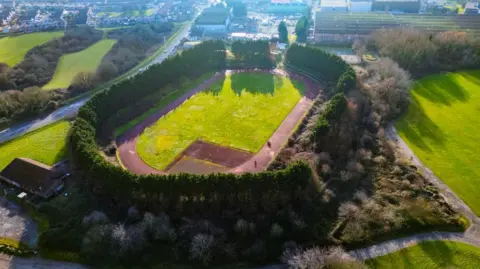
Due to its age, condition and declining use – and following public consultation with the community and key stakeholders – the Whitchurch track was decommissioned in 2010.
It was replaced by a six-lane athletics facility in Whitehall, at the offsite playing fields of the City Academy in central Bristol.
In 2016, the Whitchurch site was repurposed as part of the Bristol Family Cycling Centre.
Issue of convenience
John Pearce, founder of the campaign to regenerate the track, said accessibility to athletics remained a key issue for many Bristolians.
"For people that don't have a car and rely on public transport, Whitchurch is a lot more convenient [than Whitehall]," he said.
He added that the Whitehall facility was unavailable during the day as it is run by a school, while alternatives, such as one in Yate, are too far for many residents in south Bristol.
Jim Kyle, a para-athletics coach at Yate & District Athletic Club, said access to facilities for disabled people was almost "non-existent" in Bristol.
"We have specific cases where it is really problematic to get across the city," he said.
Mike, who has hemiplegia, a paralysis on one side of the body caused by a brain injury, said he often struggles to get from Hengrove to Yate for training.
"I've had incidents where the train gets cancelled so I can't go, [or] the train gets delayed so the taxi firm then charges me for waiting," he said.
What happens next?
The Whitchurch site, which sits within the wider Hengrove Park development area, is set to be transformed into 1,400 homes.
Campaigners have been working with the council to try to find what they describe as a "creative solution" – one that would allow housing to be built while retaining the athletics track.
The campaign group insists it is not opposed to housing but wants development to include adequate infrastructure.
Pearce said "a lot of people" in south Bristol feel that it is a part of the city that is "forgotten".
"By taking these facilities away, the council is discriminating against the young people of south Bristol," he said.
In a previous response, Bristol City Council said it understood "the concerns of residents" over the development decision" and pointed out that it had funded the track in Whitehall.
It said it remained "open to discussions with local residents" about how it can provide track facilities in south Bristol.
More than 6,000 people have signed a petition to save the track, leading to a debate by councillors at City Hall on 10 March.
Labour councillors have put forward a motion asking officers to conduct a financial study into the implications of redeveloping the land, with findings expected within four months.
Plans for the Hengrove Park development were originally approved in 2020.
While campaigners say they will continue fighting to save the much-loved facility, many fear that time may be running out.
Follow BBC Bristol on Facebook, X and Instagram. Send your story ideas to us on email or via WhatsApp on 0800 313 4630.