Clashes reported after Syria and Kurdish-led forces agree ceasefire

 Reuters
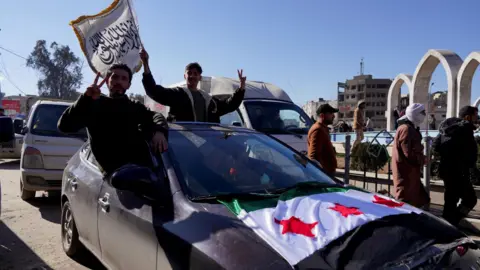
Syria's army and the Kurdish-led Syrian Democratic Forces (SDF) militia alliance have reported fresh clashes in the country's north-east, a day after a ceasefire deal brought much of the autonomous region under government control.
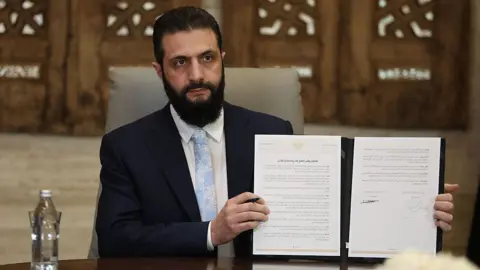
The 14-point agreement signed on Sunday, which will see the SDF withdraw from Raqqa and Deir al-Zour provinces and then be integrated into state institutions, was supposed to end almost two weeks of fighting.
President Ahmed al-Sharaa said he hoped it would allow Syria to "end its state of division and move to a state of unity and progress".
SDF commander Mazlum Abdi said the fighting had been "imposed on us" and that he had accepted the deal "to stop the bloodshed".
Abdi added that he would explain the terms after returning from Damascus, where he was expected to fly on Monday for talks on implementation.
It appears to be a major blow for the SDF, which had been reluctant to give up the autonomy it won for Syria's Kurdish minority when helping US-led forces defeat the jihadist group Islamic State (IS) during the country's 13-year civil war.
Sharaa has vowed to reunify Syria since he led the rebel offensive that overthrew Bashar al-Assad in December 2024, but the country remains deeply divided and has been rocked by several waves of deadly sectarian violence.
On Monday, Syrian government forces advanced deep into northern and eastern areas previously controlled by the SDF.
In the afternoon, the army announced that it had entered Shaddadi, in Hassakeh province, following what it alleged was the SDF's decision to release a number of detained IS members from the town's prison, according to state news agency Sana.
The army said it had contacted mediators and the SDF to discuss an organised handover of the prison, but that the SDF's leadership had "refused". Soldiers would not take the necessary measures to restore security and apprehend the escapees, it added.
The SDF said Shaddadi prison had "fallen outside the control of our forces" following repeated attacks by "factions affiliated with Damascus" since the early hours of the day. Dozens of SDF fighters had been killed as they tried "to prevent a serious security catastrophe", it added.
The SDF also reported that clashes were continuing around another prison holding IS members, al-Aqtan in Raqqa, where it said nine of its fighters had been killed.
Earlier, the army said three soldiers had been killed in two attacks by "terrorist groups" in the north-eastern Jazira region. It alleged that members of the Kurdistan Workers' Party (PKK), which fought for Kurdish autonomy in Turkey for decades and has a long-running association with the SDF, were attempting to disrupt the ceasefire and "remnants of the former regime".
The interior ministry also said its forces had begun deploying to Deir al-Zour province as "part of a broader security plan aimed at protecting civilians and property".
Dozens of government military vehicles were seen crossing a bridge to the eastern bank of the River Euphrates along with cars, lorries and motorcycles.
Safia Keddo, a 49-year-old teacher who was making her way on foot, told AFP news agency: "The past few years have been very difficult... Today we must turn the page".
"We want children to return to school without fear, and for electricity, water, and bread to be restored. We're not asking for a miracle; we just want stability and a normal life."
 Ali Haj Suleiman/Getty Images
On Sunday evening, the government and SDF agreed an immediate ceasefire on all fronts across the country, which the president hailed as a "victory for all Syrians".
"The Syrian state is unified and centralised in decision-making, and its institutions will enter all Syrian territories and manage all regional affairs," Sharaa told a news conference, according to Sana. "In areas with special characteristics, security personnel will be appointed from local residents."
He also urged Arab tribes living in Raqqa and Deir al-Zour to "maintain calm and allow the implementation of the agreement".
Before he left for Damascus, the SDF's commander said it had accepted a ceasefire agreement following an "intense war" in which many of its fighters had been killed or wounded since 6 January.
"This war was imposed on us. We wanted to prevent it, but unfortunately, because it was planned by many forces, it was imposed on us," Abdi said in a statement on Kurdish TV.
 EPA
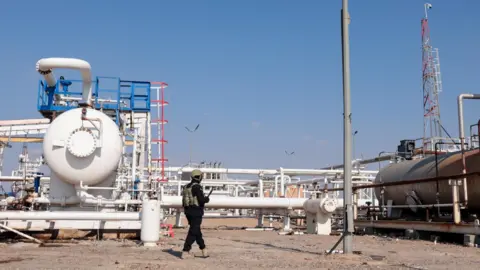
EPAAccording to Sana, the deal stipulates that the SDF will immediately hand over administrative and military control of Deir al-Zour and Raqqa provinces to the government, including all civilian institutions and facilities.
It says the government will take control of all border crossings, oil and gas fields, and prisons and camps where captured IS fighters and their family members and other affiliated civilians are detained.
It also says that the SDF's military and security forces will withdraw to Hassakeh province, where they will be fully integrated into the ministries of defence and interior "on an 'individual' basis" - not as separate Kurdish units, as the SDF had demanded.
The agreement also welcomes a decree issued by the president on Friday which recognised Syrian Kurds as an "integral and original" component of the Syrian people.
The decree affirmed their cultural, linguistic and civil rights, including designating Kurdish as a national language, which will allow its teaching at schools in Kurdish-majority areas, granting Syrian nationality to stateless Kurds, and declaring the Nowruz spring festival as a paid national holiday.
The agreement also commits the SDF to expelling all non-Syrian members of the PKK and reaffirms Syria's participation in the US-led coalition against IS.
US special envoy Tom Barrack said the deal represented "a pivotal inflection point, where former adversaries embrace partnership over division".
"The challenging work of finalising the details of a comprehensive integration agreement begins now, and the United States stands firmly behind this process at every stage - as we safeguard our vital national security interests in defeating [IS] remnants and advance President Trump's bold Middle East Peace Plan," he added.
The agreement followed months of stalled negotiations over a March 2025 integration deal, which both sides had accused each other of trying to derail.
Sharaa said last week it was unacceptable for a militia to control a quarter of the country and hold its main oil and commodities resources.