Neolithic trackway discovered by archaeologists

 Wessex Archaeology
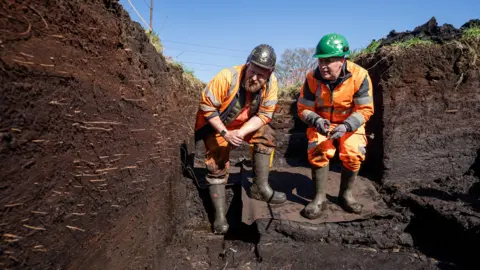
A 6,000-year-old trackway that dates back to the early Neolithic period has been discovered by archaeologists.
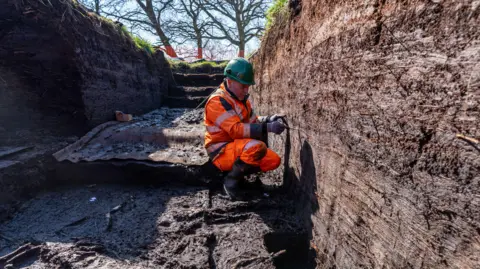
The Somerset Wildlife Trust and Species Survival Fund uncovered the ancient trackway underneath layers of peat at Honeygar Farm in Westhay during an excavation.
According to archaeologists, pollen, plant remains, insects and microscopic organisms, which reveal thousands of years of climate change and human activity, have been preserved under the peat.
The leader of the excavation said the discovery would add to the team's "knowledge of Somerset's complex ancient landscape".
The dig had been organised to investigate the condition of a prehistoric trackway and Historic England scheduled monument believed to be about 4,600-years-old.
However, the teams discovered a different trackway that was about 1,000 years older.
Trackways were used to cross the marshes that once covered the British Isles.
Archaeologists from Wessex Archaeology said the ancient trackway, which is made of birchwood poles and brushwood, dates back to between 3,770 and 3,640 BC.
 Wessex Archaeology
Honeygar Farm, which is located on the Somerset Levels and Moors, is one of the few areas in the UK that still holds deep lowland peat - which are waterlogged wetland ecosystems.
Bruce Eaton, who led the excavation, said: "Having grown up locally, I have always viewed the moors as a very special place.
"To be involved in a project which not only aims to restore valuable habitat but will also protect vulnerable archaeology has been a privilege."
Soil samples are due to be analysed by archaeologists to further understand the history of the landscape and to help ecologists recreate the wetland habitat that once thrived at the site.
Follow BBC Somerset on Facebook and X. Send your story ideas to us on email or via WhatsApp on 0800 313 4630.