How could assisted dying laws change in England and Wales?

 Getty Images
MSPs have rejected legalising assisted dying in Scotland.
In England and Wales, a different assisted dying bill was backed by MPs in November 2024, but the legislation has made slow progress in the House of Lords and supporters fear it may run out of time to become law.
In February, politicians in Jersey approved separate legislation giving terminally ill adults the right to end their life on the island.
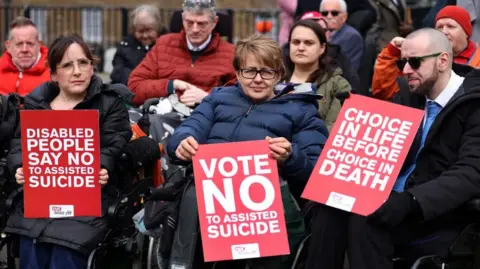
The various proposals have generated huge controversy, with passionate arguments for and against the proposals.
How would the assisted dying law have worked in Scotland?
The bill discussed by MSPs would only have applied in Scotland.
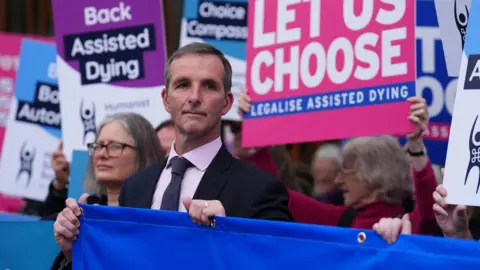
Liberal Democrat MSP Liam McArthur introduced his Assisted Dying for Terminally Ill Adults (Scotland) Bill on 27 March 2024.
MSPs were given a free vote, meaning they were not under pressure to vote a certain way by their parties.
 PA Media
On 13 May 2025, parliamentarians backed the "stage one vote" on the bill's general principles by 70 votes to 56, with one abstention.
The bill was then closely scrutinised and debated, with dozens of amendments made to the original proposals.
If passed the law would have applied to applicants who:
- were 18 or over (increased from 16 in the original bill)
- had been resident in Scotland for at least 12 months
- were registered with a GP in Scotland
- were terminally ill and expected to die within six months
- had the mental capacity to make the request
People suffering from a mental disorder which might affect their ability to make the request would not have been allowed to proceed.
On 17 March, the bill was defeated by 69 votes to 57.
McArthur said he would not reintroduce his legislation in the next parliament, adding that it was time to pass the baton to someone else.
What is the proposed law on assisted dying in England and Wales?
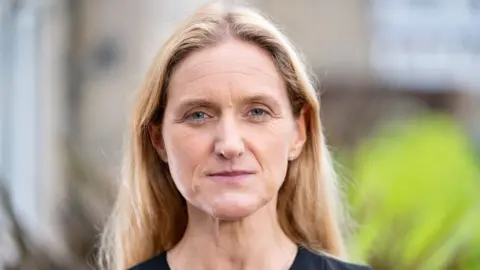
Backbench Labour MP Kim Leadbeater introduced the Terminally Ill Adults (End of Life) Bill into Parliament as a Private Members' Bill.
She argued that too many people "have a horrible, harrowing death" under the current system.
Her bill would allow terminally ill people to end their life if they:
- are over 18, live in England or Wales, and have been registered with a GP for at least 12 months
- have the mental capacity to make the choice and be deemed to have expressed a clear, settled and informed wish, free from coercion or pressure
- are expected to die within six months
- make two separate declarations, witnessed and signed, about their wish to die
- satisfy two independent doctors that they are eligible - with at least seven days between each assessment
 PA Media
Once an application has been approved, the patient would have to wait 14 days before proceeding.
A doctor would prepare the substance being used to end the patient's life, but the person would take it themselves.
The bill defines the coordinating doctor as a registered medical practitioner with "training, qualifications and experience" at a level to be specified by the health secretary. It does not say which drug would be used.
It would be illegal to coerce someone into declaring they want to end their life, with a possible 14-year prison sentence.
How has the UK assisted dying bill changed since it was first introduced?
The proposed legislation was first backed by MPs in the House of Commons in November 2024 by 330 votes to 275, a majority of 55.
It then faced months of further debate and detailed scrutiny by a committee of 23 MPs - 14 supporters - including Leadbeater - and nine opponents.
The committee suggested a number of changes to the original bill, including:
- confirming that a three-person panel including a senior legal figure, a psychiatrist and a social worker will oversee applications
- clarifying that doctors must set out palliative care options during initial discussions, and cannot initiate conversations about assisted dying with under-18s
- allowing health workers to opt out of the assisted dying process
- doubling the maximum time between the bill being passed and the law coming into effect from two years to four
- introducing a ban on advertising assisted dying services
As with the Scottish bill, MPs could vote freely throughout the process, meaning they did not have to follow a party line, and could decide whether or not to support the bill as a whole or particular amendments.
On 20 June 2025, 314 MPs voted in favour of the amended proposals and 291 voted against, a majority of 23.
The bill then moved to the House of Lords.
On 24 February 2026, Welsh politicians in the Senedd also backed the Leadbeater bill, with 28 members voting for it, 23 against and two abstentions.
Although the bill would automatically become law in Wales if it gets final approval in the UK Parliament, the Welsh government can set rules for assisted dying services.
If the Senedd had rejected the vote, it could have meant that assisted dying services were only available in Wales from private providers, not within the NHS.
Will assisted dying become law in England and Wales?
 Getty Images
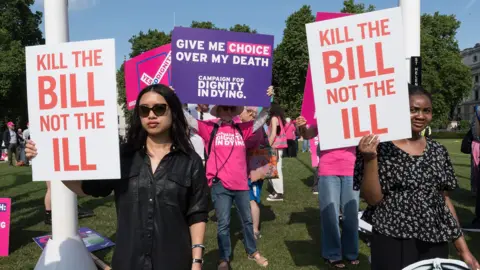
Despite the support from MPs in Westminster - and members in the Welsh Senedd - the bill will not necessarily become law.
Typically Private Members' Bills from backbench MPs fall unless they are passed by both the Commons and the Lords in one parliamentary session.
That means if the Leadbeater bill does not clear both Houses of Parliament before the end of the current session - expected in May - it will not become law.
Supporters fear the the bill has stalled in the House of Lords, where peers have proposed more than 1,200 amendments, including:
- restricting assisted deaths to cases where a person's suffering cannot be relieved by treatment
- changing how a person's capacity to request an assisted death is assessed
- lifting the minimum age to 25
- doubling the period of reflection between assessments
- requiring background checks on close relatives of those requesting an assisted death
Unlike in the House of Commons, peers generally debate every amendment tabled, which means the bill has progressed very slowly.
In January, former justice secretary Lord Falconer - who worked with Leadbeater on the bill - said it was "very, very difficult" to see how it could pass without a "fundamental change" to the House of Lords' approach.
He accused a minority of peers of deliberate time-wasting, and urged them to "stop all this smoke and mirrors and focus on making the bill better".
He suggested the government could use a rarely-used power called the Parliament Act to override peers' objections, given that elected MPs have already backed the legislation.
But former Downing Street adviser, and opponent of the bill, Nikki Da Costa said peers were "doing their best to patch the holes" in an "unsafe, deficient bill which has no electoral mandate".
She said Lord Falconer wanted the Lords "to stop doing work and just wave it through".
Separately Leadbeater told the BBC the government has a "duty" to help get the bill through. It should "respect the will of the democratically-elected members of Parliament," she added.
Around 150 MPs - including 100 from Labour - have warned Prime Minister Sir Keir Starmer that a failure to pass the legislation risks undermining trust in politics.
They want the government to guarantee that Parliament will be given enough time to come to a decision on the matter.
How will the law change in Jersey?
One of the Channel Islands, Jersey is part of the British Isles but sets its own laws.
The States Assembly, Jersey's elected parliament, first approved the principle of assisted dying in 2021.
It then backed more detailed proposals in May 2024 before the final legislation passed on 26 February 2026.
Those eligible are people with terminal illnesses causing unbearable suffering where they are expected to die within six months, or 12 months for those with neurodegenerative conditions such as Parkinson's and motor neurone disease (MND).
The bill needs to receive Royal Assent, or formal approval, in the UK before it takes effect. Once approved the first legal assisted deaths could happen as early as summer 2027.
Jersey's decision follows that of the Isle of Man - which is also part of the British Isles - and passed its own assisted dying bill in March 2025. The bill has not yet become law, after the UK Ministry of Justice raised concerns about the safeguards.
Why do supporters want to legalise assisted dying?
When the Leadbeater bill was first introduced, The Dignity in Dying campaign group said it provided the "most detailed, robust proposals" on the issue that "Westminster has ever considered".
Chief executive Sarah Wootton said that the fact that every year "up to 650 terminally ill people end their own lives, often in lonely and traumatic ways," provedthe need for reform.
Cancer patient Nathaniel Dye - who worked on the bill with Leadbeater - said it would allow people a death which was "as kind and compassionate as possible".
Broadcaster Dame Esther Rantzen, who has stage-four lung cancer, is another long-standing campaigner for change. "All I'm asking for is that we be given the dignity of choice," she said.
A YouGov poll in June 2025 - just before the second House of Commons vote - suggested that nearly three-quarters of Britons think assisted dying should be legal in principle, with 72% supporting Leadbeater's proposals.
BBC research suggests that family doctors in England are deeply divided on the issue. More than 5,000 GPs were sent a questionnaire asking whether the law should change. More than 1,000 GPs replied, of whom about 400 were in favour while 500 were opposed.
The British Medical Association, which represents doctors, and the Royal College of Nursing are neutral on the issue.
Who opposes assisted dying?
 EPA
EPAIndependent crossbench peer and former Paralympian Baroness Grey-Thompson is one of the bill's most vocal critics.
She is worried that disabled and other vulnerable people could be put under pressure to end their lives - and that doctors may struggle to make accurate six-month diagnoses.
She told the BBC that the bill was "badly written" and had significant gaps, and that many of the amendments put forward by peers in the House of Lords were designed to prevent coercion.
Actor and disability-rights activist Liz Carr, who made the BBC One documentary Better Off Dead?, also opposes the legislation.
"Some of us have very real fears based on our lived experience and based on what has happened in other countries where it's legal," she wrote on X.
Dr Gordon Macdonald, from campaign group Care Not Killing, said the bill ignored the wider "deep-seated problems in the UK's broken and patchy palliative care system".
What are assisted dying, assisted suicide and euthanasia?
However, assisted dying generally refers to a person who is terminally ill receiving lethal drugs from a medical practitioner, which they administer themselves.
Assisted suicide is intentionally helping another person to end their life, including someone who is not terminally ill. That could involve providing lethal medication or helping them travel to another jurisdiction to die.
Euthanasia is the act of deliberately ending a person's life to relieve suffering in which a lethal drug is administered by a physician. Patients may not be terminally ill.
There are two types: voluntary euthanasia, where a patient consents; and non-voluntary, where they cannot because, for example, they are in a coma.
Where is euthanasia or assisted dying legal around the world?
Switzerland has allowed assisted suicide since 1942. Its Dignitas facility accepts foreign patients, and between 1998 and 2024 the organisation says it helped 608 Britons to die.
In the US, 10 states and the Washington DC federal district allow "physician-assisted dying" where doctors can prescribe lethal drugs for self-administration.
In Canada,voluntary euthanasia or "medical aid in dying" (MAID) can be provided by a doctor or nurse practitioner, either in person or through the prescription of drugs for self-administration.
Assisted dying for terminally ill people is legal in Australia and New Zealand.
A number of other countries in Europe allow assisted dying, including Belgium, the Netherlands, Portugal and Spain.
In May 2025, MPs in France backed a bill which would give some people in the last stages of a terminal illness the right to assisted dying, but discussions about the scope of the legislation are continuing.
Update 3 January 2025: This piece has been updated to give further detail on the definition of a co-ordinating doctor.