Doctor warned attacker he would end up killing

 Nottinghamshire Police
A doctor warned a mentally ill man he "would end up killing someone" three years before he stabbed three people to death in a spate of attacks in Nottingham, an inquiry has heard.
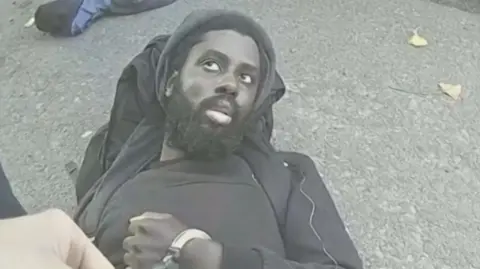
Valdo Calocane, who was diagnosed with paranoid schizophrenia, killed 19-year-old students Barnaby Webber and Grace O'Malley-Kumar, before killing grandfather Ian Coates and attacking three others on 13 June 2023.
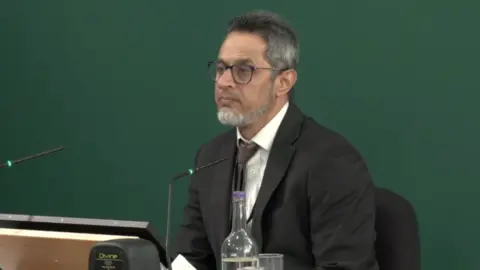
The Nottingham Inquiry heard consultant psychiatrist Dr Faizal Seedat told Calocane on a psychiatric ward in July 2020 he would end up killing someone, but he never believed he actually would.
On Thursday, Seedat said that comment was made in a "frank conversation" with Calocane about his mental illness.
The inquiry heard Seedat, from Nottinghamshire Healthcare NHS Foundation Trust, was Calocane's consultant during two admissions to Highbury Hospital in Nottingham in 2020.
Calocane - who is being referred to as VC throughout the inquiry - was first admitted to the Rowan 1 Ward on 25 May 2020, after attempting to break into a number of his neighbour's flats during psychotic episodes.
He was discharged back into the community on 17 June with a diagnosis of first episode psychosis, before his second admission less than a month later.
In notes from a ward review on 16 July, it was recorded that "Dr Seedat observed that there seems to be no insight or remorse and that the danger is that this will happen again and perhaps Valdo will end up killing someone".
 The Nottingham Inquiry
Seedat, Calocane's inpatient consultant at the time, told the inquiry: "That exchange arose having determined that VC was not demonstrating any remorse or any true understanding of what had happened.
"I wanted to have a very frank conversation, which is clearly documented.
"I painted a worst-case scenario in terms of what could happen if he continues with his behaviours."
He added he was trying to "shock" Calocane or highlight the implications of his illness.
Counsel to the inquiry Rachel Langdale KC said: "Did you think he could end up killing someone?"
"No I didn't," Seedat replied.
Asked why he said it, Seedat said: "When I said he would kill someone, this would be unintended.
"If he went and did the same thing, and somebody jumped out of the window, and maybe if they were on a higher floor, the consequences could be very different.
"And it was with that, that I made that comment."
 Supplied
The inquiry also heard Calocane's mother Celeste gave Seedat a transcript of text messages between Calocane and his brother Elias from early 2020, in which he expressed thoughts of violence.
In one message, Calocane told Elias he had been having thoughts of "red rum", before feeling better and the pair discussed their faith.
On Thursday, Seedat told the inquiry he was not aware "red rum" was a reference to murder.
"I made the assumption that it had some religious context. I did not know what else to make of it at the time.
"That's something I need to reflect on and pay more attention," he said.
Seedat said based on that assumption, he did not ask Calocane what it meant.
The inquiry also heard Seedat never shared those messages with other mental health professionals and instead provided a summary of them.
He said: "I carefully read all the messages and highlighted all the important messages within the email."
He did not share this in the multi-disciplinary meetings, which he said "in hindsight maybe I should have".
The inquiry heard Calocane attempted to contact Seedat on several occasions after he was no longer involved in his care.
On one occasion in November 2020, Seedat told Calocane he could not speak to him about his care as he was no longer involved, and advised him on who his care providers were.
Following that, Seedat contacted Calocane's then consultant, urging him to see the patient face to face.
'He's remembered you'
Calocane tried to contact Seedat again in August 2021 by visiting Highbury Hospital and instead spoke to other staff members. The inquiry heard he wanted to ask about voices he had been hearing during his time on the Rowan 1 Ward.
During a third admission to Highbury Hospital, Seedat was asked to speak to Calocane again, but was on leave at the time.
When he returned, he asked if it was still a "requirement" that he speak to Calocane, and was told that it was not.
Seedat told the inquiry he had his "own responsibilities".
"I don't see how my conversation will have changed anything. If he was not listening to them, why would he listen to me? I hadn't seen him for a long time," he said.
Langdale replied: "But he's remembered you. He's asked for you on a number of occasions by now."
Seedat added: "At that point I didn't feel that I should be getting involved in a patient that is not on my ward.
"I had my responsibilities, which is what I focused my duties on.
"If I was asked to do a joint assessment of the patient, that would be different."
The inquiry continues.
Listen to BBC Radio Nottingham on Sounds and follow BBC Nottingham on Facebook, on X, or on Instagram. Send your story ideas to eastmidsnews@bbc.co.uk or via WhatsApp on 0808 100 2210.