US lawmakers reject measure to block Trump from striking Iran

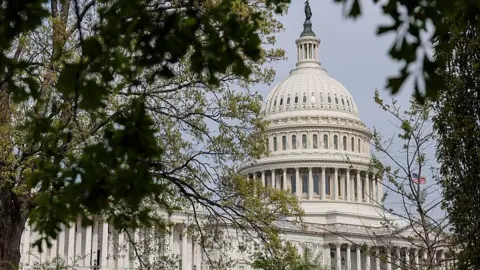 Getty Images
A Democratic-led measure to constrain US President Donald Trump's ability to wage war with Iran has once again failed in the House of Representatives, just a day after another resolution was blocked in the Senate.
The House resolution failed in a tight vote of 213-214. Democrats have vowed to maintain their efforts, saying they are an opportunity to get lawmakers' views on the record.
Most Republicans in both chambers opposed the recent resolutions - though some have signalled they could reconsider their positions if the war continues.
Trump has offered shifting timelines on the conflict's duration, most recently saying the war was "close to over".
On Thursday, he said fresh talks could resume as early as this weekend - and that Washington and Tehran were "very close" to making a deal.
Apparently confident that a fresh round of face-to-face talks was imminent, Trump said he was not sure an extension to the current ceasefire with Iran would be necessary.
Thursday's vote in the House considered a measure known as a concurrent resolution. If it had passed the lower chamber, it would have also required approval from the upper chamber, the Senate.
It would not have been subject to presidential veto, but could have been challenged in the courts. The US Supreme Court has previously found such measures to be "effectively... unconstitutional", according to a report last year by the Congressional Research Service.
In the House vote on Thursday, Representative Thomas Massie of Kentucky was the only Republican to side with Democrats in support of the measure, while Jared Golden of Maine was the lone Democrat to oppose it.
Warren Davidson of Ohio, who previously supported Democrats' effort in March, voted present, a form of abstention.
Democrat Gregory Meeks, of New York, who introduced the House resolution, told reporters after the vote that he would lobby Golden and others to support the legislation.
Meeks also indicated he would introduce another war powers resolution, continuing Democratic efforts to reassert congressional authority over military action.
Earlier attempts to pass two different types of resolution - each with a common aim of constraining Trump's powers - have failed in both chambers.
For example, on Wednesday, the Senate rejected what is known as a joint resolution, which would have been subject to a presidential veto, and was therefore seen largely as a symbolic vote.
Some Republicans have suggested their opposition to the resolution could shift if the conflict widens or persists.
Federal law requires congressional approval to continue military actions for more than 60 days. The US-Israel strikes began on 28 February.
The law setting the timelines for congressional approval, the War Powers Resolution in 1973, was passed by Congress to constrain the ability of then-President Richard Nixon to continue waging war in Vietnam.
Correction 17 April: A previous version of this story said the House resolution was not expected to overcome a presidential veto. It has been updated to clarify that, as a concurrent resolution, this particular measure would not have been subject to a veto