Is the US-TikTok deal a new reality for China's tech champions?

 Getty Images
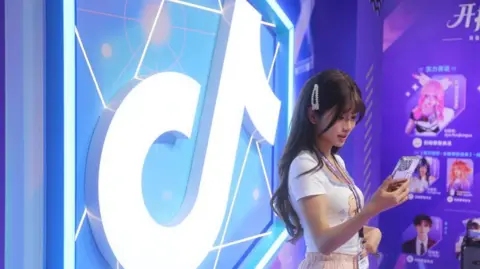
One in seven people in the world use TikTok. Yet for the company behind such a cultural phenomenon, the last few years have been a rollercoaster.
Concerns over the app first surfaced more than five years ago, prompting President Trump, in his first term, to sign an executive order aimed at removing TikTok from US stores.
Lawmakers were worried that the Chinese government could access user data of the 200 million Americans who use the app and possibly manipulate their feeds.
To address these concerns, TikTok's parent company ByteDance launched Project Texas – storing US user data on domestic servers run by American-ownedOracle. The company also moved its headquarters to Singapore and Los Angeles – in part to distance itself from its Chinese roots.
These were seen as significant concessions at the time. But still, in 2024 Congress passed a law threatening to ban the app outright, unless ByteDance transferred majority ownership and changed how TikTok operates in the US.
That deal has now closed with ByteDance signing an agreementto split the US app from the rest of its global business under a new consortium of companies that includes Oracle.
TikTok remains alive in a critical market, but the terms underline the compromises and limits that ByteDance - and perhaps other Chinese tech firms - may face as they try to expand globally.
How did we get here?
The US-China rivalry has seen Washington and Beijing crack down on each other's firms over national security concerns.
Yet in the the most recent trade war TikTok became "low hanging fruit" that China could offer in exchange for other important concessions, like American agricultural products.
The deal allows China to frame the outcome as a win - exporting tech on its own terms while gaining leverage in broader trade negotiations.
ByteDance will retain access to America's 200 million users and 7.5 million businesses, but it loses control over TikTok's algorithm and data.
Instead, the company will licence the algorithm to the new US entity, in a deal the Trump administration has valued at $14bn (£10bn).
"TikTok's power lies in its content graph - an algorithm that learns from thousands of user signals to deliver hyper‑relevant, highly addictive videos," said Kelsey Chickering, principal analyst at Forrester.
"With a US joint venture retraining that algorithm on domestic data, the experience will change... One thing's certain: TikTok in America won't be the same."
This shift could have knock on effects for advertisers and creators because of the changes.
Creators may see their engagement shrink especially because global virality will take a hit – previously content that took off in one region could become popular in the US organically. A US-only algorithm could weaken that, forcing brands to re-structure deals and perhaps having to pay more for US exposure.
TikTok's global revenue was estimated to be $20-26bn in 2024, roughly $10 billion of which came from the US with advertising accounting for a large share.
The changes will likely hurt TikTok's bottom line in the US, but ByteDance retains a 19.9% stake and therefore a share of the profits.
The retraining of the algorithm might also have consequences for ByteDance's technology development.
Running separate US and global algorithms, split workforces, and parallel governance adds engineering costs, slows innovation, and adds to the operational complexity, says Charlie Dai Principal Analyst in Technology Architecture & Delivery at Forrester.
The India experience
ByteDance has faced political and regulatory hurdles before.
The loss of India in 2020 - then TikTok's largest market, with 200 million users - was a far bigger setback than any potential disruption in the US, says Chris Stokel-Walker, author of TikTok Boom: The Inside Story of the World's Favourite App.
But, he says, even the India "setback" wasn't much of a setback.
"They've continued to show growth despite these challenges."
The struggles in both the US and India share a common thread: they were triggered by geopolitical tensions.
The India ban, however, was not aimed at TikTok alone - it targeted China more broadly, with roughly 200 apps blocked across the country. And while that ban opened the door for homegrown platforms to emerge, none have come close to matching TikTok's success.
 Getty Images
For some, the TikTok deal inevitably invites comparisons with Huawei – another Chinese tech champion whose global ambitions have been reshaped by geopolitics.
But there are stark differences, Huawei has been effectively locked out of Western markets after US sanctions cut off access to critical 5G infrastructure.
TikTok by contrast has been allowed to remain, albeit on restrictive terms for ByteDance.
Chris Stokel-Walker says this reflects a shift in how governments are responding to Chinese technology companies.
Some are excluded altogether; others are permitted to operate, but only within tightly defined political and regulatory limits.
A homegrown champion
While TikTok is being reshaped abroad, it has full control over Douyin – its Chinese sister app – which is hugely successful in its own right within China.
Douyin forms a core pillar of ByteDance's business – it is profitable, politically aligned and able to innovate because it is in charge of training the algorithm on data it has full access to.
But ByteDance is also hedging its bets for the future, investing in data centres, the cloud and Artificial Intelligence, underscoring the company's efforts to diversify beyond advertising-led consumer apps.
Chris Stokel-Walker argues that TikTok's predicament is no longer really about data security, but about who controls speech, culture and influence in the US.
Trump has never liked that China might be shaping American culture, he says.
The reality is that ByteDance will continue to operate TikTok in the US, but with distinct limitations. And this could spill over into other markets it plans to expand in with regulators looking for more control over Chinese technology.
Other experts have said the licensing aspect of the deal could form a template for how other Chinese tech companies expand globally in an environment of increasing mistrust of Beijing.