Spreading Islamist insurgency dominates Benin's presidential campaign

 AFP via Getty Images
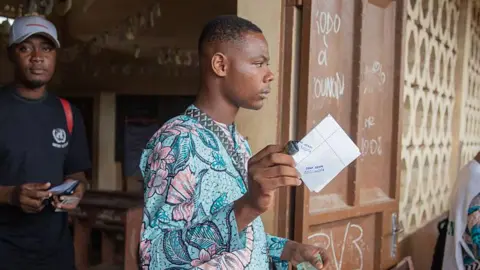
With growing fears that the militant Islamist insurgency that has engulfed large parts of West Africa is spreading, security has been dominating the campaign trail in Benin - a once-largely peaceful nation.
Sunday's presidential election comes about four months after outgoing President Patrice Talon survived a coup attempt, when Nigeria - the regional superpower - sent warplanes to bombard mutinous soldiers who had attempted to overthrow him.
Nigeria's intervention prevented Benin from going down the path of several other regional states - including Niger, Burkina Faso and Mali - where the military seized power in recent years as disillusionment grew over the failure of civilian governments to beat back the militants allied with al-Qaeda or the Islamic State (IS) group.
The threat posed to Benin by the insurgents was highlighted by the fact that an al-Qaeda affiliate, known by the initials JNIM, killed 15 soldiers last month in an attack on a military base in Kofouno, near the border with Niger.
It signalled the continuation of a trend witnessed last year, when 28 of Benin's soldiers were killed in January in an attack in the W National Park, which stretches into Niger and Burkina Faso, and another 54 three months later in the same park - making it the highest death toll suffered by the military at the hands of the insurgents.
W National Park and two adjacent ones, Pendjari and Arly, are the largest protected wilderness areas in West Africa, covering 1.7 million hectares.
The forests are dense and the region's porous borders make it easy for the militants to set up bases and to move across countries without being detected by the security forces.
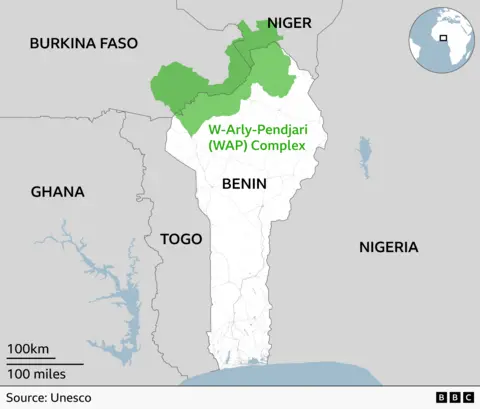
Violence monitoring group Acled says a sharp increase in attacks on the borderlands between Niger, Benin and Nigeria has also been recorded, turning remote transit corridors into active conflict zones.
As attacks intensified, at least 1,000 people were killed in these border areas in 2025, more than double the number from 2024, according to Acled.
The attacks have alarmed locals, with a school teacher telling the BBC: "We only want to work, to educate the youth, but it's becoming so difficult.
"We can't imagine our country becoming like Nigeria with Boko Haram's threats, which has killed so many people."
Expressing her fears, a mother-of-one said: "We are afraid to go to the fields.
"I don't know what to do, where to go. Anytime, those guys could come here and rape us, steal our stuff or kill us. It's not easy.
"Benin doesn't deserve this. The youth don't deserve this."
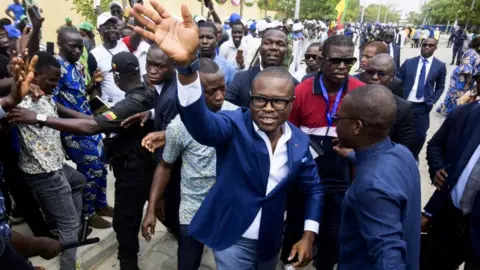
In an attempt to allay the fears of voters, the candidate of the ruling coalition, Finance Minister Romuald Wadagni, 49, launched his campaign in March in Kandi, a strategic trading hub near the border with Niger and Nigeria, and then travelled to other parts of the north, including Banikoara and Ségbana, two localities deeply affected by attacks.
 Reuters
In front of thousands of supporters, he pledged that the safety of every resident will be a "daily priority" if he takes office.
"We will not let any dark forces to come and take our lands or threaten citizens. We will make sure our whole country is under protection," he said.
While launching his campaign in the economic capital, Cotonou, his sole rival, Paul Hounkpè, 56, adopted a similar position, saying: "We must join forces with our neighbours without losing our dignity.
"Benin cannot act alone, close cooperation with Niger and Burkina Faso is essential."
Hounkpè's view is significant, as Benin's relationship with the two states plummeted following the coups there.
The West African regional bloc Ecowas - to which Benin belongs - suspended the membership of Niger, Burkina Faso and Mali, and - in the case of Niger - threatened military intervention to reinstall the civilian president.
The three states retaliated by forming their own group and have pivoted towards Russia, accusing Ecowas of being proxies of Western powers - a charge it denies.
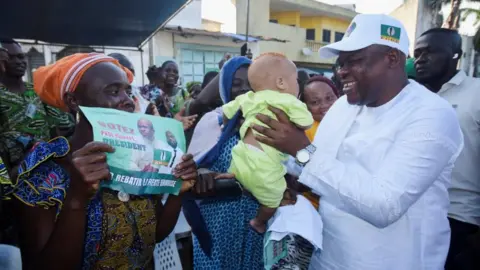
Wadagni has also expressed support for improving relations with the military-ruled states, though he is seen to be closer to Western powers than Hounkpè, who worked as the culture minister in the government of Talon's predecessor, Boni Yayi.
 Reuters
Led by Gen Abdourahmane Tiani, Niger's relationship with Benin is particularly strained.
Niger has kept the border between the two nations shut since Gen Tiani took power in 2023, denouncing what it describes as "hostile manoeuvres" from Benin's territory - a charge Talon's government denies.
Talon is stepping down at the end of his two terms, with his supporters saying that he has kept Benin's reputation as a democracy intact - vital at a time when military rulers like Burkina Faso's Capt Ibrahim Traoré, have been pushing the view that democracy "kills" and people must "forget" it.
But Talon's critics say democracy has suffered setbacks under his presidency, with changes to electoral laws and party registration rules significantly reducing opposition participation.
The new requirements led to the main opposition party, the Democrats, failing to win a single seat in January's parliamentary elections.
Its candidate has also been disqualified from the presidential race on the grounds that he did not have enough sponsors to back his candidacy.
In contrast, Hounkpè's candidacy - the South Africa-based Institute of Security Studies think-tank noted in a recent report - was made possible "only through a political deal with the ruling coalition, which gave him the sponsorships needed to meet the legal requirements for the race".
With the Democrats out of the race, many of its high-profile members have backed Wadagni possibly because they see him as the winning horse who could offer them posts in his government.
However, Hounkpè remains confident of victory, believing he represents change.
Regardless of who wins, most people in Benin expect a smooth transfer of power, and hope that the next leader will have greater success in improving relations with neighbouring states and containing the insurgency that has caused havoc in the region.
You may also be interested in:
 Getty Images/BBC
Go to BBCAfrica.com for more news from the African continent.
Follow us on Twitter @BBCAfrica, on Facebook at BBC Africa or on Instagram at bbcafrica