Why are chips washing up on the beach?

 Joel Bonnici
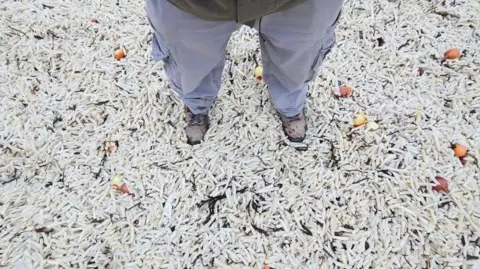
Thousands of chips washed up on a Sussex beach over the weekend.
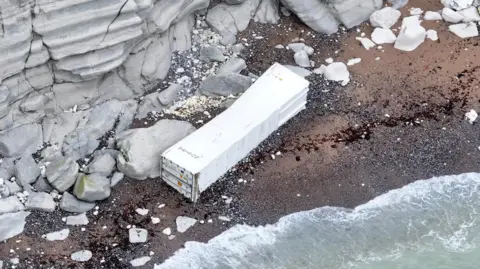
The unusual sight came after several shipping containers containing "food and packaging" came ashore nearby earlier that week.
But the chip wreck in Eastbourne - which one resident said made the beach look like the golden sands of the Caribbean - was part of a series of recent shipping incidents.
Two vessels are reported to have lost 24 containers off the Isle of Wight earlier this month.
Some of these containers are believed to have sunk, but others washed up at Selsey, Eastbourne, Newhaven, Rustington, Rottingdean and Beachy Head.
Meanwhile, 16 shipping containers - mostly filled with bananas - fell off a cargo ship in December, with several later ending up on beaches across West Sussex.
Why has this happened?
Bad weather has been blamed for the incidents.
The two ships which lost cargo in January were caught up in strong winds caused by Storm Goretti.
Meanwhile, last year's banana container "carnage" happened in choppy seas.
But marine salvage expert Captain John Noble told the BBC it is likely containers were not properly secured.
He added that ships are often under considerable time pressure to maintain their schedule, which can mean lashing is not always completed before they set sail.
Dr Simon Boxall, senior lecturer in oceanography at the University of Southampton, told the BBC "bigger ships" visiting ports and an increasing frequency of storms were also contributing factors.
However, he added that 2024 - the latest year for which data is availible - actually saw a reduction in the number of containers falling overboard.
Who is responsible?
The shipping company is ultimately responsible, according to Boxall.
The master of a ship is also obligated to ensure a ship's cargo is properly secured, Noble said.
But he added it can "get quite complicated" as shipmasters often work through agencies and are not directly employed by shipping companies.
Who should pay for the clean up?
In short, a ship's insurers.
As Noble explained, local authorities will typically handle the clean-up operation but will then claim their expenses back from the insurers.
Fines can be placed on shipping companies to make sure they pay up if they are found at fault, Boxall added.
Seatrade, which operates two of the three ships involved in recent incidents, said it is "closely cooperating" with local authorities and the HM Coast Guard to locate and salvage containers.
Resources, expertise and assets have been mobilised on behalf of Seatrade and insurers, it added.
Seatrade said it had engaged its insurers from the outset.
Volunteers have also been working to remove thousands of bags of chips which recently washed ashore amid concerns over the potential impact of the debris on wildlife.
What can the authorities do?
An investigation into the loss of cargo from the Baltic Klipper in the Solent in 2025 has been launched by the Marine Accident Investigation Branch.
The government organisation says it is aiming to "establish the cause of events that led to this accident, understand why it happened, and make recommendations to prevent similar accidents reoccurring".
Noble said the shipping companies themselves will also likely launch internal investigations into what happened.
Seatrade has said it is investigating the exact cause of the chip spill.
 Eddie Mitchell
Boxall told the BBC from 1 January it is compulsory for shipping companies to report any lost containers.
Offenders can be subjected to fines and other restrictions, such as not being allowed into certain ports, he said.
Boxall added shipping companies have been called on to secure containers inside vessels.
However, he warned this could mean more ship journeys as they would be carrying less, which in turn could increase the chance of accidents, alongside emissions and shipping costs.
Will anyone be held to account?
Boxall told the BBC shipping companies will be held to account.
He said it was "not that difficult" to identify what ship containers come from since they carry tags and ID numbers.
"The main solution is to identify when these things fall off," Boxall said.
Shipping companies can minimise the potential impact of incidents by storing dangerous or hazardous goods in the inner part of the ship or in the middle of other containers to reduce their chance of going overboard, he added.
Allow X content?
However, Boxall said washed-up containers should not come as a surprise.
He explained the south coast is home to the second biggest container port in the UK – Southampton Docks – and the English Channel itself is one of the busiest shipping lanes in the world.
A German submarine, illegal drugs and even a dead elephant are among the unusual items washing up on Sussex's beaches over the years.
Follow BBC Sussex on Facebook,X and Instagram. Send your story ideas to southeasttoday@bbc.co.uk or WhatsApp us on 08081 002250.