'Mum would have been better supported on death row'

 BBC
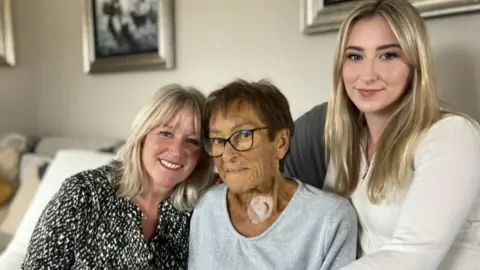
BBC"I'm sure my mum's end-of-life would have been quicker and better supported on death row. It was the most undignified end I can possibly imagine. I'm just hoping she wasn't aware."
Those are the words of Shelley Crouch who cared for her dying mother overnight with no support from the NHS or health officials. She said as her 77-year-old mother, Maureen Harris, choked from internal bleeding, the only support she could find was from online searches.
The 54-year-old, from Tisbury in Wiltshire, is speaking out as peers in the House of Lords debate assisted dying, with some calling for improvements to palliative care rather than allowing terminally ill adults to seek medical help to end their lives.
"Well, that's OK for them to say that but it's not happening," Shelley said.
"You are on your own at night and that, believe me, as a daughter, that's the most terrifying time when you are laid in bed next to a poorly mummy and the hours are endless."
A spokesperson for Salisbury NHS Foundation Trust said they were very sorry to hear how distressing the experience had been for the family at "such an incredibly difficult time".
- If you've been affected by issues in this video, help and support is available via the BBC Action Line.
Shelley said there had been no palliative care at night for her mother, who had cancer, and she had to care for her alone - an experience she describes as "terrifying".
Speaking after her mother's death, Shelley said: "In my own naivety, I thought mum's end-of-life was going to be us all stood around the bed, holding hands, talking to her, letting her slip off, and all I can say is that is exactly what didn't happen."
Her mother was discharged home from hospital with the expectation that fast-track palliative care would be in place.
Instead, Shelley described weeks of delays that left her coping on her own.
She had to deal with her mum's laryngectomy hourly, a surgical procedure which means patients breathe through an opening in the neck called a stoma.
She also had to change her mother's urostomy bag, administer medication and oversee regular nebulising.
Two days before her death, Maureen was offered a hospice bed, but the family, in consultation with the GP, felt she was not in a condition to travel to Salisbury.
'Most undignified end'
Desperate for clinical help, during Maureen's final days, Shelley said it had taken 18 hours for HCRG Care, which is responsible for district nurses, to return her calls.
The family have since filed a complaint.
A HCRG spokesperson said: "We take concerns of this nature extremely seriously and an investigation is now under way.
"It would not be appropriate to comment further while that process is ongoing."
Shelley said on Maureen's final nights there had been no nursing care to help her cope with a large blood clot.
"Mum was actually choking, with a blood clot in her laryngectomy, and blood coming from her mouth," she said.
"I had to put mum in recovery while calling Mia, my daughter, to get the suction machine... to allow her to breathe, because I couldn't let her choke.
"Mum's end was traumatic to say the least. She had internal bleeding which meant she bled from her neck stoma and mouth for hours - so it was the most undignified end I can possibly imagine. I'm just hoping she wasn't aware."
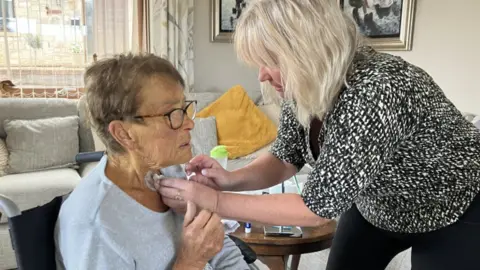
She said the strain on caring for her mum had been so great she had turned to online searches for guidance.
Desperate for night-time help, Shelley said she had been forced to rely on informal contacts rather than NHS or hospice services.
Her experience comes as peers in the House of Lords debate proposals to legalise assisted dying for terminally ill adults.
Several peers have said no-one should feel they have to consider assisted dying because of inadequate support.
Shelley said the gap between political debate and day‑to‑day reality has been stark.
Charities including Marie Curie and Hospice UK have warned for years that palliative and end‑of‑life services are unevenly funded, particularly outside normal working hours.
According to Hospice UK, the UK death rate is expected to rise over the next two decades, with about 130,000 more people projected to die each year by 2040 than in 2023.
It is estimated that at least three-quarters of the 650,000 people who die every year in the UK require palliative care.
A 2026 Marie Curie-funded study estimates about 170,000 people annually - nearly one in three - die in England in pain, distress or without vital support, highlighting a significant unmet palliative care need.
Overall, half of families said they were unhappy with the care their loved ones received in their final months.
In a statement, Salisbury NHS Foundation Trust said it could not comment on the care of any individual patient but it outlined how local services were organised.
It said Salisbury Specialist Palliative Care works across community, hospital and hospice settings with a consultant‑led community team supporting patients at home alongside GPs and district nurses.
However, the trust said the specialist service does not currently provide domiciliary care.
It added that Continuing Healthcare (CHC) fast‑track packages were requested by GPs and district nurses, not by the specialist palliative care team, and were allocated through the CHC process.
"As we do not allocate these packages, we do not hold the data requested," the statement said.
Addressing hospice capacity, the trust said Salisbury Hospice has 10 beds and that, despite high occupancy, "it is very unusual for a patient with urgent clinical need to be unable to access a bed promptly".
The trust said it recognised the challenges faced by patients and families "during a time of national debate over assisted dying" and said it would continue to support all patients and loved ones who require its services.
What is assisted dying and why is it being debated?
Assisted dying allows terminally ill adults to seek medical help to end their life.
The House of Lords is currently debating proposals that would apply to adults with a prognosis of six months or less.
Supporters say the legislation would give people dignity and choice at the end of life.
Opponents warn it could put vulnerable people at risk and argue improving palliative and end‑of‑life care should be the priority.
As the House of Lords has, in effect, kicked the assisted legislation into the next Parliament by adding more than 1,000 amendments to the act, Shelley hopes families like hers are not forgotten.
Follow BBC Wiltshire on Facebook, X and Instagram. Send your story ideas to us on email or via WhatsApp on 0800 313 4630.