Assisted dying on Welsh NHS a step closer as Senedd votes in favour

 Getty Images
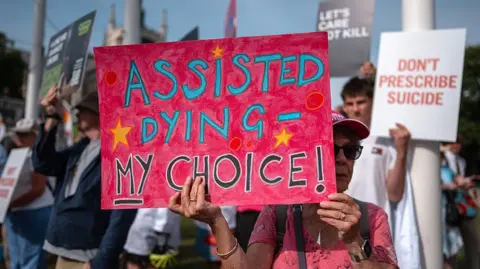
Welsh politicians have paved the way for assisted dying services on the NHS after a key vote took place in the Senedd on Tuesday night.
Following an emotional debate, Wales' parliament gave its consent to Westminster legislation that would allow terminally ill people to obtain a medically assisted death.
The landmark bill, which is currently in the House of Lords, would legalise the practice across England and Wales if passed.
The vote in Cardiff Bay was needed because the backbench law gives powers to the Welsh government to set rules for assisted dying services if it wishes to.
First Minister Eluned Morgan and Health Secretary Jeremy Miles were among those who voted against.
Had the Senedd rejected the vote, it could have meant that assisted dying services were only available in Wales from private providers, not within the NHS.
MSs also backed a Plaid Cymru amendment criticising "the lack of thorough consideration of the constitutional implications of this bill for Wales".
Several criticised the process - with the Senedd having no say in whether or not assisted dying is actually made legal - and voting while the Lords are still considering a large number of changes.
Regardless of how Tuesday's legislative consent motion could have gone, if the law is passed in Westminster the practice would have been legal anyway, with Wales' parliament only left with a decision about how to implement it.
A Plaid amendment calling for the issue to be given to the Senedd to fully control failed to pass, however.
The next step is with the House of Lords, where there are fears among supporters that the legislation may be in danger because of the amount of amendments proposed there.
If agreed by the UK Parliament the issue falls to the next Welsh government, following an election in May, which would face the prospect of asking the Senedd to approve regulations for an assisted dying service.
The motion was backed by 28 Senedd members, with 23 against and two abstentions.
Voting tables show that while 21 Labour and seven Plaid Cymru MSs backed the vote, five Labour ministers and four Plaid politicians opposed the decision.
Mabon ap Gwynfor, Plaid's spokesperson on the NHS, voted against, as did deputy Plaid leader Delyth Jewell.
Despite voting against the motion, Jeremy Miles had earlier warned Senedd members that if they were to do so "there would be no powers in the bill for Welsh ministers to implement assisted dying services in Wales or to oversee or regulate such services" if the practice were legalised by the Westminster legislation.
Former Plaid Cymru leader Adam Price backed the motion because "the alternative, in my view, does not protect Wales".
"It abandons Wales to a private only system no-one here, in all conscience, would design," he said.
Alun Davies, the Labour Blaenau Gwent MS, said the Senedd should have been able to take a "complete decision" on assisted dying.
But refusing the motion would have made Wales "a much much worse place to be".
"What debate on morality can take place when we say to people in Wales 'you can exercise the choice on this fundamental matter but only if you've got the money to pay for it?"
All Tory MSs opposed the motion. Darren Millar, Welsh Conservative leader, accused the law's backers of "sanitising" the issue.
"While the term assisted dying is used my many to soften the reality we are actually talking about assisted suicide," he said.
He said as a "matter of conscience" he "could not support a framework that treats some lives as less worthy of protection than others".
"Welsh hospices are in the middle of a funding crisis," he said. "We should use taxpayers money to ensure that as many people in Wales as possible have access to the high quality palliative care that they deserve."
Speaking against, Plaid's Delyth Jewell: "The fear and terror I have is how this will end in situations where disabled people, those who are poor or lonely or abused will be led to feel they have no choice but to end their life."
Reform's two MSs abstained. James Evans had previously supported the broad principle of assisted dying in a previous Senedd vote 18 months ago.
He told the Senedd on Tuesday that his position had not changed and that it was his "fundamental view".
Announcing that he would abstain "with a very heavy heart", he said the bill was "still a work in progress" and that granting consent before the legislation was complete would bind Wales to a framework that was not yet finished.
Welsh Liberal Democrat leader Jane Dodds, the party's only MS, voted against the motion.
Heledd Fychan, a Plaid Cymru MS, expressed support for the principle of assisted dying while telling the Senedd it should have been the parliament in Cardiff Bay's decision to "look at this in the whole".
"Wales' voice needs to be heard," she said.
"Constituents of mine have been left traumatised, have been arrested as they were suspected to have assisted a suicide, even though they hadn't, and it's clear to me that we need to confront this issue properly in Wales," she added.
A spokesperson for the backbencher Kim Leadbeater, who launched the legislation in Parliament, said: "Both the elected House of Commons and the elected Senedd have registered approval.
"Only a small minority of unelected peers are standing in the way of a democratic decision."
Former Deputy Prime Minister and a member of the lords, Thérèse Coffey, said: "With the LCM now approved, Wales faces a Westminster-designed assisted dying regime imposed upon it."
She claimed it was "clear that funding and resources will be diverted from palliative care" to implement the service.
The Senedd is usually asked for its consent whenever Westminster tries to pass legislation that changes laws in devolved areas.
It is not legally binding, although the supporters of the legislation had promised to respect the decision.