A year on: Four ways Trump's tariffs have changed the global economy

 EPA-EFE/Rex/Shutterstock
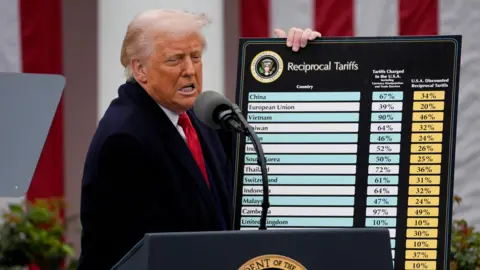
When US President Donald Trump launched his trade war last April, he promised a new era for America - vowing to restore manufacturing, raise money for the government and open up new markets.
One year later, tariff rates in the US stand at the highest level in decades, with the average effective rate at roughly 10% up from about 2.5% at the start of last year.
Here are four ways they have changed global trade.
1. US-China break-up accelerates
 AFP via Getty Images
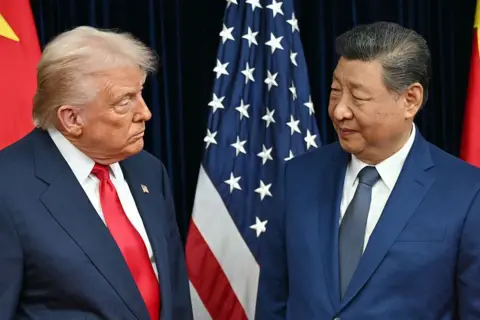
Trump delivered a global shock last April on so-called Liberation Day when he unveiled a minimum 10% tariff on many foreign goods - targeting items from some countries, such as China, with far higher duties.
As China hit back with tariffs of its own, the tit-for-tat exchange sent tariff rates spiralling into the triple digits and for a few weeks brought trade between the two giants to a screeching halt.
Those tensions eventually calmed. At the end of 2025, Chinese goods faced tariffs, or border taxes, that were 20% higher than at the start of the year.
But trade between the two countries still took a major hit.
The value of US imports from China plunged roughly 30% last year. Shipments from the US to China saw a similar drop, down more than 25%.
By the end of last year, Chinese goods represented less than 10% of America's overall imports - comparable to levels last seen in 2000 and down from more than 20% in 2016, the year Trump was first elected.
Increased US imports from Vietnam and Mexico, where Chinese firms have boosted their investments, suggest business ties between the two countries have not completely unwound.
But the numbers indicate that the decoupling that started during Trump's first term has finally arrived, says Davin Chor, professor and globalisation chair at Dartmouth University's Tuck School of Business.
When it comes to direct shipments, "it has been very dramatic and it has been very decisive," he said.
Chor said the big shift that happened last year suggested that companies had acted on plans that were already under way for some time. Even if Trump does not end up resurrecting his most aggressive levies, that suggests the break will linger, he added.
"I don't think you should expect things to go back to business as usual," he said.
2. Trade partners look elsewhere
 AFP
AFPTrump's changes to the US tariff regime were more far-reaching than just his Liberation Day announcement. He also raised levies on specific items such as steel, lumber and cars and ended rules that had allowed shipments worth less than $800 to enter the country, among other measures.
Despite the new taxes,US imports ended up increasing more than 4% last year - more slowly than in 2024 but hardly evidence of a plunge into isolationism.
Still, the measures pushed many firms in other countries to look beyond the US for buyers, as political leaders raced to shore up non-US trade relationships.
That was the case even for a country like the UK, which faced a relatively limited 10% tariff on its goods.
Though the US remained the top destination for British goods in 2025, America's share of exports sank, while countries such as Germany, France and Poland gained ground.
"Some people might be surprised - global trade as a whole...has held up quite well," says economics professor Jun Du of Alston University. But she adds, "there's a lot of re-wiring."
The US successfully convinced some countries to agree to trade changes intended to increase opportunities for US businesses, like farmers, to sell abroad.
But Trump's push has also alienated allies, spurring changes at odds with US interests - even in cases like Canada, where Trump ultimately exempted the vast majority of goods from tariffs, citing a North America free trade pact.
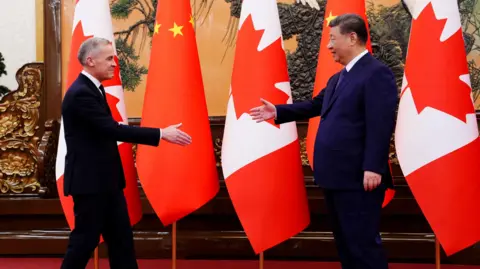
Canada recently agreed to slash its tariffs on thousands of Chinese-made electric vehicles from 100% to roughly 6.1%. It marked a sharp turn away from the US to China, and a particularly unwelcome one for American car firms, which have long dominated the Canadian market.
What is driving alarm "is not as much the level of tariffs as it is the unilateralism," says Petros Mavroidis, a professor at Columbia Law School.
3. Tensions with allies build
 Bloomberg via Getty Images
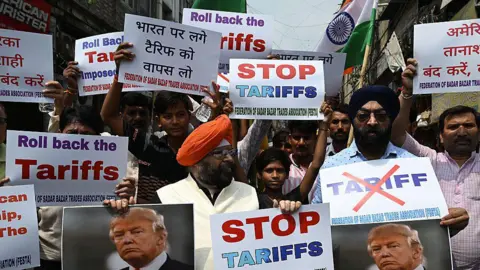
Tensions from the tariffs have spilled over into non-trade areas.
Canadian travel to the US plunged by 20% last year, costing the US economy more than $4bn, according to estimates by the US Travel Association.
The tariffs have also complicated US efforts to rally support for issues big and small, whether that's the war in Iran or the extension of a 28-year ban on tariffs on electronic transactions such as streaming, Mavroidis said.
"How can you ask for co-operative behaviour when you screw them on trade?" he says. "You lose your soft power, which was the biggest advantage to the US. All of this is gone now and how do you build it back?"
While direct trade retaliation against the US has remained limited, there is no guarantee that pattern will hold, says economist Michael Pearce of Oxford Economics. He noted that Trump's stance has encouraged other countries to explore their own more protectionist policies.
"That's the significant risk - that over time we do start to see that retaliation in other ways," he says. "That's how damage from the trade war can spread."
4. Prices rise in the US
 EPA/Shutterstock
The tariffs Trump threatened on Liberation Day and that sparked such alarm were ultimately watered down, after the president exempted many goods and struck deals with countries that granted lower rates.
The big promises he made then have not materialised either.
Manufacturing spent much of last year in contraction, while foreign investment into the US also fell, despite pledges by some firms, such as drugmakers, to boost their spending, according to Tax Foundation analysis of government data.
Then in February, the US Supreme Court struck down the Liberation Day duties altogether, even calling into question the surge in tariff revenue the government took in last year. The US is now on the hook to return more than half the $260bn it had collected.
The White House has said it will take time for its policies to pay off, pointing to promises by firms and countries of big investments.
But for now the primary fallout from the tariffs in the US has been business strains and higher prices for consumers.
About 55% of the new charges were passed on to consumers last year, Goldman Sachs estimated in October.
That helped push up the US inflation rate last year by about half a percentage point to roughly 3%, compared to what it would have been without tariffs, Pearce said.
With affordability top of mind for many voters, the issue has complicated Republicans' pitch ahead of of mid-term elections in November.
But though tariffs weighed on consumer spending and business activity, the economy still grew 2.1%, with unemployment in December standing at 4.4%.
"It's created a lot of noise, but I think it's difficult to say that it's had very significant negative macroeconomic impacts," Pearce says.
The White House vowed after the Supreme Court ruling to resurrect its policies with other laws. How hard Trump will push in the run-up to the elections remains to be seen.
"I don't think we'll ever get back to Liberation Day levels," says Erica York, vice president of federal tax policy at the Tax Foundation.