US detainee Dennis Coyle released by Taliban after more than a year

 BBC
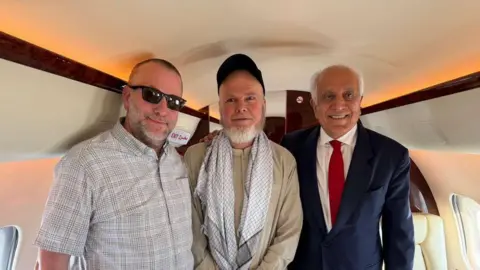
BBCThe Taliban has freed an American citizen after more than a year in captivity, amid pressure from President Donald Trump's administration.
Dennis Walter Coyle, 64, who was living in Afghanistan working as a language researcher, according to his family, was arrested in January 2025.
In a statement posted online, the Taliban-run Afghan foreign ministry said Coyle's imprisonment was deemed "sufficient" and that he had been pardoned to mark Eid al-Fitr, the holiday at the end of Ramadan.
The US government - which declared Afghanistan a "state sponsor of wrongful detention" just weeks ago - welcomed the release, but called for other US citizens being "unjustly" held to be freed, too.
According to a family website, Coyle arrived in Afghanistan in the early 2000s to study Afghan linguistics and help communities develop resources in their native languages.
He was never charged with a crime by the Taliban following his arrest last year, but was held in "near-solitary conditions", prompting concerns about his health, said his relatives.
Asked by the BBC's Afghan service how he was feeling following his release, Coyle said he was feeling good.
While Afghan authorities said at the time that he had violated unspecified laws, they did not provide details.
In a statement posted on X on Tuesday, the country's foreign ministry said that a "plea had been made for his release".
"The esteemed authority of the Supreme Court deemed his prior imprisonment sufficient, and today he was handed over to his family in Kabul."
A letter from the Coyle family, published by Afghan news outlet Pajhwok, called on Afghan authorities to "look upon him with leniency, as one who meant no harm".
It said Coyle had "carried a deep love for Afghanistan in his heart for nearly twenty years".
In a statement, US Secretary of State Marco Rubio said that "today, after more than a year of captivity in Afghanistan, Dennis Coyle is on his way home".
"President Trump is committed to ending unjust detentions overseas," the statement added. "Dennis joins over 100 Americans who have been freed in the past 15 months under his second term in office."
Coyle's release was supported by the United Arab Emirates, the state department said.
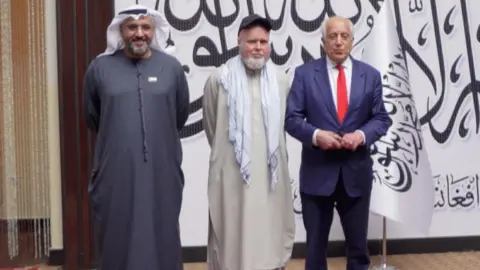
The Emirati special envoy to Afghanistan, Saif Al Ketbi, was at Kabul's airport for the release. Al Ketbi told the BBC that the release was the result of negotiations between Washington and Kabul.
On 9 March, Rubio declared Afghanistan a state-sponsor of wrongful detention and accused the Taliban government of using "terrorist tactics" and "kidnapping individuals for ransom or to seek policy concessions".
The same day, Adam Boehler, US special envoy for hostage response, warned that any nation holding innocent Americans could become the "next Venezuela" or Iran.
Afghan authorities have denied detaining foreigners for political ends.
Former US ambassador Zalmay Khalilzad - who was present for Coyle's release in Kabul - told the BBC he was hopeful other Americans would eventually be released.
At least two other US citizens are believed still to be held in Afghanistan.
One is Mahmood Habibi, a contractor for a local telecommunications firm. He vanished in 2022 shortly after a US drone strike killed al-Qaeda leader Ayman Al-Zawahiri in Kabul.
In January, a Taliban official told the New York Times it was prepared to release two Americans in exchange for an Afghan national and accused al-Qaeda courier held in Guantanamo Bay.
The state department also called on Tuesday for the release of Paul Overby, an American who went missing in Afghanistan a decade ago.
Overby was last seen in Khost City in 2014 while conducting research for a new book, according to the FBI.
The US does not recognise the Taliban as Afghanistan's legitimate government and has no formal diplomatic presence in the country, complicating negotiations that are often conducted via intermediaries such as Qatar.