What's going on with the price of gold?

 Getty Images
It's been a wild ride for the price of gold over the past few days.
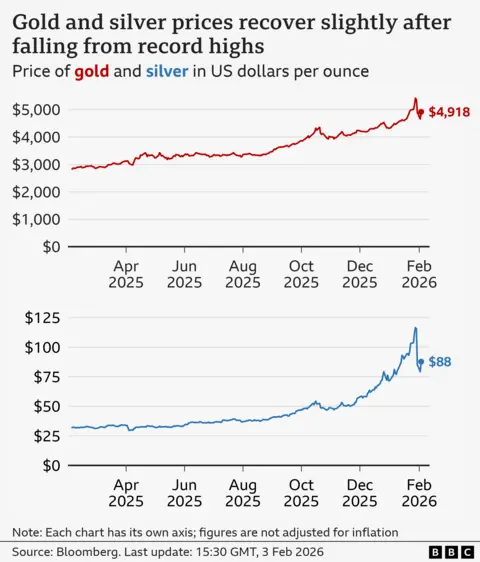
Last week, the yellow metal touched a record high above $5,500 an ounce, following a year in which its value has soared.
But on Friday, the gold price plummeted more than 9%, its sharpest one-day drop since 1983, before a further decline on Monday.
A slight recovery on Tuesday saw it rise more than 5%, and that rise continued into Wednesday.
And, despite the recent falls, its price is still about 75% higher than it was at the same point last year.
So, what is going on?
What triggered the recent falls?
Financial markets can move for a variety of reasons, but analysts seem to agree that the decision by US President Donald Trump to nominate Kevin Warsh as the head of the US central bank, the Federal Reserve, was key in this case.
Warsh is viewed by the markets as a "very acceptable" choice, April Larusse from Insight Investment told the BBC, amid recent worries over the independence of the Fed.
This boosted the value of the dollar and helped to calm investors' nerves. However, this easing of concerns was not so good for the gold price, which is seen as a safer investment in times of uncertainty.
Another reason cited for the slump in prices was changes to trading requirements on a major exchange, which made it more expensive for speculators to trade.
Prices of gold and silver have soared since the start of the year, and some analysts had begun to feel the rises were overdone.
Mark Matthews, head of research for Asia at Bank Julius Baer, told Reuters that one explanation for the collapse in prices is "simply because they had already gone parabolic in the previous week".
"Once profit-taking started, it just snowballed."
However, some believed the falls were just a blip in gold's onward march upwards. Michael Hsueh, an analyst at Deutsche Bank, said "conditions do not appear primed for a sustained reversal in gold prices" and reiterated the bank expects the metal to reach $6,000 an ounce.
Why had gold been rising?
The price of gold has been rising slowly for the past few years but it really took off last year when it posted its biggest annual gain since 1979.
The precious metal is seen as the ultimate "safe haven" investment - providing a more secure asset in times of uncertainty.
"When you own gold, it's not attached to the debt of somebody else like a bond is or an equity where the performance of a company will drive performance," Nicholas Frappell, global head of institutional markets at ABC Refinery, told the BBC.
"It's a really good diversifier in a very uncertain world."
Last year, the key worry for investors was the unpredictable changes in US trade policy, introduced by the Trump administration. The "Liberation Day" tariffs announced by Trump in April led to months of uncertainty as negotiations continued over what level the tariffs would be set at.
In January, Trump's threat to impose fresh tariffs on eight European countries opposed to his proposed takeover of Greenland, which has since been reversed, sent gold and silver to fresh record highs.
His trade policies continue to worry investors, helping to support the gold price, says Emma Wall, chief investment strategist at Hargreaves Lansdown.
Geopolitical tensions have also added to the appeal of gold as a safer investment, and the US seizure of Venezuelan President Nicolás Maduro in early January helped to push the gold price higher.
"Gold is doing what it does best when the world feels messy, jumping amid rising trade tensions, geopolitical flare-ups, political uncertainty in the US," Wall says.
"Fresh friction between the US, Canada and China, unease around Europe and the Middle East, and even shutdown risks in Washington have all added to gold's appeal."
Central bank buying
One factor which started to push up the price of gold before last year's surge was central banks increasing their purchases of bullion.
This has been a trend over the past few years, after the reserves of the Russian Central Bank were frozen following the invasion of Ukraine.
"Investors and global central banks have... favoured gold as their reserve currency of choice, which they believe insulates them from US policy dependence," says Wall.
"Certain nations will have observed the threat of Russia having its US dollar assets seized by global players supportive of Ukraine, and subsequently considered the metal a more attractive neutral reserve," she added.
Other buyers of gold include China, which is believed to be the biggest buyer of gold, with demand in the country coming from the central bank and investors, as well as individuals buying jewellery.
Investors in the west have also been attracted to gold, with many putting money into funds that own and trade the metal.