'Doll therapy helps my mum come to life'

 BBC
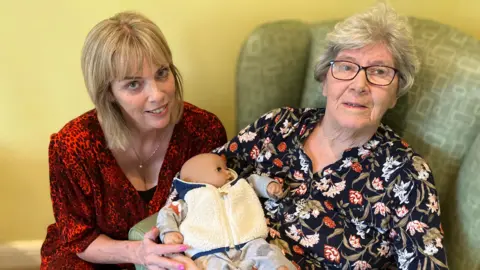
BBCIrene Nason "comes to life" as she cradles a baby doll in her arms and offers it a bottle.
The 86-year-old has Alzheimer's and is almost non-verbal, but the doll therapy exercise at her care home in Nottinghamshire has had numerous positive effects on her wellbeing, according to her daughter Paula Wright.
"Mum hasn't got a lot of short-term memory but she has got a long-term memory and these dolls bring back those memories and nurturing feelings from when me and my brother were babies," she said.
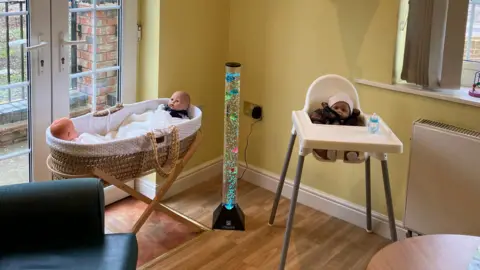
Nason is one of a number of residents at Belvoir Vale care home in Widmerpool with access to its doll therapy nursery.
Nason moved to Belvoir Vale last year, following the death of her husband.
Wright, 59, said she was not sure about the dolls to begin with but has seen a big difference in her mum after she started using them.
"I thought it was all a bit strange but they've made mum happier," she added.
"She laughs a lot now and it brings out the nurturing side of her."
She added that it had given them something to bond over.
"It was always a struggle to think of things to talk about but now we can talk about the baby and what they're wearing," Wright said.
"I had a lovely childhood and seeing her looking after the dolls reminds me of when she used to brush my hair."
Doll therapy involves offering a person with dementia a doll or soft toy to help calm and relax them. It was introduced at the home in December.
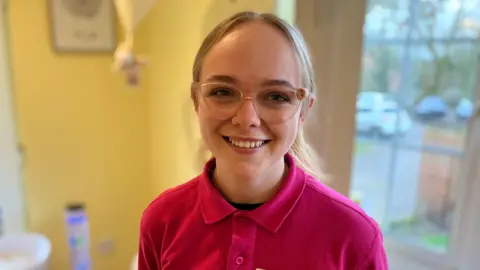
Grace Mackin, lifestyle coordinator at Belvoir Vale, set up the home's nursery after she noticed a number of residents showing interest in dolls others had brought from home.
She said: "It's amazing how the dolls can help them speak to us and they bring up their own children.
"It sparks memories and brings everything back for them, from emotions to just the heaviness in their arms.
"They hang up the clothes on a washing line and fold them away. They play with the babies and tidy up after them.
"They go to sleep feeling like they've had a purposeful day and like they've achieved something."
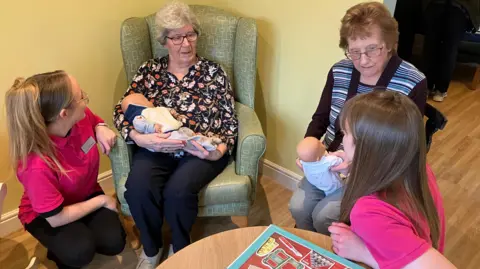
The act of caring for the doll or soft toy can be comforting, provide a sense of purpose, and reduce anxiety, according to the Alzheimer's Society.
Angelo Makri, senior knowledge officer for wellbeing at the society, said: "Different approaches work for different people, and for some people doll therapy can be a helpful way to give comfort, provide a sense of purpose, and reduce anxiety.
"A person-centred approach should always be used, and dolls should be introduced sensitively.
"For some people dolls can be an effective way to reduce anxiety and distress, however, for others they may cause confusion.
"It is important to gauge the person's reaction."
Listen to BBC Radio Nottingham on Sounds and follow BBC Nottingham on Facebook, on X, or on Instagram. Send your story ideas to eastmidsnews@bbc.co.uk or via WhatsApp on 0808 100 2210.