How could the assisted dying law work in Scotland?

 Getty Images
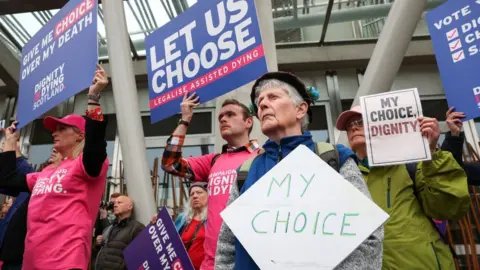
Assisted dying could soon be legalised in Scotland as MSPs prepare for a historic vote.
Parliamentarians backed the general principles of the Assisted Dying for Terminally Ill Adults (Scotland) Bill in May following a highly emotional debate.
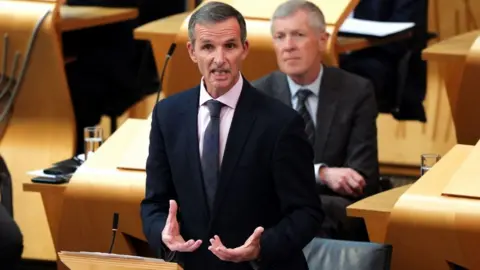
The proposals, brought by Liberal Democrat MSP Liam McArthur, will be put to a final vote in March.
A bill to legalise assisted dying in England and Wales is also making its way through the Westminster parliament - though there are some key differences with the Scottish proposals.
Some important changes have been made to the Scottish bill since the initial vote.
Most notably, the minimum age at which people can seek to end their life has been raised from 16 to 18.
MSPs will decide on further amendments ahead of the final vote.
The Assisted Dying for Terminally Ill Adults (Scotland) Bill says that eligible applicants must be:
- aged 18 or older
- resident in Scotland for at least 12 months
- registered with a GP in Scotland
- terminally ill
- deemed to have the mental capacity to make the request
To have capacity, the bill says a person applying for assisted death must be capable of understanding information and advice about the process.
They must also be able to make, communicate, understand and remember their decision.
People suffering from a mental disorder which might affect the making of the request would not be allowed to proceed.
The definition of capacity is a key area of difference from the UK bill, which leans on the typical approach in law that a person is assumed to have capacity unless shown otherwise.
Which approach is more suitable to assisted dying legislation is a matter for debate.
 PA Media
Under the Holyrood bill, a person wishing to end their life would begin by signing an initial declaration.
Two medics would then check whether the person is eligible and assess whether they are being pressured or coerced.
That would be followed by a 14-day period of reflection. In cases where the patient was expected to die of their illness before then, the period could be shortened to as little as 48 hours.
If they want to continue, the person would make a second declaration.
At this point a medical practitioner or authorised health professional would give them an "approved substance" to be used to end their own life.
The lethal drug that will be used is yet to be agreed, but the bill says it must be self-administered.
The legislation would allow for a proxy to sign a declaration for those who are physically unable to do so, and create a new offence to coerce or pressure a terminally ill adult into an assisted death.
Medics involved in the process would also be exempt from criminal and civil liability.
Both the Scottish and UK bills say no-one is obliged to participate in assisted dying.
Unlike the UK bill, the Holyrood bill includes a conscientious objection provision, stating that individuals or organisations must not be "subject to any detriment" if they opt out.
However, the Scottish government has said this section will have to be removed because the UK government is in charge of employment protections. Health Secretary Neil Gray said that the provisions could be added retrospectively with the consent of Downing Street.
The UK government must also sign off on the use of lethal drugs for assisted dying in Scotland.
'Slippery slope'
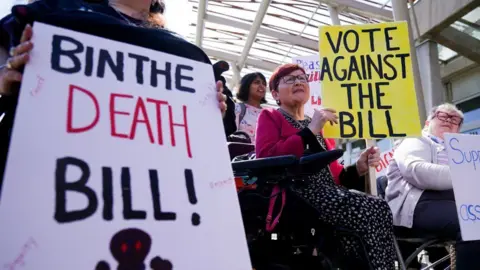
Several MSPs have warned that if the bill becomes law it could face legal challenges on human rights grounds, leading to eligibility being extended over time.
This "slippery slope" argument was one repeatedly raised during the stage one debate at Holyrood.
Concerns were also raised about residency and how to fairly assess the decision-making capacity of people with mental disorders.
Further questions have been asked about the length of the period of reflection, how coercion would be assessed and which professionals would provide end-of-life assistance.
 PA Media
Another key issue raised by MSPs is how to define a terminally-ill person.
In the assisted dying bill making its way through Westminster, a terminally ill person is defined as someone who has less than six months to live.
The Scottish bill, meanwhile, does not have a life expectancy timescale. It instead defines someone as terminally ill if they "have an advanced and progressive disease, illness or condition from which they are unable to recover and that can reasonably be expected to cause their premature death".
Opponents argue this definition is too broad.
McArthur has acknowledged such complaints but said he does not believe the definition should include life expectancy, citing advice from medical experts.
After MSPs expressed concerns at stage one, the bill now explicitly says that disability and mental illness alone do not constitute terminal illness.
Further concerns have been raised about the risk of coercion, with some MSPs fearing people could be pressured into ending their life.
Former health secretary Michael Matheson, for instance, told parliament that coercion would be an "inevitable" consequence of the bill.
McArthur insisted the bill will provide dying people with the freedom to choose how they end their life.
Could the NHS cope?
Ethics aside, some have questioned whether the NHS has the capacity and funds to facilitate assisted dying.
The costings submitted with the bill are based on estimates that there will be 25 assisted deaths in the first year, rising to up to 400 deaths after 20 years.
The documents assume that about a third of people who apply for assisted dying will not proceed.
It forecasts that the NHS will bear the brunt of the financial burden – £200,000 in the first year of the legislation, rising to as much as £342,973 after 20 years.
The main costs come from paying for clinicians, staff training and the drugs used to end life.
However, the bill claims the legislation would be "effectively cost neutral" due to savings from the reduced cost of care and less money being spent on accessing services such as Dignitas.
However, MSPs are set to scrutinise those claims further, with some raising concerns that the forecasts underestimate training costs and the capability of the NHS to finance assisted dying.
Assisted dying bills have been tabled before at Holyrood, but none have ever made it this far.
Whatever MSPs decide, it will be a historic moment for the Scottish Parliament.