Billions in SEND funding to make schools more inclusive, ministers say

 Getty Images
The government says it will spend billions to make mainstream schools in England more inclusive for pupils with special educational needs and disabilities (SEND).
That includes £1.6bn over three years going directly to schools, early years settings and colleges, and £1.8bn over the same period to provide more access to experts such as specialist teachers and speech and language therapists.
The new money is part of a major SEND system overhaul, with government plans for a series of school reforms due to be published in full on Monday.
Teaching unions said they would be scrutinising the proposals closely, with one saying the money was "barely a drop in the bucket" of what was needed because of "years of underfunding".
The latest funding announcement comes days after other details of the government's proposals were leaked before the Schools White Paper, the government's formal policy document setting out all its plans for SEND, was due to be published.
That included plans to reassess children's education, health and care plans (EHCPs) - the legal documents setting out what support they are entitled to - after they leave primary school, and again after GCSEs.
That change could lead to fewer children retaining their EHCPs, which are an expensive part of the SEND system, into secondary school. Children in Year 6 in 2029 would be the first to be reviewed under the plans, ahead of starting secondary school in 2030.
Disability charities and campaign groups said that would raise concerns among parents, worried that support could be withdrawn at a time when "stability is critical".
The leaked plans also included proposals for new individual support plans (ISPs) for all children with SEND, which would have some level of legal backing.
Currently, just over 480,000 of the 1.7 million pupils with SEND in England have EHCPs.
Responding to the announcement of more money targeted towards making mainstream schools more inclusive, Matt Wrack, general secretary of the union NASUWT, said: "£1.6bn over three years may sound like a lot of money, but it equates to just a few thousand pounds per setting."
He said it was "ridiculous" to suggest the system could be overhauled with that amount of funding.
Luke Sibieta, from the Institute for Fiscal Studies, described the new funding, which is being allocated to SEND from within the Department for Education's budget, as a "reasonably significant change".
But he said reform would be a "long and complicated process", adding that a new funding system would need to be developed "to ensure resources are targeted across schools to where they are needed".
The government will need to manage that transition carefully to minimise any disruption to existing support for pupils with SEND, he said.
Prime Minister Keir Starmer said the changes would mean families get "tailored support built around their child's individual needs, available on their doorstep".
"Whatever their background, wherever they live - this government will do right by every child," he added.
Education Secretary Bridget Phillipson said the reforms would be a "watershed moment" for children, and a "major milestone in this government's mission to make sure opportunity is for each and every child".
Speaking to the BBC on Sunday, she said ministers would not be withdrawing "effective support", and stressed that the government would be "spending more money", not less, on providing for children with SEND.
Shadow education secretary Laura Trott said the government's plan lacked clarity on where the new funding comes from. She said families should be given "cast-iron guarantees" that no child with an EHCP will lose support.
"This is not money you can find down the back of the sofa," she added.
Liberal Democrat leader Ed Davey said any changes to SEND must include better early intervention and universal screening "so that each child has the best chance to succeed.
The National Association of Head Teachers welcomed the "principle" of more funding to help support pupils in mainstream schools, but said it would be speaking to school leaders "to weigh up whether it is sufficient".
"There will always be some pupils whose needs are so great that they require support in a special school, and it's crucial the government's plans ensure all children get the support they need at the right time in the right setting," Paul Whiteman, general secretary of the union, said.
Jon Sparkes, chief executive of learning disability charity Mencap, said the extra funding for more inclusive mainstream schools was "welcome news".
"Families must have their children's needs identified early and for them to be given the right help straight away, backed by services fully funded to do the job, and rights underpinned by law," she said.
Part of the new funding also includes £200m to make every teacher qualified to support pupils with SEND, in what the government called the biggest SEND training offer ever seen in English schools.
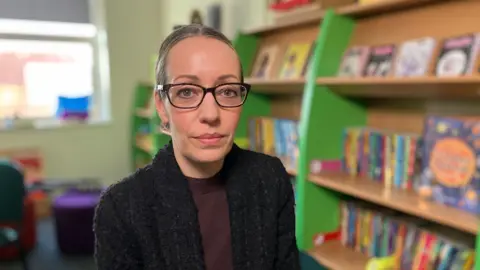 Kate McGough / BBC
More teacher training around SEND is something many school leaders have been hoping to see in the government's reforms.
Claire Robertson, head teacher of Cherry Fields Primary School in Banbury, said mainstream schools like hers "have a duty to be as inclusive as we can".
Speaking to BBC News before the latest funding announcement, she said she hoped the White Paper would have a particular focus on developing SEND training for mainstream staff.
"Our staff are wonderful but we need to have access to appropriate training to support our young people," she said.
Under its proposed reforms, the government said it is also planning to halve the attainment gap between disadvantaged pupils and their peers in England by the time children born in this Parliament finish secondary school.
Full details of all of the government's planned reforms for schools will be published on Monday.