Customers failed over outages, water boss tells MPs

 PA Media
The boss of a water company has admitted to MPs it "failed" customers when severe supply issues caused misery for tens of thousands of people over winter.
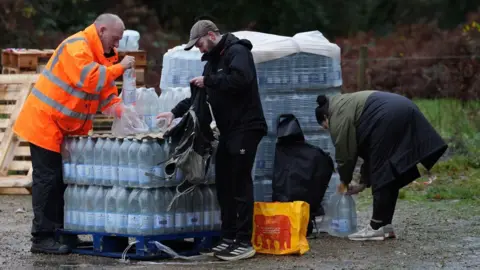
Some 24,000 properties in Kent and Sussex lost water or had low pressure in November and December, and just weeks later up to 30,000 were hit with more issues.
Grilled by MPs from the Environment, Food and Rural Affairs Committee on Tuesday, South East Water (SEW) chairman Chris Train said the company "failed on the basic objective of delivering water".
He added: "It is absolutely untenable for customers to be without water."
SEW chief executive David Hinton - who earns a base salary of £400,000 and received a £115,000 bonus last year - has faced multiple calls to resign over what happened.
But Train told MPs the company's board was backing him.
He added that the chief executive has surrendered his upcoming bonus for this year.
A source close to the Environment Secretary Emma Reynolds told the BBC she believes that SEW is now being held back by its leadership.
'Failing'
Tunbridge Wells MP Mike Martin said SEW's leadership had given a "pathetic performance" at the committee.
"If the board thinks Dave Hinton is the best person for the job, then they too are failing in their job," he told the BBC.
When asked if he intends to step down, Hinton said on Tuesday he wanted to "keep pushing on".
"I feel really emotionally connected to the service and the communities that I serve," he told the BBC.
Bills for SEW customers were set to rise by 7% from April, bringing the average yearly bill to £324 for 2026/27 - up from £303 the year before.
Businesses previously told the BBC they lost tens of thousands of pounds due to the supply failures.
And one resident likened the outage in January - which SEW blamed on Storm Goretti and power cuts - to "Armageddon".
A number of schools were also forced to close as SEW customers could not shower, bathe or flush their toilets.
SEW has launched a £600,000 fund for affected businesses to claim compensation, the committee heard.
However, Alistair Carmichael, the committee's chair, said on Tuesday that the amount "does not touch the sides".
'Lasting consequences'
Dr Mike Keil, CEO at the Consumer Council for Water, said a survey of SEW customers in the area shows 54% now store bottled water in case there is another outage.
He added that nearly a fifth of people now only drink bottled water, after SEW issued a boil water notice for several days.
"This type of interruption, of this duration, has lasting damage and lasting consequences," he said.
Environment Secretary Emma Reynolds called the water supply disruptions "completely unacceptable".
Hinton said on Tuesday that the company had learnt some lessons following the supply failures.
But he added: "Clearly we've got a lot more to learn".
Committee member and MP Josh Newbury said SEW's communications at the time were "haphazard and inconsistent".
Hinton conceded he "got it wrong" over how quickly he communicated with the public.
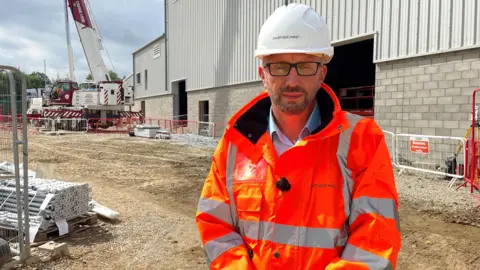
He added the company did not identify issues at one of its treatment works in November, which left homes in Tunbridge Wells, Pembury, Eridge, and Frant without drinking water for nearly two weeks, quickly enough.
"If we had spotted it earlier we would have resolved it," he added.
The Drinking Water Inspectorate said its investigation had found the outage was "foreseeable and preventable".
It said "longstanding weaknesses" in management, monitoring, maintenance and organisational preparedness were to blame.
The inspectorate added SEW had been placed in a "transformation programme" aimed at fixing the "root causes of poor performance".
The company has said it is investing £2.1bn into infrastructure and resilience over the next five years.
SEW chairman Train called climate change an "element factor" in the outages.
He said the "speed and severity" of the phenomenon in the South East has "outstripped reasonable predictions".
 BBC/Yvette Austin
Ofwat proposed fining SEW £22m in March over disruptions affecting 286,000 people between 2020 and 2023.
The fine - which is the second biggest fine the regulator has ever put forward - does not cover newer failures.
Ofwat is also investigating whether the company has breached its licence conditions.
Speaking to the committee on Tuesday, the regulator's chief executive Chris Walters said they were seeing SEW making "steps forward".
"Only time will tell if those are sufficient," he said.
SEW, which is owned by a group of investment and pension funds led by Utilities Trust of Australia, has debt of £1.3bn, according to its latest annual report.
Pre-tax losses for the year to 31 March 2025 narrowed to £19.8m from £36.7 in the previous year.
SEW serves about 2.3 million people across Kent, Sussex, Surrey, Hampshire and Berkshire.
Follow BBC Kent on Facebook, X, and Instagram. Send your story ideas to southeasttoday@bbc.co.uk or WhatsApp us on 08081 002250.