Review will create 'Britain's poorest council'

 Houses of Parliament
A former Conservative council leader claims the restructuring of local government will lead to the creation of "Britain's poorest council".
Lord Fuller of Gorleston, who was leader of South Norfolk Council for 17 years, accused the government of " partisan gerrymandering" while drawing up its plans for local government reorganisation (LGR).
He told the House of Lords that the proposed East Norfolk authority will face spending challenges but not have much of a tax base to fund them - because many wealthy areas in Broadland and South Norfolk will fall within the new Greater Norwich Authority.
The government says the process of drawing up the new council boundaries has been "extremely vigorous".
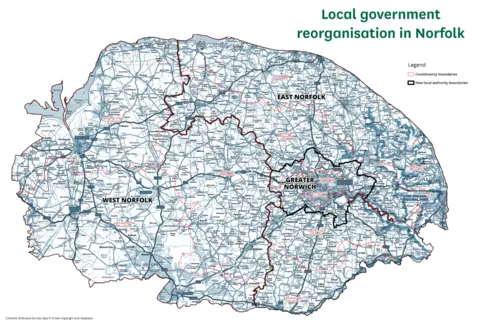
Under the proposals announced earlier this year, the county council and Norfolk's seven district authorities will be abolished in 2028, with their responsibilities transferred to three unitary authorities.
Labour believes that having fewer councils will improve the provision of local services and save money.
But Fuller complained that in Norfolk, and other parts of the country, the new city-based councils like Norwich "have been given the choicest parts of their neighbours". like well-off suburbs and business and research parks which all pay a lot in tax.
"Labour's proposal in Norfolk will create Britain's poorest council in East Norfolk on the altar of shoring up Labour's (electoral) prospects in Norwich," he told peers during a debate in Parliament.
"The proposed East Norfolk unitary will comprise North Norfolk, which has England's oldest population, the greatest social care needs and the lowest economic population; Great Yarmouth, which has some of the country's most deprived wards - and parts of South Norfolk, where the main industry is agriculture, with miles of open fields and little wealth-generating industry.
"It is all the cost and none of the revenue."
Like many other Conservative politicians, he also complained about the cost of setting up the new councils and questioned Labour's claim that the new authorities would deliver value for money.
Plans were 'considered carefully'
The local government minister Baroness Taylor told Fuller: "I am not going into all the details of the Norfolk process but it was extremely vigorous.
"Locally submitted proposals were considered very carefully against the clear criteria that had been set."
The local government changes are a big talking point in this year's local elections, which at one stage were going to be cancelled because the government felt that electing councillors who would only serve a two-year term would be a waste of money.
All the opposition parties have concerns about the handling of LGR and oppose plans to delay the elections.
Reform UK questions whether the new councils will save money, and both the Greens and Liberal Democrats say they will ask the government for extra funding to make the transition easier.
Do you have a story suggestion for Norfolk? Contact us below.
Follow Norfolk news on BBC Sounds, Facebook, Instagram and X.