Rubio warns Europe of new era in geopolitics before big Munich speech

 Reuters
US Secretary of State Marco Rubio has spoken of a defining moment and a "new era" as he travels to Europe to give a major speech at the Munich Security Conference.
Rubio will lead the US team at the first major global event since President Donald Trump threatened Denmark's sovereignty with a pledge to annex Greenland.
French President Emmanuel Macron has insisted Europe must prepare for independence from the US, while Nato Secretary General Mark Rutte stressed that transatlantic bonds were as close and important as ever.
The war in Ukraine, tensions with China and a potential nuclear deal between Iran and the US are also on the agenda at the annual security conference, which began on Friday.
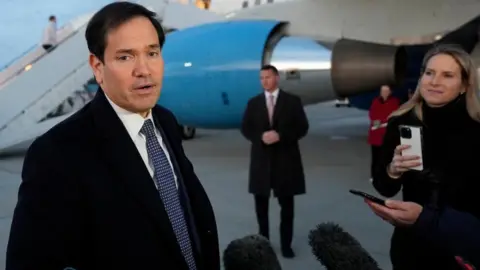
"The world is changing very fast right in front of us," Rubio told reporters, when asked if his message to Europeans would be more conciliatory than a year ago.
"We live in a new era in geopolitics, and it's going to require all of us to sort of re-examine what that looks like and what our role is going to be."
At last year's conference, US Vice-President JD Vance attacked Europe, including the UK, for policies on free speech and immigration. His comments triggered a year of unprecedented transatlantic tension.
Opening this year's conference, German Chancellor Friedrich Merz appealed directly to the US, saying "let's repair and revive transatlantic trust together".
He also revealed that "confidential talks" were ongoing with Macron on creating a joint European nuclear deterrent.
France and the UK are the only two nuclear powers in Europe - but Germany and many other European nations have traditionally relied on the US nuclear umbrella within the Nato alliance for deterrence.
Some 50 world leaders are set to attend this year's event, where European defence and the future of the transatlantic relationship will be discussed at a time when US commitments to Nato have been called into question.
Tensions have been heightened in recent months as Trump has repeatedly said that Greenland is vital to US national security, stating without evidence that it was "covered with Russian and Chinese ships all over the place".
Danish Prime Minister Mette Frederiksen said on Friday she planned to meet Rubio to discuss the US threats to seize Greenland - Denmark's semi-autonomous territory from its Nato ally.
The US threats have been viewed by many European leaders as a watershed moment that has eroded trust with its biggest ally.
Ahead of the conference, eight former US ambassadors to Nato and eight former American supreme commanders in Europe issued an open letter calling for Washington to maintain its support for the Western defensive alliance.
"Far from being a charity", they said Nato was a "force-multiplier" that allowed the US to assert its power and influence "in ways that would be impossible - or prohibitively expensive - to achieve on its own".
The transatlantic relationship has come under increasing strain following the Republican president's introduction of tariffs and a suggestion in the US national security strategy that European nations may not remain "reliable allies" in the long term.
Dutch Foreign Minister David van Weel told the BBC on Friday that he recognised "the world has changed" and that he hoped the "transatlantic bond" remains "solid".
Rubio is expected to avoid taking Vance's abrasive approach but, when asked if he was planning to be more conciliatory, he said that Europeans "want to know where we're going, where we'd like to go, where we'd like to go with them".
Macron will also address the conference on Friday, having told the World Economic Forum in Davos last month that now was "not a time for new imperialism or new colonialism".
After a week of turbulent domestic politics, UK Prime Minister Sir Keir Starmer will also travel to Munich, where he is expected to hold meetings both Merz and Macron, before addressing the conference on Saturday.
Conference chairman Wolfgang Ischinger, in a report ahead of the event, said: "For generations, US allies were not just able to rely on American power but on a broadly shared understanding of the principles underpinning the international order.
"Today, this appears far less certain, raising difficult questions about the future shape of transatlantic and international co-operation."
The former German diplomat said the White House's foreign policy "is already changing the world, and it has triggered dynamics whose full consequences are only beginning to emerge".
Upon arrival in Munich, Ukraine's President Volodymyr Zelensky said the conference would bring "new steps toward our shared security - that of Ukraine and Europe".
On Friday, Russia and Ukraine announced that a new round of peace talks also involving the US would take place in Geneva on 17-18 February, aimed at bringing Russia's full-scale, four-year invasion to an end.
The three countries recently held talks in Abu Dhabi, the capital of the United Arab Emirates (UAE), with no apparent breakthrough - though Ukraine and Russia carried out a rare prisoner of war exchange shortly after the meeting.
Rubio met Chinese Foreign Minister Wang Yi at the sidelines of the conference on Friday, as Washington and Beijing seek to ease tensions over a number of issues including trade and tariffs, as well as Taiwan.
Last week, China's President Xi Jinping called Taiwan "the most important issue" at stake between the US and China during a phone call Trump.
Xi also told the US president to be "prudent" when supplying weapons to the self-governing island, which Beijing views as a breakaway state it has not ruled out taking by force and which has long been supplied militarily by the US.
Iran's nuclear programme - which Tehran maintains is peaceful - is also expected to draw focus in Munich.
Trump has threatened military action against Iran if it does not agree a new deal to prevent it from developing nuclear weapons.