Trains cancelled in black alert over storm threat

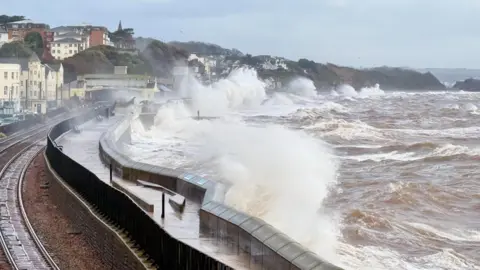 Weather Watchers/AstroPostie
Rail passengers are facing a service shutdown in some parts of the region due to heavy rain and strong winds in Devon and Cornwall caused by Storm Ingrid.
Network Rail issued a black alert, the highest warning from 20:30 to 22:30 GMT on Friday, with 12ft (4m) waves expected to hit the sea wall at Dawlish and gusts of up to 60mph (96km/h) expected.
It is only the second time a black alert has been issued since a storm destroyed sections of the track around Dawlish in February 2014.
Great Western Railway (GWR) said the line between Exeter St Davids and Newton Abbot would shut between 20:30 on Friday and 14:00 on Saturday, due to "significant risk" of sea water breaching the Dawlish sea wall.
Chris Fuoco, Devon and Cornwall director of Network Rail, said it was "the first time we've had our highest alert" since 2014.
He added: "We are just taking every safety precaution we can to make sure everyone is safe.
"High tide tomorrow is a problem, as well, so we will inspect the line tomorrow before we can reopen it.
"Mother nature can do some dangerous things to the railway so we have to stay on top of that."
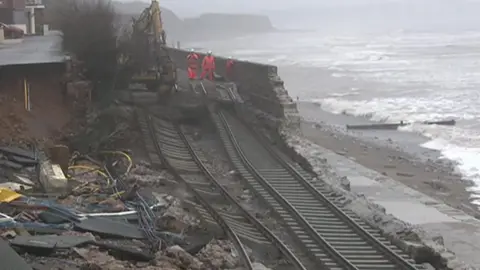
BBC South West reporter John Henderson, who was watching the scene at Dawlish, said just after 21:30 GMT the line was still intact.
"It's totally and utterly wild," he said.
"I'm on a hillside as you come into Dawlish and I can see the station in front of me lit up, just being pounded by wave after wave.
"The wind is howling, and it's taking a fearful battering, but the line is still there.
"This is the first real, proper test after it was destroyed in 2014.
"It's an incredibly vibrant, raw winter's evening here, just extraordinarily powerful."
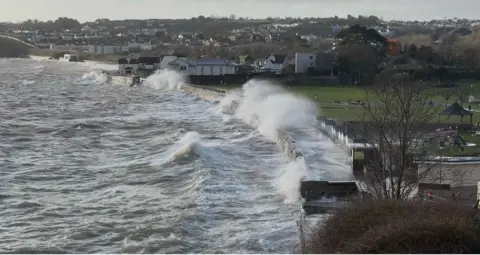 weather watchers/shaws view
A new sea wall was built in Dawlish at a cost of about £80m after the storm in 2014 left the track dangling in the air.
GWR said: "Predicted heavy and persistent rain in the south west, combined with gusts of up to 60mph in coastal areas during high tide, represents a significant risk of sea water breaching the Dawlish sea wall, and debris on the railway."
Train services would run between London Paddington and Exeter St Davids, and Newton Abbot towards Penzance, said GWR.
It added replacement coaches were on standby.
Tickets on the affected routes would be accepted up to and including Sunday.
All other routes are expected to operate as normal but passengers are advised to check their journey before travelling through Friday evening and Saturday morning.
How bad is Storm Ingrid?
David Braine, senior meteorologist, BBC South West
From late January 2014 to mid February 2014, six major storms hit the South West, separated only by intervals of two to three days.
The sequence of storms followed an earlier stormy period of December 2013 to January 2014.
The storm on 4 and 5 February 2014 caused the damage to the railway line at Dawlish, but it is believed that the stormy winter and numerous deep areas of low pressure prior to that storm may have weakened the railway line defences.
Today this is the first time the new defences have been tested by Storm Ingrid, mainly because of the strength of wind and the wind direction, which is south easterly.
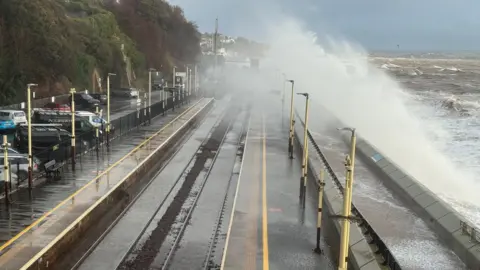 Steve Briers
A GWR spokesperson said the line between Liskeard and Looe was shut due to flooding and disruption was expected until Monday.
They said the closure was due to heavy rainfall and high tides during December, leading to water levels at several bridges to be above the safety levels.
Bridges along the branch line were damaged and required repairs which have been delayed following Storm Goretti on 8 January.
Flooding is also expected along parts of the South West coast as Storm Ingrid sweeps in.
The Environment Agency issued 16 flood warnings around Devon and Cornwall including the Tidal Fal Estuary, the stretch from Lizard Point to Gribbin Head, Gribbin Head to Rame Head, and Plymouth Sound, Wembury Bay and nearby tidal estuaries.
A flood warning means homes, roads and businesses are expected to be affected.
The Met Office has a yellow wind and rain warning for Devon and Cornwall from 02:00 GMT on Friday to 09:00 GMT on Saturday, with persistent rain falling on already saturated ground.
Follow BBC Devon on X, Facebook and Instagram. Send your story ideas to spotlight@bbc.co.uk.