'As soon as he was born he went to intensive care'

 BBC
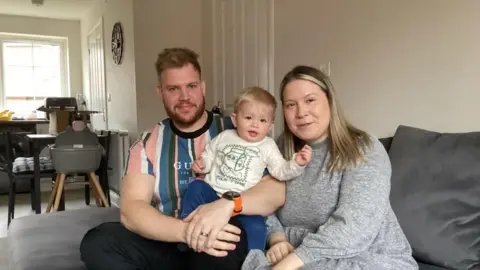
BBCEmma Connor is unlikely to forget the "really scary" moment she was told her unborn son would have to be taken straight into surgery.
The 33-year-old first time mum, from Upper Lighthorne, Warwickshire had known something was wrong with Vinnie when the 20-week scan during her pregnancy showed his stomach was empty and he had not been swallowing amniotic fluid.
From there he was diagnosed with Oesophageal Atresia (OA) and Tracheo-Oesophageal Fistula (TOF), meaning his oesophagus was not connected to his stomach.
OA/TOF affects one in 3,500 births globally and during an an awareness week about the condition, Connor told her story to let other parents in her position know support is out there.
"As you can imagine, first time mum - really scary - all these things thrown at you," Connor said.
After Vinnie's diagnosis, the family met with a team of surgeons at Leicester Royal Infirmary to discuss a treatment plan for the moment he was born.
"It was really daunting, hearing those things, your unborn baby's got to have surgery straight away."
Eight-hour surgery
Not only would Vinnie need the life-saving surgery, but it would be followed by him being placed in an induced coma for a week.
A date was planned for Vinnie to be born by C-section as Emma feared he wouldn't have the facilities needed if he was born anywhere other than the Leicester Royal.
"I didn't want to go into spontaneous labour, because if we did go into labour here, Warwick couldn't have him, nor could Coventry because of the intensive care level needed," she said.
"We had him on the Friday and at two o'clock he went down for the eight-hour surgery."

Of the seven days Vinnie was in the coma, Emma said she and father Daniel couldn't hold him.
"I was so scared because there were so many wires," she remembers.
While she was still pregnant and undergoing tests at Coventry's University Hospital, Emma found out about the TOFS charity and once Vinnie's health improved she decided to become a volunteer.
"They got me in contact with another family, her son was also born with VACTERL, it was nice to have that contact in terms of someone else I could talk to", Emma said.
VACTERL is a medical acronym that stands for Vertebral Anorectal atresia, Cardiac, Tracheo-oesophageal fistula with or without Esophageal atresia, Renal and Limb, when describing anomalies that affect newborn babies.

Daniel says the charity has been able to support Emma in ways that he couldn't while he was working. But, it has also been a support him too.
He said: "There's a lot of things I didn't know that I do now, when we go and we volunteer we get to meet other parents. While we are volunteering we also learn from other parents."
Reuben's story
 Hannah Boden
Mum Hannah Boden, 44, from Stoney Stanton, was also introduced to the TOFS charity by her consultant after the birth of her son Rueben.
"Even early on, you don't know what support you need, but they've got a parent's Facebook group which is incredible with more than 5,000 people on it and you can ask them any question you want," she said.
Reuben was born in August 2024, but for him it was five days before to finally had the surgery at Leicester Royal Infirmary to fix his oesophagus.
Like many babies born with OA/TOF, that has not been the end of problems for Reuben. At six-weeks-old, doctors discovered his trachea was also not properly developed and he need support breathing.
By the time he had been discharged in October 2025, he had been treated at three different hospitals and had three major operations on his heart, trachea and oesophagus and had been in respiratory arrest 12 times.
"I was there for every single [respiratory arrests] and you look at your baby and you think, "How on earth are they doing this?'," Boden said.
But things are now looking brighter for Reuben.
"He's a cheeky little chap. We've been home since October [and] his development has come on massively.
"There's no reason why he can't now live a normal life"
'Awareness is key'
The TOFS charity began in 1982 and registered as a charity in 1987.
Volunteers like Emma Connor also organise events to bring affected families together.
Diane Stephen, chief executive of TOFS, said: "It does make a huge difference because people feel less alone.
"Having a baby born with OA/TOF is very scary. People can feel very alone and very isolated.
"These aren't paediatric conditions like they were once considered. Some adults continue to have significant difficulties in adulthood."
As well as helping those with the condition, the charity tries to raise awareness of the condition among medical professionals.
Stephen said: "Many healthcare professionals have never even heard of TOFS which, as you can imagine, creates difficulties for babies born with the condition accessing the services and treatment they need – especially in adulthood."
"Awareness is really key"