Asda boss rejects profiteering claims as petrol price tops 150p

 Getty Images
The boss of Asda has rejected claims retailers are using soaring oil costs to boost their own profits, after fuel prices inched up again on Friday.
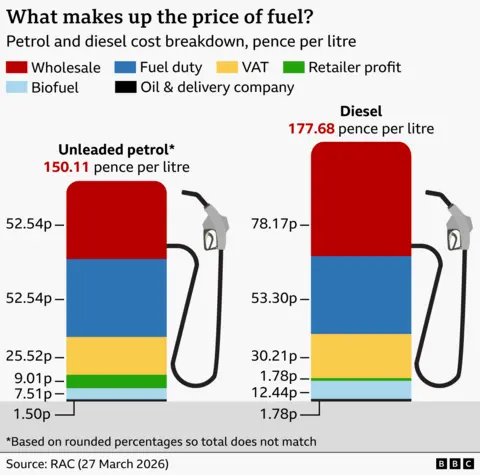
The average price for a litre of petrol rose above 150p for the first time in nearly two years, with diesel over 177p, a month after the US and Israel launched attacks on Iran.
The figures from the RAC show the conflict is continuing to push up fuel prices, although they remain below the peaks seen after Russia's invasion of Ukraine.
The cost of filling a typical family car with unleaded petrol is now £9.50 higher than a month ago, at over £82. A tank of diesel costs £19 more at over £97.
Asda executive chairman Allan Leighton hit back at suggestions forecourts had been profiteering from the crisis, accusing ministers of "pointing the finger" at retailers.
He also said the conflict was affecting fuel supplies in some locations, with a small number of pumps out of use following bumper demand.
Leighton said Asda - the UK's second biggest fuel retailer - had not closed any forecourts as a result of the conflict and expected any affected petrol pumps to be back in use after its next delivery.
"Our fuel volumes are up quite significantly and clearly demand has been outstripping supply," he said.
"Supply is tight and we are all trying hard on that."
The Petrol Retailers Association (PRA) said it was aware of reports about fuel availability "at a small number of forecourts for one retailer" but that there was no cause for concern.
"Supply across the UK is flowing normally and there is no need for any change in usual buying habits," said said PRA director Gordon Balmer.
The RAC described the rise in petrol prices above the 150p-a-litre mark as an "unwelcome milestone".
"With the long-awaited four-day Easter weekend almost within touching distance, the cost of getting away by car is going to be noticeably higher this year," said RAC head of policy Simon Williams.
Unleaded petrol is now 17p more per litre than before the conflict began. Diesel is 35p per litre more expensive.
The RAC's advice for drivers is to "plan carefully" where to refuel, making use of apps that allow them to compare prices at local outlets.
The discussion over fuel pricing has become increasingly heated in recent weeks as the wholesale price has risen.
Fuel retailers have criticised the government for using "inflammatory" language, after the government said it would clamp down on any retailers who tried to "rip off" customers.
The Competition and Markets Authority has said it will step up its monitoring of a sector.
Leighton said Asda's profit margins were down as a result of the recent spike in prices and that it was "very clear" there was no profiteering.
"The government is getting a lot of money off the back of this, and before they start accusing people of profiteering, just in my book, there's no credibility in any of it," Leighton said.
"You don't have to be Einstein to work out that that actually is impossible in the current situation.
"I think the government needs to look at what it is doing instead of pointing the finger at everybody else," he added.
While fuel duty is imposed at a flat rate, the government levies VAT on the overall retail cost of petrol and diesel, which means higher prices boost tax revenues.
Brent Crude oil topped $110 a barrel again on Friday, despite President Trump further postponing plans to start destroying Iranian energy plants.
Wholesale oil prices have fluctuated between $73 and $116 a barrel for Brent Crude over the past four weeks, driven by traders' views of whether the flow of oil out of the Middle East was set to get easier or more difficult.
Late on Thursday Trump said talks with Iran were going "very well" and that he was holding off on military strikes on Iran's energy infrastructure until at least 6 April.
In the past such pronouncements have helped to calm the markets.
However, Russ Mould investment director at AJ Bell said comments out of Washington and Tehran seemed to come from "parallel worlds".
Higher wholesale prices push up prices at the pump, often with a slight delay, although a big proportion of the overall fuel price is made up of the cost of transport, processing, retail and tax.
Analysts say every $10 increase in the wholesale oil price pushes up pump prices by around 7p a litre.