Long queues and confusion mar first day of India's landmark AI summit

 Getty Images
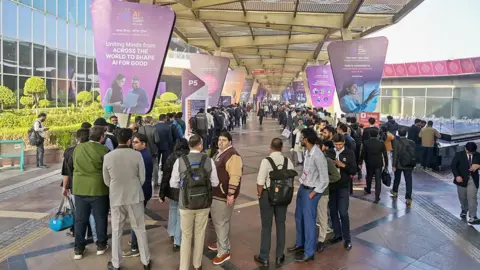
India's AI Impact Summit, billed as a landmark gathering of global leaders and technology executives, was overshadowed by logistical chaos on its opening day in Delhi on Monday.
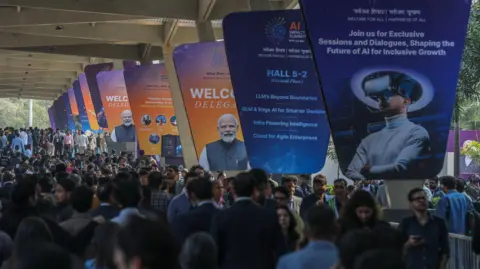
Participants complained about long queues, overcrowding and confusion at the venue, saying they had to wait for hours. Some also reported limited access to food and water and said their products were stolen from their stall.
The five-day summit, inaugurated by PM Narendra Modi, is being promoted as the first major international AI meeting hosted in the Global South.
On Tuesday, India's Information Technology Minister Ashwini Vaishnaw apologised to exhibitors for "any issue or inconvenience".
 EPA/Shutterstock
More than 100 countries are taking part, with technology leaders including Sam Altman of OpenAI and Sundar Pichai of Alphabet Inc expected to attend.
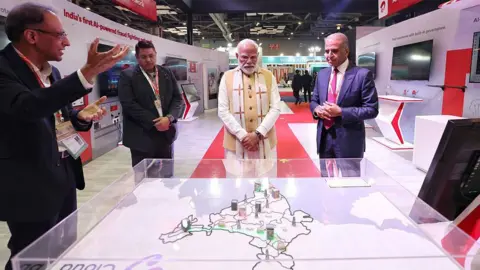
Speaking at the inauguration, Modi said the summit showcased "the extraordinary potential of AI, Indian talent and innovation", adding that India aimed to shape solutions "not just for India but for the world".
Vaishnaw said the summit intended to look at both the benefits and harms of AI.
In the next few days, "we are basically looking at and measuring what [AI's] impact on human society is going to be", he said.
But the opening day was marred by complaints of poor crowd management at the summit venue Bharat Mandapam. By Monday afternoon, social media was flooded with complaints from founders, exhibitors and delegates who said security sweeps and last-minute closures left them stranded outside exhibition halls.
Maitreya Wagh, co-founder of voice AI start-up Bolna, wrote on X that he was unable to access his company's booth after gates were closed. Punit Jain, founder of tech platform Reskill, described "7 AM queues" followed by hours of waiting and a "full evacuation" before the prime minister's arrival.
Reuters reported that some speakers were still awaiting confirmation of their session timings, adding to concerns over mismanagement.
 Getty Images
Dhananjay Yadav, founder of wearable AI start-up NeoSapiens, alleged that products from his company's stall were stolen at the venue. Writing on X, he said the firm had spent heavily on travel, accommodation and exhibition space, "only to see our wearables disappear inside a high-security zone".
Several attendees also complained about payment arrangements at food stalls inside the venue, saying food counters were accepting only cash and not digital payments, adding to the inconvenience, particularly for international visitors.
Soumya Sharma, founder of healthcare-focused Livo AI, said several discussions were held behind closed doors and that security shut down sessions because of overcrowding, preventing many delegates from taking part.
The closures, he suggested, undercut the summit's ambition to showcase India's AI ecosystem to a global audience.
While he said he attended some "excellent sessions", Sharma added that operational lapses risked overshadowing the substance of the event. "Unless we get the basics right, we cannot claim to be utilising AI to its fullest," he wrote on X. "AI is only part of the system. We must solve basic on-ground issues first."
The BBC has reached out to the Ministry of Electronics and Information Technology for a comment on these specifics.
The poor organisation of the event was acknowledged in a press conference on Tuesday by Minister Vaishnaw, who said "a war-room" had been set up at the summit to address any issues reported to them.
"About 70,000 people have attended the summit and we can say the organisation is very slow," he said. "Whatever feedback you have, please share with us. We are working very hard to make this experience enjoyable for everyone," he added.