Father of student killed by drunk driver welcomes tougher sentencing

 PA Media
Drivers in Northern Ireland who kill or cause serious injury while under the influence of drink or drugs will now face up to 20 years in jail.
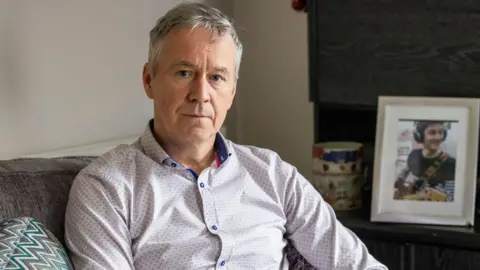
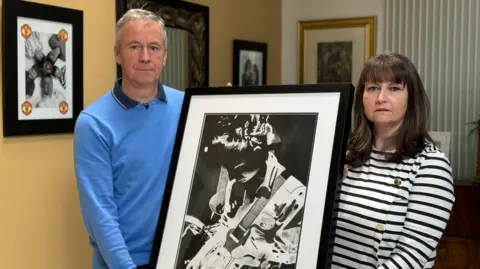
Peter Dolan, whose son was killed by a drink driver, said he hopes the higher sentences will change how people behave on the roads.
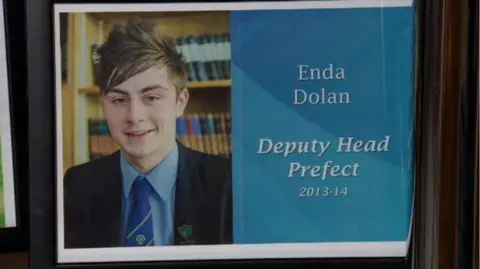
Enda Dolan, 18, was in his first term at Queen's University Belfast when he was struck by a van that mounted the footpath in 2014.
The Sentencing Bill will mean more stringent sentences for a range of offences, including increasing the maximum penalty for causing death, or serious injury by dangerous driving or careless driving whilst under the influence of drink or drugs, from 14 years to 20 years.
The bill, which has been brought forward by the Department of Justice (DoJ), will also introduce a discretionary life sentence for repeat offenders and ensure driving disqualification periods will normally be served after release from prison.
Driver had taken 13 drinks
 Dolan family
 Enda, from County Tyrone, a talented artist and musician who was studying architecture, was walking to his student accommodation when a van was driven onto a footpath and hit him.
A trial heard that the driver, David Lee Stewart, drove with the teenager on the roof of his van for about 800 yards before he stopped.
The court was told Stewart, of Gray's Park Avenue, Belfast took 13 drinks, including six pints of beer and four Jagerbombs - a mix of a spirit and an energy drink.
Traces of drugs, including cocaine, were also found in his system.
He received a sentence of seven years, half to be served in prison and half on licence.
It was later increased to nine years on appeal.
Following the case in 2016 the then-justice minister, Claire Sugden, announced a major review of sentencing.
In 2021, Justice Minister Naomi Long proposed a change in the law to increase the maximum sentence from 14 year to 20 years.
'Important the powers are used'
Speaking to BBC News NI, Peter Dolan said his family welcome the tougher sentences.
"Along with the legal change, it's important that the people - the judges - making the decisions in terms of sentencing use the powers and the law available to them."
Peter said when he hears about another death on the roads his "heart sinks" and brings his family back what they went through.
"With this deterrent, with the judges handing out stiffer sentences, along with a media campaign and educating young people from an early age whenever they're taking their driving lessons and at school, this will make our roads a little bit safer, and I think that's paramount," he added.
Previously, the penalty for each crime was a maximum prison sentence of 14 years.
The change brings Northern Ireland closer in line with England, Scotland and Wales, where new legislation was introduced in 2022.
Judges there are able to hand down life sentences to dangerous drivers who kill and careless drivers who kill while under the influence of drink or drugs.
What else will the bill introduce?
The bill will also create 'Charlotte's Law', which would see longer time in jail for killers who refuse to disclose where they have hidden their victims' bodies.
The legislation has been dubbed Charlotte's Law after murder victim Charlotte Murray who went missing in 2012 but whose body has never been found.
Her former partner Johnny Miller was convicted of her murder.
Provisions equivalent to Helen's Law, requiring parole commissioners to consider failure to disclose the location of victims' remains in release decisions.
The Sentencing Bill will also "modernise" hate crime laws in Northern Ireland and introduce a new offence and higher sentences for assaulting those providing a service to the public or performing a public duty.
'Victims integral to bill'
 Liam McBurney/PA Wire
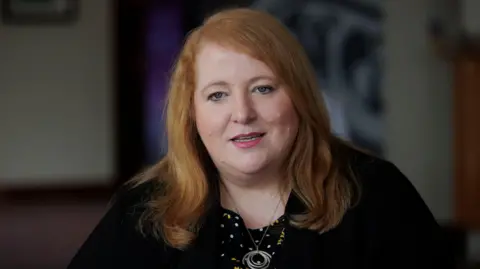
Justice Minister Long said the introduction of the bill was an important day for victims.
"Victims of crime, and their families and representatives, have been integral to the development of this bill," she said.
"We have listened to the concerns they raised and we have responded."