Grieving widow's warning over blood thinners

 Rachel Hyman
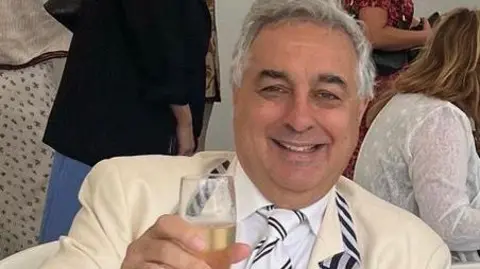
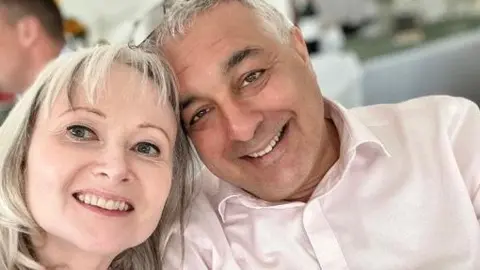
Clive Hyman was 64 years old and had only been married four years.
Despite being relatively fit and healthy for his age, he died suddenly, days after a seemingly minor trip on some stairs.
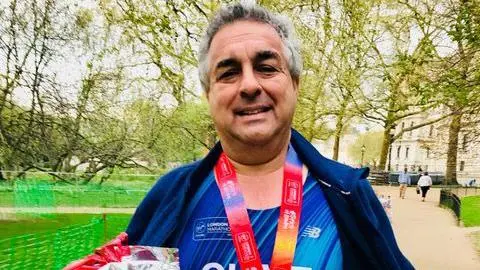
"Clive loved rugby and cricket. He played enthusiastically. He had had some heart problems in the past but he took his health incredibly seriously," explained his widow Rachel Hyman.
"He was going to the gym five times a week, he was eating a very healthy diet."
Clive was taking the blood thinner apixaban.
At an inquest into his death last month, a coroner in London raised concerns about whether the warnings given to older patients about asymptomatic bleeding were clear enough.
 Rachel Hyman
Apixaban is an alternative to medicines like warfarin for those people who have, or may be at risk of, atrial fibrillation, as well as those who have had a heart attack or stroke.
It is by far the most frequently prescribed direct-acting oral anticoagulant or DOAC in England, with millions of prescriptions given out each year.
It is part of a group of anticoagulant drugs credited by the NHS with saving thousands of lives each year.
But like all drugs, it can have unwanted and unexpected side effects on some people.
In Clive's case, despite having no head injury symptoms as a result of his fall, he suddenly became ill days later with a severe headache and extremely high blood pressure.
Clive had suffered a bleed on the brain and fell into a coma. He then had a stroke and never regained consciousness.
He died on 10 August 2025.
His widow believes that had he known the risk of bleeding on the brain if he continued to take apixaban after his fall, he would have stopped taking it and gone to the hospital to be monitored, even without symptoms.
Rachel said her husband had continued to take his medication, and was only concerned about a bruise on his leg, which she was monitoring by drawing a ring around it with a marker pen to check it wasn't getting any bigger.
He had no other symptoms and did not feel unwell.
"You could see the cuts and bruises (on his leg) and a bit of a lump, but he said he was fine," she recalled.
"We went to a wedding the next day, Saturday, and we had a wonderful time. Then on the Tuesday he said he had a really bad headache."
An ambulance was called, but it was too late. By the time he got to hospital he had suffered a left-sided subdural haemorrhage.
 Rachel Hyman
In her findings at Poplar Coroner's Court, Assistant Coroner Sarah Bourke said it was her statutory duty to report a number of matters of concern.
In a prevention-of-future-deaths report, she said: "Having reviewed several patient information leaflets issued with apixaban, it is evident that patients are advised not to take the drug if they are 'bleeding excessively'.
"In addition they are encouraged to seek medical advice if they are 'at increased risk of bleeding'.
"None of the patient information leaflets that I reviewed expressly addressed the steps to be taken by a patient if they sustain trauma to the head."
The coroner's concerns have been sent to the Medicines and Healthcare products Regulatory Agency (MHRA), the Association of the British Pharmaceutical Industry and Medicines UK, with a response from each expected by 19 March.
'Too young to die'
An MHRA spokesperson said: "We are saddened to hear of the case of Mr Hyman. We offer sincere condolences to his family.
"Patient safety is our top priority. We take all prevention-of-future-deaths reports very seriously and will review the findings carefully alongside assessment of other relevant evidence before providing a full response within 56 days."
Mark Samuels, chief executive of Medicines UK, said: "First and foremost, we extend our condolences to the family of Clive Hyman.
"Member companies of Medicines UK who are marketing authorisation holders for medicines containing apixaban comply with the pharmacovigilance requirements of the medicines' regulator, the MHRA, which may include changes to product information.
"They will also comply with any future changes should the regulator require them."
The Association of the British Pharmaceutical Industry told the BBC it was considering the coroner's findings and would reply in due course.
 Rachel Hyman
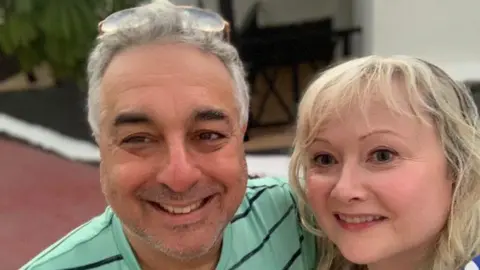
Rachel was looking forward to a long and happy married life with Clive.
She has been struggling to come to terms with his untimely and unexpected death, and feels they have both been cheated out of more time together by not knowing something that could have prevented it.
She had this warning for any other older people who are taking apixaban.
"If you fall and hit your head you should go to hospital and tell them you're on apixaban and get it checked out," she said.
"The current guidance does not refer to people who are older.
"Clive was not elderly. He was 64 years old, working over 50 hours a week. He was at the gym five days a week, he was eating a healthy diet.
"He was far too young to die."
Listen to the best of BBC Radio London on Sounds and follow BBC London on Facebook, X and Instagram. Send your story ideas to hello.bbclondon@bbc.co.uk