Nepal election results - Balendra Shah's party wins in a landslide

 AFP via Getty Images
The party of rapper and ex-Kathmandu mayor Balendra Shah has won a a clear majority, according to the final results from Nepal's general election held on 5 March.
The Rastriya Swatantra Party's (RSP) victory marks the first time in decades that a single party has garnered a majority in Nepal, which has a two-system format that makes it difficult for any one party to win outright.
The snap election was held six months after deadly youth protests toppled the government in September 2025.
What are the final results?
The RSP won a total of 182 seats in the 275-seat parliament, just two seats shy of a two-thirds super majority.
The Nepali Congress came in second with 38 seats, while the Communist Party of Nepal UML (CPN-UML) was third with 25.
The RSP has put forward Shah as its prime ministerial candidate. He defeated the former Nepalese Prime Minister Sharma KP Oli in his parliamentary constituency.
If he is confirmed in that position, it would make him the youngest prime minister in the history of Nepal.
Why were the results announced sooner than usual?
It took seven days from when the election took place to the formal declaration of results on Thursday, though the outcome of most individual seats had already been announced.
The speed of the results is a huge departure from previous polls.
During the last election in 2022, it took nearly two weeks for results to be released.
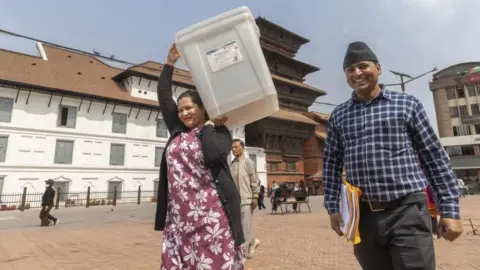
This is because some polling stations are located in difficult, hilly terrain – more than 80% of Nepal is mountainous – which makes the collection of ballot boxes a challenging logistical exercise.
Some need to be carried down by hand, for instance, while others have to be airlifted in and out of polling stations.
Planes and helicopters are also not allowed into some remote areas after dark, which often means collection can begin only the next morning. Bad weather also interferes with the collection process.
 EPA
EPAIn one remote village in Mustang district, where just four villagers were registered to cast their votes, 20 officials were deployed to deliver election materials as well as to supervise voting and ensure security on election day.
A further 35 eligible voters from the village live in other parts of the country, but recent heavy snowfall has made it difficult for them to return.
Nepal's law requires citizens to cast their ballots in their registered constituency, which is often where they were born.
Counting of votes, which is done by hand, also usually takes a long time. Every political party would dispatch representatives to the counting centres and they will inspect every open ballot cast before they are counted.
These representatives have sometimes been known to dispute issues like results and the validity of votes, which had previously led to recounts, further delaying the process.
How did the vote take place?
Nearly 19 million people, including almost a million first-time voters, registered to take part in the ballot to elect 275 members of parliament.
The election commission said 60% of registered voters took part in the poll.
Most of the MPs - 165 of them - are elected through first past the post voting, meaning the candidate with the most votes wins the seat. The other 110 MPs are selected via proportional representation, which takes into account the proportion of votes cast for a political party.
This two-system format makes it difficult for any one party to win outright, which means whoever comes out top in an election usually has to govern in a coalition.
According to the election commission, there were 6,541 candidates in total. Some 3,406 stood in directly elected seats - more than 1,000 of them aged under 40 - while 3,135 candidates contested under the PR system.
Voting started at 07:00 local time (01:15 GMT) and continued until 17:00 local time.
Who were the main players in the Nepal election and where were the key contests?
 Reuters
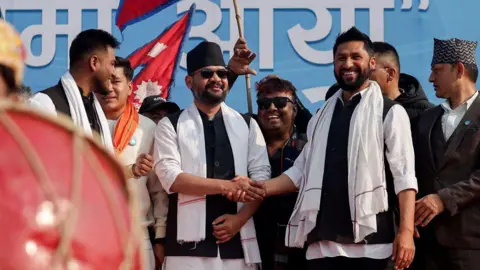
Not only did Balendra Shah take a parliamentary seat from former prime minister Oli, he also won with the highest vote total ever recorded in a Nepali election.
The large number of winning candidates under the age of 40 in this election, including Shah, shows that the political pendulum has firmly swung in favour of the youth, says Amish Raj Mulmi, an analyst based in Kathmandu.
Oli, 74, and his government were forced to resign last September amid mounting public anger at long-entrenched corruption and social inequality in the Himalayan republic.
Shah's party, the RSP, has also nudged other more established parties out of the running.
The Nepali Congress, the country's oldest and largest party by membership, was projected as a strong contender but only managed to garner 18 first-past-the-post seats, coming in a distant second to the RSP which claimed 125 seats.
Oli's party, the Communist Party of Nepal UML, which won the second-largest share of seats in the last election won only nine direct seats this time, and the Communist Party of Nepal (Maoist) led by former Maoist leader Prachanda won eight.
What were the main issues in the Nepal election?
The authorities said 77 people were killed during last September's demonstrations, many of them protesters shot by police. Crowds set fire to many buildings, including parliament, the Supreme Court and central government secretariat.
The protests were triggered by a ban on social media but fuelled by anger against corruption, unemployment and economic stagnation.
These were the main issues in the 5 March vote.
Most political parties put particular focus on issues such as better governance, fighting corruption and reducing employment in their manifestos, which is being widely seen as a nod to the frustrations that led to the toppling of the previous government.
The Nepali Congress, for instance, proposed holding a high-level investigation into the assets of public office holders since 1990.
This election had important geopolitical ramifications too.
Neighbouring India, which has historically had an outsized role in Nepal's political history, was watching closely. It has had a fractious relationship with former prime minister Oli in the past.
This is primarily because it sees Oli as someone who has actively pursued a closer relationship with China, India's rival, during his several terms as prime minister.
China has a major influence in Nepal and will be hoping that any future government is supportive towards its interests in the country, including the Belt and Road Initiative (BRI).
The US has also been playing a role in this election and has been more aligned with India in terms of its strategic objectives, observers say.