Artificial reef of cubes and tiles boosts marine life

 George Carden/BBC
Artificial habitats installed at a harbour have led to a "massive increase" in marine life, according to the project's leader.
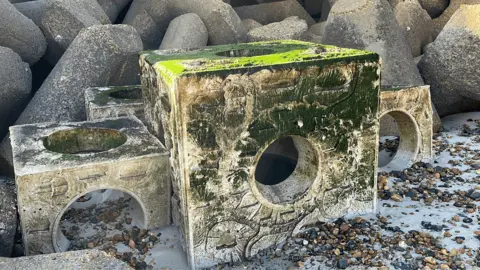
Large cubes, vertical rockpools and sea wall tiles were installed at Shoreham Port in West Sussex as part of Southwick Reef, which publicly launched on Wednesday.
Port director of engineering Brian Rousell told the BBC several reef cubes had been in place for about 12 weeks and were already collecting algae.
"We're hoping that the same will happen again with the living sea wall panels as well, as they've only been in for a couple of weeks," he said.
According to Rousell, sea defences are made of smooth concrete and steel, which means there is "nowhere for the wildlife to hang on to".
He said artificial features created "that texture and that habitat" for marine life where they could "get a bit of refuge".
 George Carden/BBC
Over 100 living sea wall panels, about 25 rock pools and two sizes of reef cubes were installed, he said.
Port chief executive Tom Willis said he believed they had created "the biggest living sea wall in the UK".
"We're hoping that over the years as the tide interacts with those structures we see an uptick in marine biodiversity within the location," he said.
A University of Brighton PhD researcher will monitor biodiversity at the site to track the effect of the artificial reef. Baseline studies took place before the features were installed.
 George Carden/BBC
Mica Bobsin, a member of the public at the project's launch event, said it was a "wonderful thing to enhance biodiversity in our coastal habitat".
"We are using the seas, we are using and abusing them, so it's nice to refresh and re-habitat what we've destroyed," she told the BBC.
According to Willis, the project is "unique" as it is also publicly accessible.
The chief executive said: "When the tide goes out what we're hoping is that educators - local schools, our local universities - will be able to bring students along and interact with the structures, so it creates a real living lab working environment.
"Equally parents can bring along their children, can explore, can do some rock pooling and can look at the changes, and hopefully the improvements, in marine life over time."
Follow BBC Sussex on Facebook, on X, and on Instagram. Send your story ideas to southeasttoday@bbc.co.uk or WhatsApp us on 08081 002250.