3D heart to let surgeons practise baby's vital op

 BBC
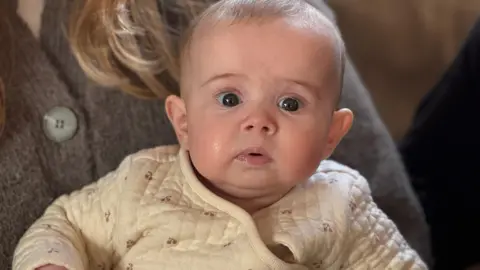
BBCA couple say their "world will stop" on the day their baby goes into an operating theatre for life-saving open heart surgery.
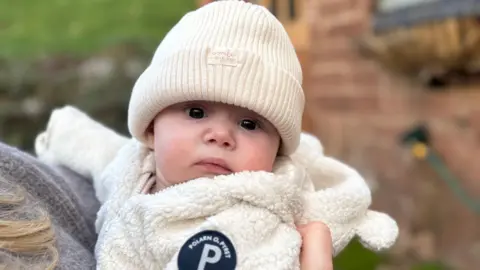
Their daughter Penny has a condition called Tetralogy of Fallot, a congenital heart disease which affects about five out of every 10,000 babies.
A 3D model will be made of Penny's tiny heart, so doctors can practise with it as they prepare to operate later this year.
"A 3D model of Penny's actual heart was just something that we thought 'wow it's amazing that they can actually do that and practice on Penny's heart before she goes into surgery'," said her mother Lizzie.
A spokesperson for Birmingham Children's Hospital said the 3D printed heart would be a big help for them in the run-up to the operation, as well as to teach future surgeons.
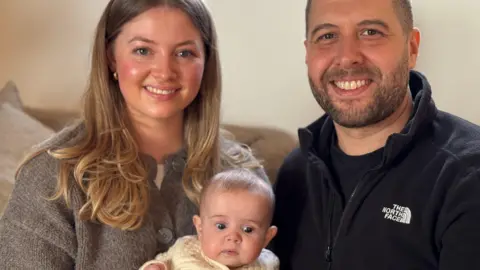
Penny's condition was was found by chance during a routine GP check-up when she was a few weeks old.
Further tests at Birmingham Children's Hospital revealed she had Tetralogy of Fallot, a condition which affects four different parts of the heart.
The diagnosis at Birmingham Children's Hospital came as a shock to her family, who live in Broome, near Stourbridge.
Her father Brad, 41, said it had been "overwhelming" when they found out.
"The journey back home after going through all the information was a very quiet journey while we tried to absorb what we'd been told," he added.
"But the main thing that we came away with was actually 'this is very serious and life-threatening'."
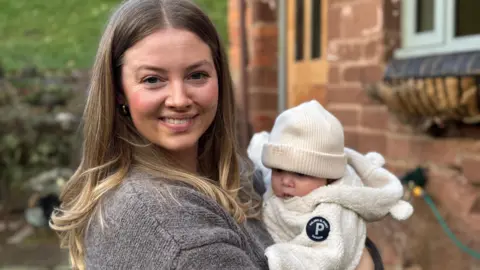
The signs for their daughter were good, the family said, and Penny, now six months old, was doing well.
Lizzie, 30, said: "She's thriving, she's happy, she's growing, she's doing really well.
"You wouldn't know that there is anything wrong with her heart so it came as a shock to us all that she's got this problem that needs sorting."
Brad added that it could be easy to overlook her condition at times as she "looks so perfect" and grows like other children.
"But it's always in the back of your mind that she has to go through something very serious and that's the day that for me, and I'll say this out loud, when the world will stop," he said.
"It will only restart again when she's back out and I can see her face and she's back through."
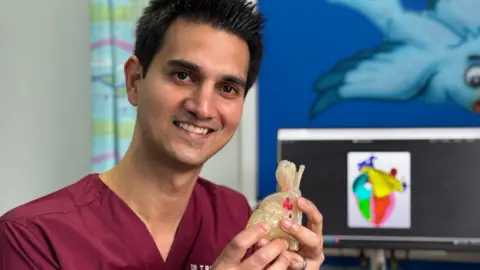
The 3D replica of Penny's heart will be printed at Aston University, from information taken from a CT scan of Penny, with the model funded by Birmingham Children's Hospital Charity.
Dr Tristan Ramcharan, a consultant paediatric and sport cardiologist at the hospital, explained: "We can visualise where the hole in Penny's heart is and we can see a relationship to the structures inside and outside the heart."
He said surgeons could even practise on it ahead of the operation and doctors could show parents the replica to explain more, rather than relying on a black and white CT image on a computer screen.
"It can be very difficult sometimes to explain why an operation is needed, particularly in someone like Penny where she looks so well," he said.
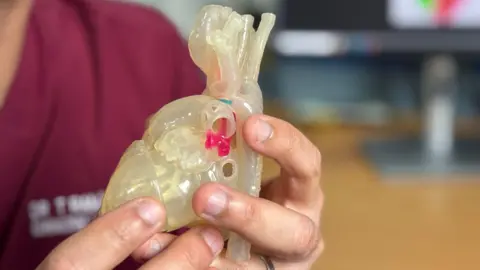
The 3D heart had given Penny's mum and dad a little peace of mind at a stressful time, they admitted.
Brad said: "[It] means they can dissect it, they can potentially carry out the operation on it, so there'll be no surprises for them on the day.
"As a parent, you couldn't ask for anything more."
The next step will be making the 3D model, before Penny has open heart surgery later this year.
Follow BBC Birmingham on BBC Sounds, Facebook, X and Instagram.